How Wells Fargo keeps advisors by letting them go independent
Like other large wealth managers,
Processing Content
By making the transition to independent status easier,
John Tyers, FiNet president, said many advisors who join

Wells Fargo
“We continue to see strong interest in FiNet from both internal and external advisors looking to launch, grow, or expand independent practices,” he said.
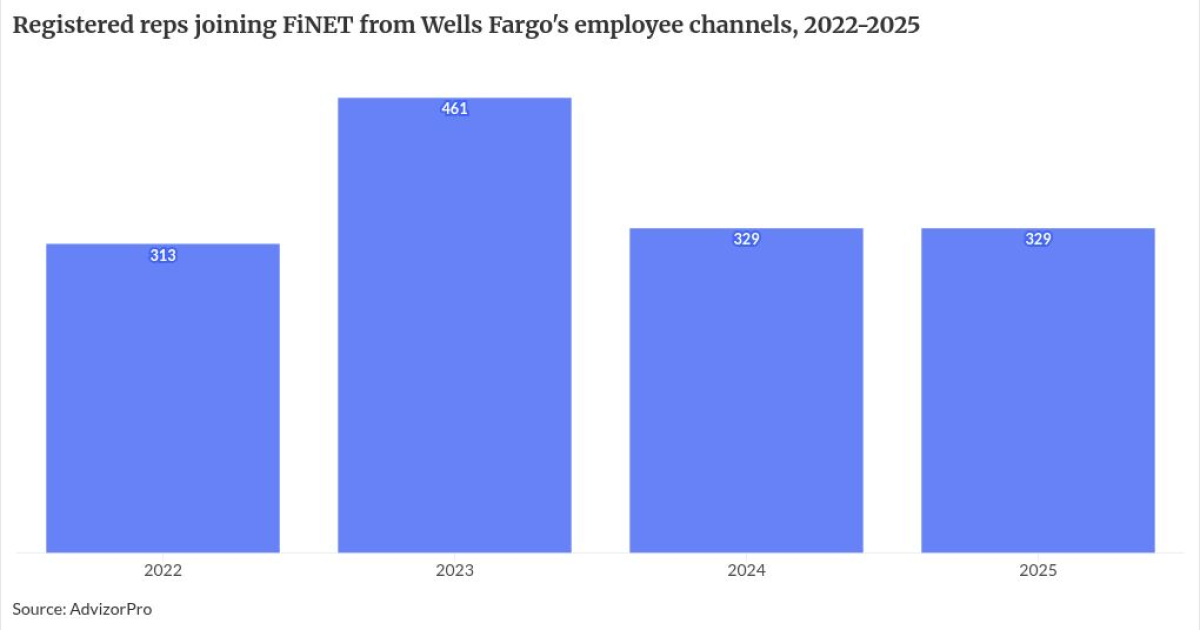
FiNet may have helped Wells retain hundreds of advisors
In the past four years, just over 1,400 registered representatives have left
Of course, the term “registered representative” is not synonymous with “advisor.” Many professionals registered with the Financial Industry Regulatory Authority perform back-office functions unrelated to managing assets or working with clients. AdvizorPro’s figures include some of that support staff, in addition to advisors.
Still, in a year when industry recruiters counted more than 11,000 experienced advisors switching firms,
Often, when advisors leave employee roles to join an independent broker-dealer or similar firm, they also leave behind 10% to 20% of their books of business, Waxelbaum said. Some find their clients don’t want to move with them. Others end up contending for their book with their former firm.
Neither scenario occurs when a
“Nobody’s going to compete for your book,” he said. “Nobody’s going to call your clients. You don’t have to change account numbers. You don’t have to do 4,000 reams of paperwork. Your clients will hardly even know what happened. You’ll explain it to them in whatever way you choose to, but you don’t have to sell a new firm.”
What Wells Fargo gets from having FiNet
The benefits to
Firms typically retain a fairly high percentage of the profits generated by employee advisors and then use part of those proceeds to pay for expenses such as office space, staff, health insurance and other benefits. Independent contractors, by contrast, keep a greater proportion of what they generate but assume a much larger share of their business expenses.
Ron Edde, the president and CEO of the recruiting firm
“Those advisors that move are picking up a lot of expenses that you know the firm previously covered,” Edde said. “I’m referring to things like health insurance, unemployment insurance, software-licensing fees, rent, secretarial and administrative assistant help. Those aren’t inconsequential costs.”
Firms that offer advisors an in-house independent option generally face pressure on profit margins. That may help explain why few others have set up a division in the same vein as
If advisors are going independent, why not keep them in-house?
For Wells, the value of its independent channel most likely comes in the answer to a simple question: How many advisors would have left to join industry rivals had the FiNet option not existed?
Researchers who study the wealth management industry have long noted the strong allure independence holds for many advisors. In an
Headcounts at wirehouses like
Waxelbaum said

Rather than fight the trend,
So why aren’t more firms following Wells’ example? Aside from profit considerations, it’s likely because FiNet was the result of a happy confluence of events rather than a deliberate attempt to build an independent channel from the ground up.
FiNet owes its existence to
Waxelbaum said the better comparisons to Wells are large regional firms like Raymond James and Ameriprise that have long had channels for both independent and employee advisors. Although both firms have stopped regularly reporting their advisor headcounts, other figures indicate the majority of their advisors operate as independent contractors. (
Wells makes it easy to go indie
Waxelbaum said
Edde said advisors who go independent but stay at the same firm — say by moving from one of Wells’ employee channels to FiNet — forgo any such transition checkthey could easily receive from an industry rival. For many, the question is: Is the hassle of changing firms worth the money they’d receive from a recruitment deal?
“That fear of change is what keeps a lot of advisors in their seats right now,” Edde said. “Let’s face it: The money being thrown on advisors to change T-shirts and play for a different team is massive. And yet, not 100% of advisors are doing it because they fear one of my clients won’t follow me.”
Brian Mora, the head of experienced advisor recruiting at Ameriprise Financial, said there are other reasons firms may not necessarily want to eliminate all barriers to advisors moving between employee and independent channels.
“I would say that the transition assistance factors in a little bit,” Mora said. “But there are other factors when you, when you move someone into our [employee] branch platform around the amount of real estate we commit to, the amount of operations staff we commit to.”
Mora said so much attention is paid to employee advisors going independent that movement in the opposite direction is perhaps given short shrift.
“There are many instances where someone who has been independent for 10, 15, 20 years and realizes, ‘My life would be better or simpler if I didn’t have to run the business part anymore, with rents or leases and staff and benefits,'” Mora said. “And they ask us questions about coming back into our employee platform.”
Will more firms follow Wells Fargo’s example?
Many large independent broker-dealers like LPL Financial, Osaic and Cetera Financial Group have recognized the appeal of direct employment and set up divisions for advisors who don’t want to operate as independent contractors. Employee status can be particularly beneficial to advisors who are nearing the end of their careers and looking to hand their business down to successors. Independent broker-dealers with employee divisions can buy the businesses of older advisors and then keep them on the payroll for a number of years until they’re ready to retire.
Meanwhile, some firms have found that maintaining channels for both direct employees and independent contractors is not for them. Most notably, Stifel sold its independent advisors unit to the financial services firm Equitable earlier this year.
But for firms that do choose to maintain both employee and independent channels, Waxelbaum thinks
“I think that the thing that the industry has to give notice to is that the