83% of Financial Firms Rate ID Systems Highly Despite Friction
Financial firms have confidence to spare in digital identity systems, even when the results leave plenty of room for improvement.
The January 2026 PYMNTS Intelligence report “Digital Identity Verification in the Age of Bots and Agents” draws on a survey of 350 companies across financial services, retail, software, travel and other sectors. It found that digital identity checks now sit at the center of both growth and risk. Among financial firms, 76% generate at least three-quarters of their revenue through digital channels. Still, 74.6% say their verification technology produces inconsistent results. The upside is that firms can improve without starting over.
Like a dashboard with a green status light beside several warning indicators, the findings show a gap between how firms rate their systems and how those systems perform.
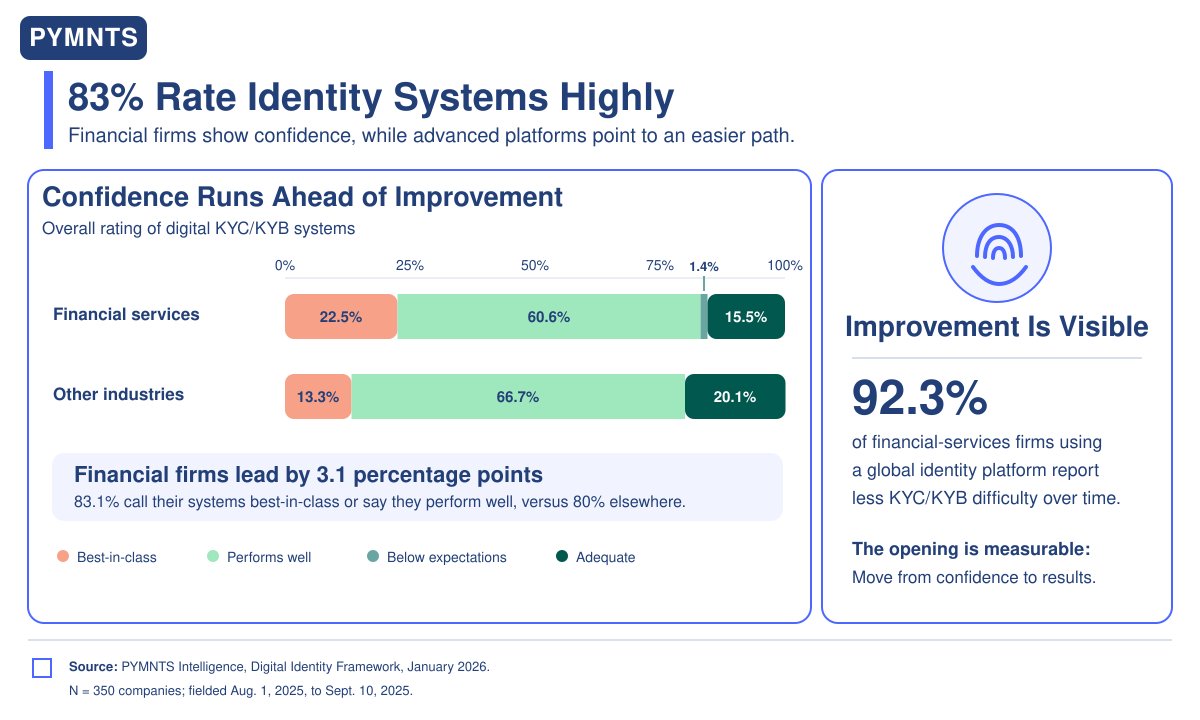
- Confidence stays high. Nearly 23% of financial-services firms call their know-your-customer and know-your-business systems best-in-class. Another 60.6% say the systems perform well with few issues. Combined, 83.1% give their tools one of the top two ratings, 3.1 percentage points more than companies in other industries.
- Familiarity supports that confidence. Nearly three-quarters of respondents cite the quality and reliability of their tools or vendors as a source of confidence. About 61% point to regular audits, testing or reviews. Those practices offer useful discipline, but they can also make established processes feel stronger than the business results indicate. Firms don’t have to discard working controls to improve them. They can use performance data to identify where added coverage or integration would help.
- More advanced platforms show a path forward. Among financial-services firms using a global identity platform, 92.3% report that KYC and KYB have become easier over time. That result suggests firms can reduce friction while preserving the controls customers and regulators expect. Better technology can support faster reviews, more consistent decisions and smoother expansion into new markets.
The wider report shows why that progress could pay off. About 76% of financial firms say identity processes prevent them from adding customers or entering markets and geographies. Roughly 55% cite onboarding abandonment, while the same share says regulatory uncertainty limits innovation. Identity failures cost the sector an estimated 3% of revenue, or nearly $34 billion a year.
Financial firms already have trusted vendors and oversight routines. The next step is to test that confidence against outcomes such as approval consistency, onboarding completion and fraud losses. That gives the industry a practical route to stronger protection and steadier digital growth.