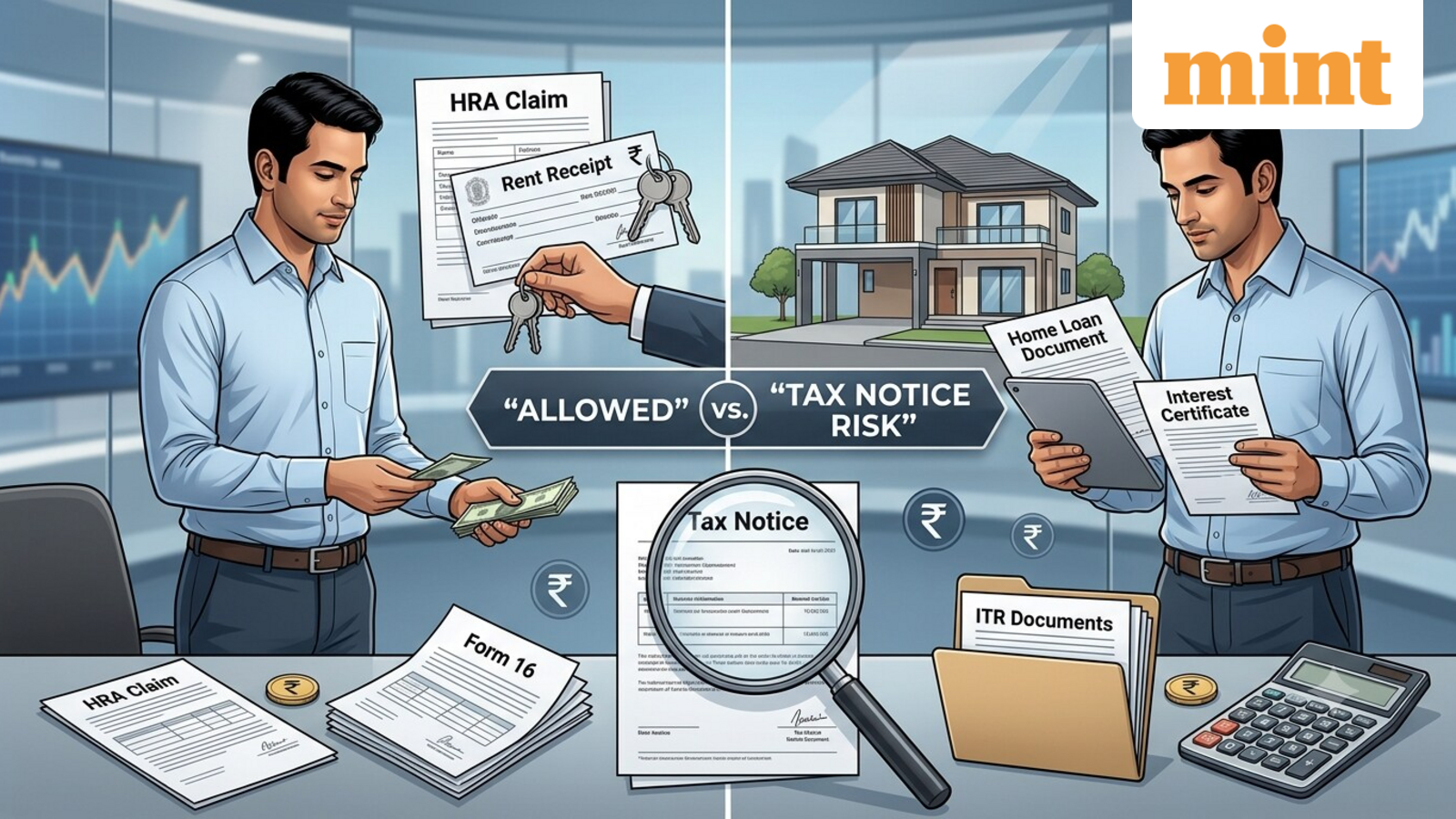
Claiming both HRA exemption and home loan interest deduction: Know when it is allowed — and when it’s not
If you are claiming both HRA exemption and home loan interest deduction, then it is not automatically invalid. However, taxpayers must ensure that the rent paid, property status, and home loan details are genuine and properly documented.
Siddharth Maurya, Managing Director, Vibhavangal Anukulkara, has explained the key tax rules and conditions taxpayers should know.
Can taxpayers claim HRA and home loan interest together?
Yes. Maurya noted that “both can be claimed at the same time if the prescribed conditions are met”.
He added that HRA under Section 10(13A) can be claimed for rent actually paid, while the interest deduction under Section 24(b) can be claimed for a home loan on a different or even the same property, provided the taxpayer is not actually living in the owned house.
However, these benefits are available only under the old tax regime, not the new tax regime.
What are the limits on HRA and home loan interest deductions?
Maurya noted that HRA exemption under Section 10(13A) requires actual rent payment. The exemption is the least of:
- Actual HRA received
- Rent paid minus 10% of salary
- 50% of salary for specified metro cities or 40% for other cities
For Section 24(b), he added that “interest deduction is capped at ₹2 lakh for a self-occupied property. For a let-out property, there is no overall cap on interest deduction, although the loss from house property that can be set off against other income is capped at ₹2 lakh”.
Can taxpayers claim HRA and home loan interest in same city?
Claiming HRA while renting and treating an owned house as “self-occupied” can raise questions when both properties are in the same city.
Maurya mentioned that living separately from an “available” self-occupied house without a genuine cause can look odd.
“Tax authorities may see it as claim juggling to reduce tax, and then it can trigger scrutiny like mismatch flags, defective notices, or discrepancy-type questions during ITR processing. Typically, they look for whether the separation is reasonable, not just convenient,” he noted.
What if the family lives in the owned house in another city?
Maurya explained that “both HRA exemption and home loan interest deduction can be claimed when the taxpayer genuinely pays rent because of the place of employment while family members stay in the owned house in another city.”
- Rent agreement and receipts
- Landlord’s PAN if annual rent exceeds ₹1 lakh
- Proof of employment location
- Home loan interest certificate from the lender
- Property ownership documents
What if the owned property is considered as let out?
If the owned house is let out in the same city and the taxpayer lives in rented accommodation, HRA and home loan interest can both be claimed.
Maurya stated that “this is legitimate — HRA is claimed for the actual rent you paid, while the interest on the let-out property can be taken as a deduction under Section 24(b) without the ₹2 lakh cap (but that cap is against rental income).”
He further noted, “There’s no single fixed distance rule. Still, the overall arrangement has to look real and commercially reasonable, not just a neat device to get dual benefits without proper justification.”
Can using both deductions trigger tax notice?
Maurya explained that “the Income Tax Department cross-verifies data through Form 26AS, AIS/TIS, Form 16, landlord PAN, TDS under Section 194-IB, property records and home loan interest certificates.”
Any mismatch in HRA, property status, or loan interest can trigger scrutiny or a defective notice.
What mistakes should taxpayers avoid?
Maurya highlighted these key points:
- Only the old tax regime allows both deductions together.
- Maintain paperwork, including rent agreement, receipts, and loan certificate. Do not claim HRA for rent paid to a spouse unless it is a genuine transaction.
- Ensure the declared property status — self-occupied or let-out — matches municipal records. If you are staying in an owned house, an HRA claim becomes invalid.
Disclaimer: This is only for informational and educational purposes. Please consult a qualified expert for the latest laws and regulations.