How to Build a Humanoid Brain
In our previous guide to building a humanoid robot, we mapped out the three essential pillars of the project: the brain, the body, and the energy systems. Now, it is time to look closer at the brain. This integrated system of sensing and computing is what allows a robot to navigate physical environments safely and with situational awareness.
- Humanoid brains require specialized modular assembly. Building a functional digital brain requires assembling best-in-class hardware from specialized suppliers across perception, feedback, and compute, rather than relying on a single off-the-shelf unit.
- Multimodal perception is necessary for real-world navigation. Building situational awareness in humanoids depends on combining macro 3D spatial mapping from Ouster Inc. (OUST), ultra-low-latency vision processing from Ambarella, Inc. (AMBA), and tactile force-torque feedback from Novanta Inc. (NOVT).
- Central compute calls for a layered semiconductor stack. Onboard decision-making combines high-level AI processing and path planning from Nvidia Corp. (NVDA), Qualcomm Inc. (QCOM), and Advanced Micro Devices Inc. (AMD) with foundational microcontrollers and signal processing from Analog Devices Inc. (ADI) and Microchip Technology Incorporated (MCHP).
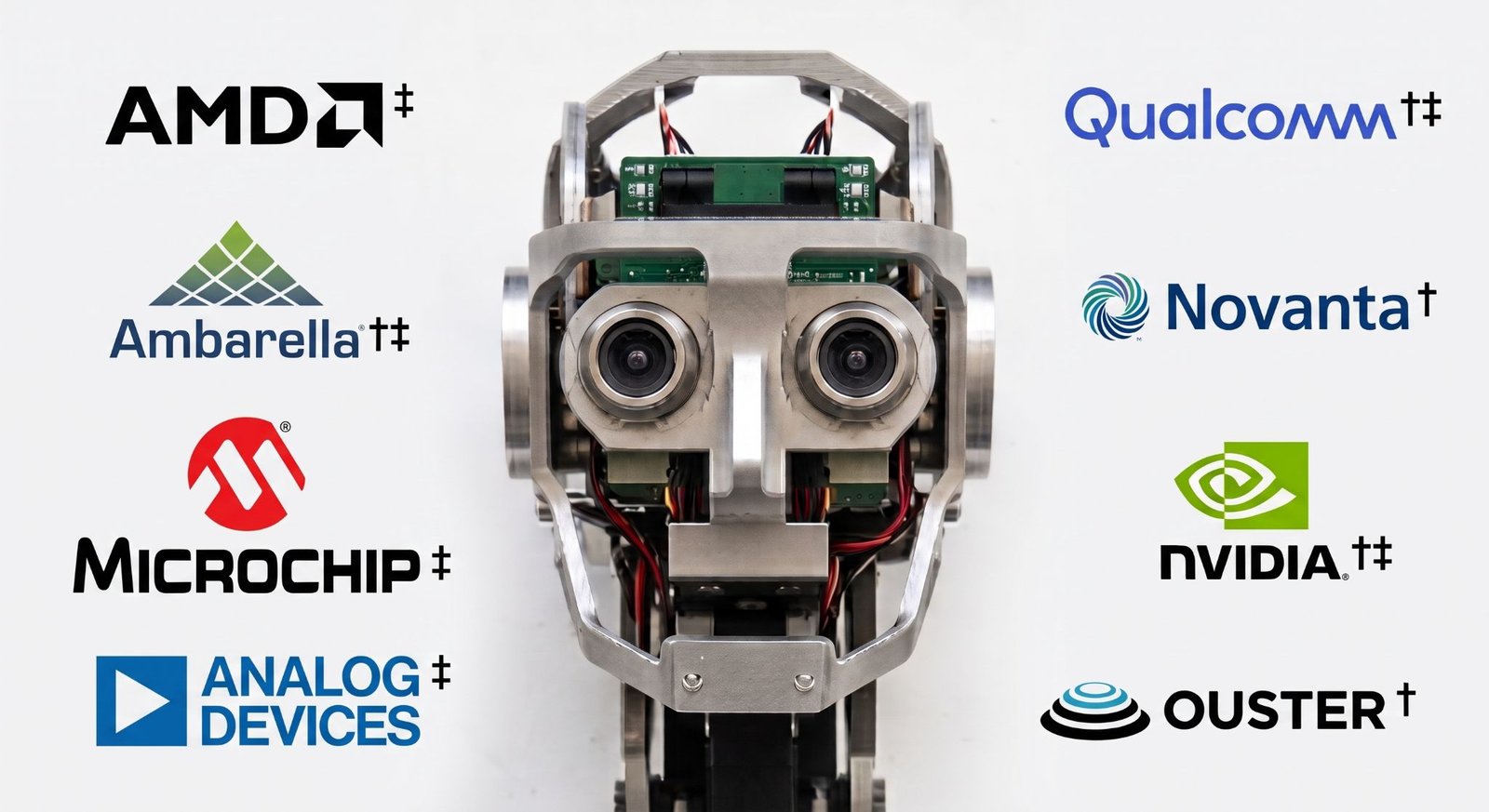
Because you cannot buy a fully formed humanoid brain off the shelf, you have to assemble specialized hardware from different suppliers. Fortunately, the ROBO Global Robotics and Automation Index (ROBO), alongside the ROBO Global Artificial Intelligence Index (THNQ), tracks the companies leading the manufacturing of these components. Here is your shopping list.

Source: Image generated by Google Gemini | † Current constituents of ROBO | ‡ Current constituents of THNQ
To understand its environment, your humanoid needs to see more than just flat images; it requires a deep understanding of volume, depth, and spatial geometry. This is where specialized vision and depth perception technologies come into play.
To understand the overall layout of a space, you need LiDAR. Ouster Inc. (OUST) digital LiDAR sensors emit laser pulses to create a dense 3D point cloud of the entire room. This allows the humanoid to map out the geometry of a room in real-time, ensuring it can navigate around furniture, people, and unexpected obstacles without bumping into anything.
However, capturing visual data is only the first step; the robot must also interpret it instantly. To sharpen this responsiveness, Ambarella, Inc. (AMBA) enables rapid processing directly at the sensor level. By merging image signal processing with neural inference, Ambarella provides ultra-low-latency vision, allowing the robot to “see” and react to camera feeds faster than it would if it had to send data away from where it was received.
Navigating a room is only half the battle; your robot must also interact safely with the physical world. If you want it to hold a glass of water without crushing it, you need highly tuned tactile feedback.
This physical intuition is provided by Novanta Inc. (NOVT). Through their ATI Industrial Automation division, they provide multi-axis force and torque sensing. By integrating these sensors into your robot’s wrists, fingers, and feet, it receives immediate feedback, allowing it to dynamically adjust its balance as it walks and manipulate objects with a gentle, compliant touch.
The final piece of the puzzle is the processing power required to manage these senses. As your robot gathers mountains of data, it needs a central nervous system to turn that noise into real-time action.
To handle the most complex cognitive tasks, you need platforms capable of running multimodal foundation models and managing high-level edge AI. Leading companies in this space include Nvidia Corp. (NVDA), Qualcomm Inc. (QCOM), and Advanced Micro Devices Inc. (AMD).
NVIDIA’s Jetson Thor and Isaac platforms excel here, acting as the primary neural processing engine for your robot’s spatial path planning. Working alongside them, Qualcomm provides highly efficient edge processors like the RB5 platform to manage complex AI inference without draining the battery. AMD contributes processors that manage the timing for joint movements, helping ensure that the robot’s actions are smooth.
Beyond high-level AI, a robot also needs essential components to turn physical signals into usable data, and vice-versa. Companies like Analog Devices Inc. (ADI) and Microchip Technology Incorporated (MCHP) provide the microcontrollers and power management systems that connect sensors to the processor.
By combining these advanced sensors with sophisticated processing firepower, your humanoid emerges as a highly capable machine ready to navigate and interact with the real world safely. This integration of perception and intelligence is what defines the next generation of robotics.
For those not keen on retooling their garage to build a state-of-the-art humanoid brain, but who still want to capture the growth of this sector, the ROBO Global Robotics and Automation Index and the ROBO Global Artificial Intelligence Index offer a strategic way to invest in the companies leading this revolution and defining the future of human-machine interaction.
ROBO is the underlying index for the ROBO Global Robotics & Automation ETF (ROBO), the L&G ROBO Global Robotics and Automation UCITS ETF (ROBO.LN), and the Global X ROBO Global Robotics & Automation ETF (ROBO.AU). THNQ is the underlying index for the ROBO Global Artificial Intelligence ETF (THNQ) and the L&G Artificial Intelligence UCITS ETF (AIAI.LN).
Related Research
Investing in the Exponential Humanoid Wave
2026 Robotics Update: The Physical AI Ecosystem
For more news, information, and analysis, visit our Artificial Intelligence & Disruptive Technology Content Hubs.
vettafi.com is owned by VettaFi LLC (“VettaFi”). VettaFi is the index provider for the ROBO ETFs, for which it receives an index licensing fee. However, the ROBO ETFs are not issued, sponsored, endorsed, or sold by VettaFi. VettaFi and its affiliates have no obligation or liability in connection with the issuance, administration, marketing, or trading of the ROBO ETFs.