
1 Major Red Flag AMD Investors Can’t Afford to Ignore
Chipmaker AMD (AMD +6.50%) has had a tremendous year, rising around 125% so far in 2026. However, I think there’s a major red flag that investors cannot afford to ignore: its valuation, which has risen to sky-high levels. I think its current lofty price tag could dampen the stock’s future performance or even set it up for a decline due to the unreasonable expectations now baked into it.

Image source: Getty Images.
AMD’s results and stock price don’t jive
AMD and Nvidia (NVDA -0.06%) are direct competitors in the AI build-out. With fairly similar businesses, their valuations can be easily compared to determine which one is overvalued and which is reasonably priced (if either of them is).
AMD is more expensive by every earnings metric, and that is a problem.
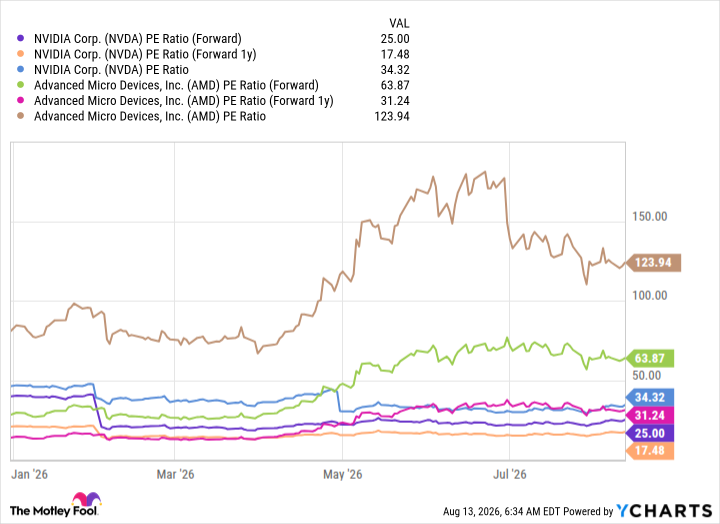
NVDA PE Ratio (Forward) data by YCharts.
AMD trades at a very pricey 124 times trailing earnings, while Nvidia trades for 31. In fact, when 2027 earnings projections are used for AMD, it is still more expensive than Nvidia on a trailing earnings basis. AMD’s 34 times 2027 earnings is very pricey and far more than the 31 times trailing earnings Nvidia is at now, or the 17.5 times next year’s earnings that Nvidia trades at.

Today’s Change
(6.50%) $31.38
Current Price
$514.39
Key Data Points
Market Cap
Day’s Range
$483.20 – $514.67
52wk Range
$149.22 – $584.73
Volume
25.6M
Avg Vol
29.9M
Gross Margin
50.37%
If AMD were growing far faster than Nvidia and taking market share, I think a premium of that degree could be deserved, but that’s not what’s going on.
Because AMD is a more diversified company, its other categories are dragging on its overall growth rates, and as a result, its sales and earnings are growing more slowly than Nvidia’s.
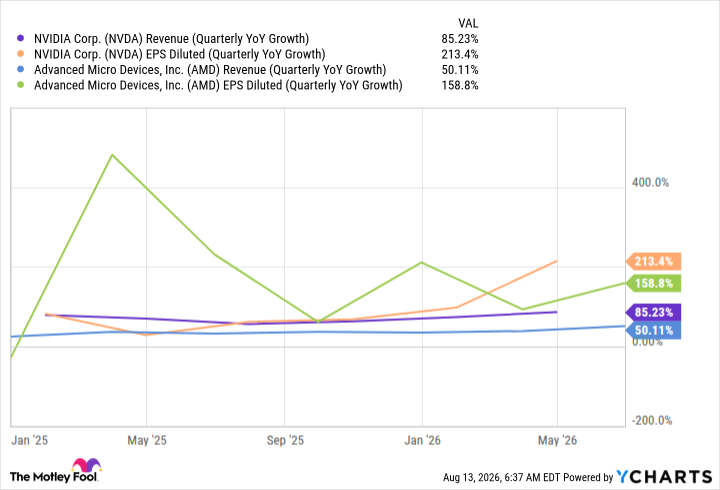
NVDA Revenue (Quarterly YoY Growth) data by YCharts.
Regardless of whether you’re looking at profits or revenue, Nvidia is dominating AMD.
If you zoom in a bit and look at AMD’s latest results from its data center division, revenue grew at 107% in Q2. Nvidia hasn’t reported results for its recently ended quarter yet (it is set to report on its fiscal 2027 Q2 at the end of August), but it saw 92% data center growth in fiscal Q1. However, I wouldn’t be surprised if Nvidia’s data center growth rate exceeds AMD’s in Q2.
So, we have two similar companies from a business standpoint, yet one stock is reasonably priced as-is, while the other would need a year and a half’s worth of growth to reach a more reasonable valuation if the stock stayed flat over that time. Something has to give, and I think eventually AMD investors will rotate back into Nvidia, sending AMD shares sinking and Nvidia’s soaring.
That doesn’t bode well for AMD, but even if it doesn’t happen, the stock could still suffer a year of underperformance due to so much expected future success already being baked into its price.