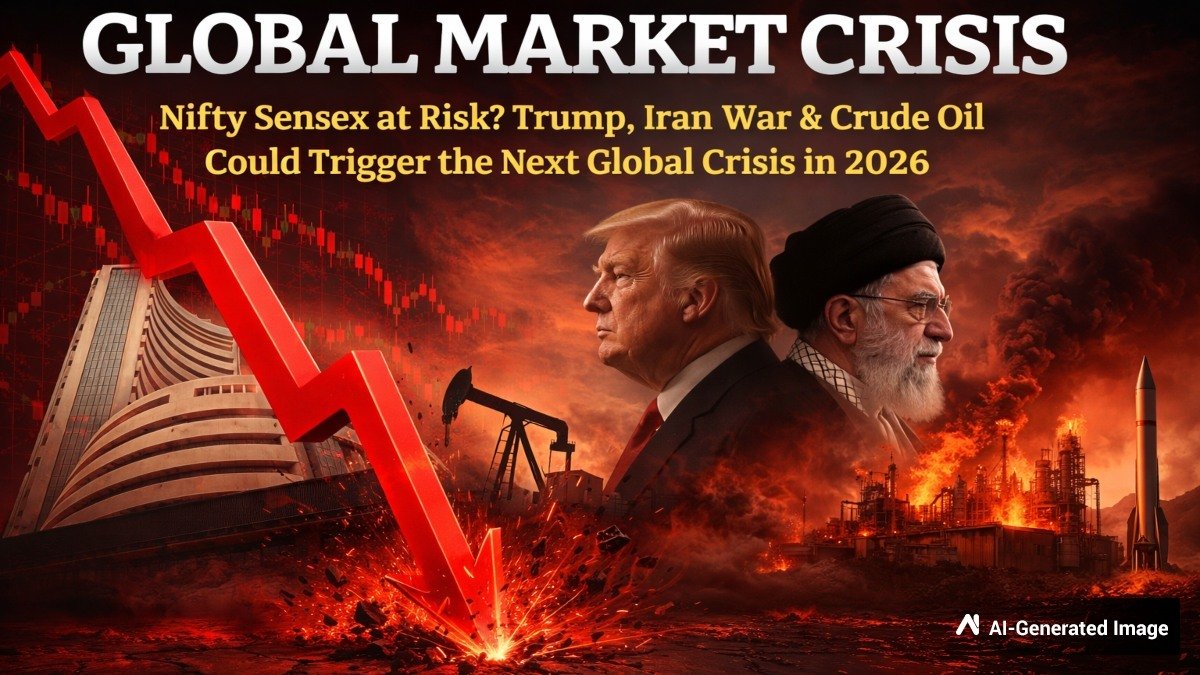
Nifty Sensex at Risk? Trump, Iran War & Crude Oil Could Trigger the Next Global Crisis in 2026
When I looked at news portals this morning, I came across news such as US President Donald Trump wants to end the Iran war, and the very next header was that fresh missiles were launched on Iran by the United States military after he removed the ceasefire on Wednesday, triggering crude oil to shoot up.
Crude oil – the primary cause of the war-was trading near $75 per barrel at around 0830 IST, but these everyday kneejerk moments are causing chaos not only in the stock markets across the world but doing more harm than good for humanity.
/img/2026/07/stcok-market6-16031783571095.jpg "Geopolitics")
Following Trump’s announcement, there was a bloodbath in the Indian stock market – Nifty 50 and Sensex crashed, and investors lost over Rs 8 lakh crore on Wednesday, with a cascading effect on the other side of the Pacific Ocean, where the Dow Jones collapsed by almost 800 points, and the S&P 500 index followed the bearish trend.
This has been going on for months now and is showing no signs of slowing down; economies are hit, financial markets are taking hits, and humanity is lost, but influential world leaders are meeting at summits to discuss trade, which, by the way is also impacted by the war.
An official Iranian source states 3,468 people were killed, while HRANA documents 3,636 deaths (including 1,221 military personnel and 1,701 civilians). US and Israeli estimates report over 6,000 Iranian military personnel killed in the ongoing conflict, which started in February 2026.
Brent crude has been driven almost entirely by this development. After Iran closed and locked up the Strait of Hormuz, oil jumped nearly 65% in the immediate aftermath of the war and touched $120 per barrel earlier in March, lost more than 40% as fears eased, and has now rebounded modestly following the latest escalation. While prices remain well below the conflict’s peak, it is largely driven by oil production globally.
That, added to the loss of technology jobs due to AI implementation, fading consumer confidence, an uptick in the global inflation rate, and economies slowing down, could plunge the world economy into a recession much sooner than expected.
The International Monetary Fund (IMF) slashed its 2026 global growth forecast by 10 basis points to 3%, based on the assumption that the Strait of Hormuz starts reopening in mid-July and the region stabilises by March 2027. The projection, however, comes as Trump abandoned the ceasefire with Iran, raising fresh questions about whether that outlook can hold. The IMF also cut India’s GDP growth forecast by a notch to 6.4% from 6.5% in April.
AI And Climate Change Precautions: A Much Larger Threat or a Boon?
Artificial intelligence (AI) is reshaping industries and redefining the future of work, making it one of the biggest technological shifts of our time. But as AI capabilities continue to grow, the key question is how much it will ultimately change our lives. Anthropic, one of the world’s leading AI companies, states that its mission is to develop AI that benefits humanity. If that vision becomes reality, future generations may look back on this era as the beginning of a technology revolution that delivered more opportunities than risks.
Having said that, currently over 1 lakh tech employees have lost jobs in the first half of the year, driven by AI implementation by almost all companies in the world. Either you adapt to AI and evolve or you are out of the system is the current mantra of every corporation.
Only time will tell where we are and what the world becomes.
Corporate climate plans to achieve net zero emissions are yet to show some significant results, and if my research is correct, except Bhutan, most countries in the world are yet to deliver balanced carbon emissions.
The Indian Government decided to include E20 petrol, a blend of 20% ethanol and 80% petrol, to curb its massive crude oil import bills, reduce vehicle emissions, and boost the rural agricultural economy, according to Niti Aayog. This could be one effort to become “Aatmanirbhar” and limit dependency on other countries for oil while healing the environment.
Although India’s target to attain net zero is much beyond what some European countries aim to achieve, with 1.4 billion people, when reached, it would be a massive achievement.
AI may define the future, and climate change may challenge humanity’s survival, but for now, the world’s biggest disruption is being written in war rooms, oil markets, and political decisions.