With Data Centers Devouring Construction Materials, Mass Timber May Finally Have Its Moment
With interest from Big Tech and a new bill before Congress that would expand its use in federal projects, mass timber is on the cusp of a new era of growth.
Relatively stable lumber prices that buck the broader trend of increasingly expensive construction inputs are meeting with greater levels of comfort around the material’s use to drive faster adoption after years of cautious incorporation.
“There’s a more robust supply chain and we’re getting more experienced,” said Dean Lewis, director of mass timber and prefabrication for Skanska USA. “When you say, ‘I want to use mass timber,’ people aren’t like, ‘What is that?’ They want to know what you want to do with it. The conversation has changed.”
:no_upscale():quality(75))
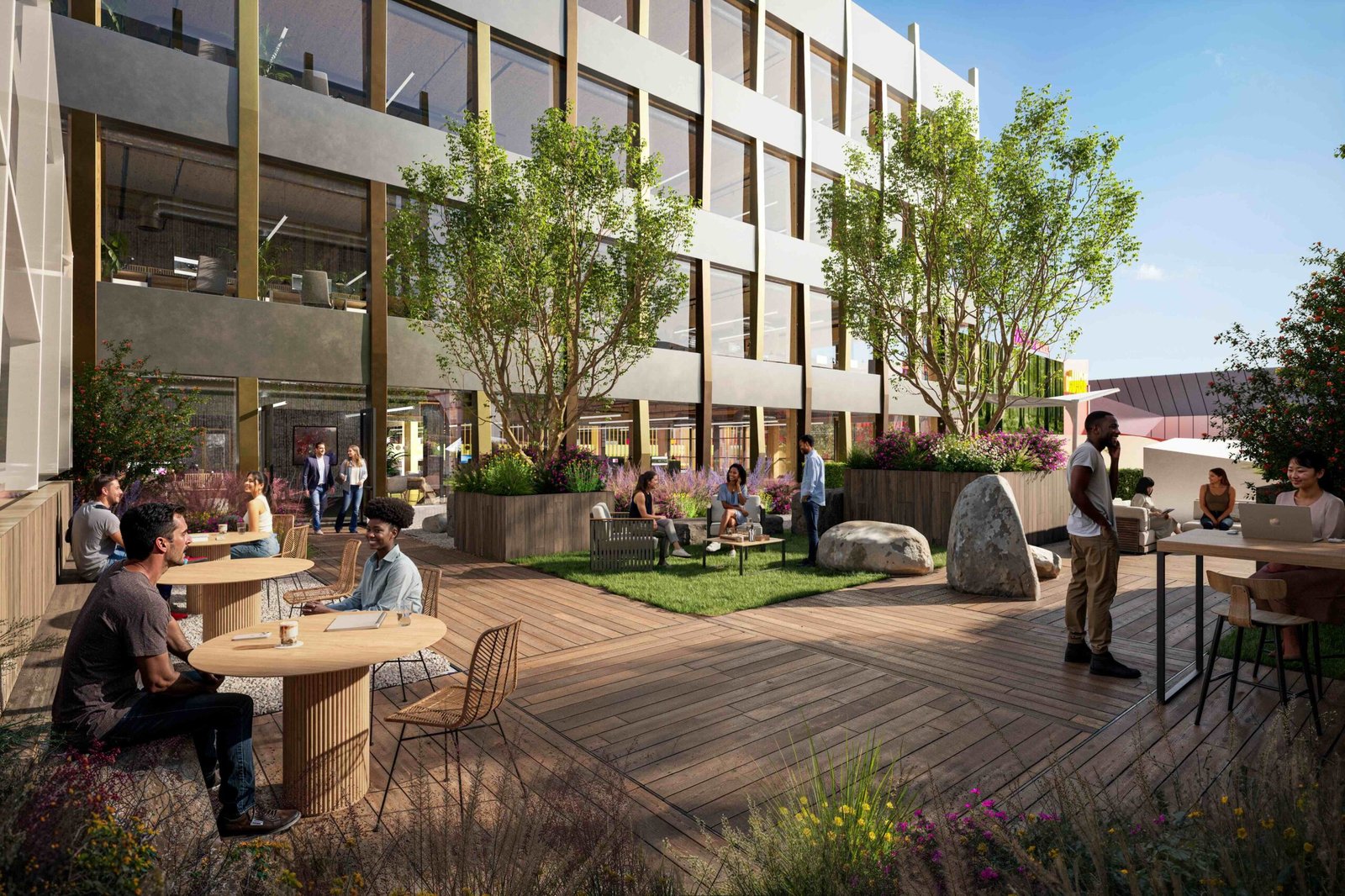
Photo credit: Courtesy of OCVibe
A rendering of the exterior of the Weave, a mass timber office under construction in Anaheim, California, as part of OCVibe
Construction using mass timber is expected to grow to a $5.7B market by 2030, with annual growth rates topping 20% to 30%, according to Grand View Research data. The market is valued at roughly $2B today.
Mass timber — engineered wood made from compressed layers of lumber — entered the commercial construction scene in the mid-2010s as developers and architects sought lower carbon footprints, faster assembly and a warmer aesthetic. Its adoption was slow, with restrictive height limits and constricted supply chains.
But now, aided by regulatory changes at the federal and local levels that allow mass timber to be used in larger projects, its incorporation into offices, multifamily, hotels, data centers and educational facilities has caused “exponential” growth, Lewis said.
The Mass Timber Federal Buildings Act, submitted to the House on May 29 by a bipartisan pair of representatives, would incentivize mass timber for public housing, military projects and federal buildings.
The bill would require federal construction projects under five stories to prioritize mass timber systems when life cycle cost analyses show they can compete on price. It also creates a $200M grant program to help states update their building codes to the 2024 International Building Code’s standards, which allow timber buildings up to 18 stories.
In their haste to satisfy the ever-growing need for data centers, tech giants are getting on board as well, drawn by the eco-friendly reputation of mass timber amid growing pushback on the environmental toll taken by data centers.
Amazon, Google and Microsoft all have mass timber office campuses in operation or in the works. Microsoft expects to complete two more mass timber data centers in Virginia this year, and Meta has an $800M mass timber data center in South Carolina under construction.
The use of mass timber for data centers is likely to expand, Lewis said.
“The hope is that we can continue to prove successful on these projects,” Lewis said. “It’s not like we’re fighting over pieces of the pie. The pie is literally growing.”
Data center construction has tied up large swaths of the steel and concrete supply, pushing developers to consider different building materials, he said.
Data centers use about 1 million tons of steel per year, worth about $1.4B, and the country will need an estimated 1 million metric tons of cement by 2028 to meet demand, according to the American Cement Association.
Prices for common construction materials like copper and aluminum have increased sharply over the last year, but lumber prices have remained relatively stable, despite new levies issued by the Trump administration.
Lumber prices are hovering in the mid-$500 range per 1,000 board feet after coming down from a huge spike in 2022.
:no_upscale():quality(75))
Emerging mass timber coalitions in states and regions across the country are helping grow out larger production capacity. New North American production facilities from Element5, Nordique Structures, Smartlam and Timberlab are expected to continue to grow the supply chain, Lewis said.
That additional supply, as well as more experience with mass timber construction and operations, is making investors and financiers more comfortable with the material.
“It’s in a growth mode, but it’s measured growth,” said Stephen Cavanaugh, DLR principal and design group leader. “It’s slower than I would want it to be, of course, because I’m an advocate. It’s just a result of the construction industry being kind of a slow-moving beast.”
The global design firm has worked on 2M SF of mass timber projects, with another 2M SF in the pipeline.
It is all about hitting the “striking distance” – not necessarily hitting cost parity, but having a small premium, say 3% or 5%, that can easily be made up over time with faster construction timelines, higher rents and a better return on investment, Lewis said.
Rent premiums for mass timber buildings vary by asset class but can reach up to 9%, according to a report from Cromwell Property Group.
The expansion in the building material’s use also comes as some of the most historically active sectors of the broader commercial construction pipeline contract.
Office construction remains severely depressed compared to historical standards, hitting just under 2M SF per quarter, down roughly 90% from the 2021 peak, when pre-pandemic projects were still in the pipeline, according to JLL data. Multifamily deliveries fell 27% year-over-year, according to Cushman & Wakefield, hitting their lowest level since 2013.
But for offices that are being built, some developers see mass timber as a way to set their buildings apart in a highly competitive market. The six-story, 173K SF office building in the 100-acre OCVibe, an under-construction megaproject in Anaheim, California, uses mass timber.
Going with mass timber was an easy choice, according to Scott Frick, senior vice president of real estate and district operations at OCVibe. The developer hopes the inclusion will help it land an anchor tenant.
“It’s just a total flight to quality for office users nationwide,” Frick said. “We’re out there leasing office space against premium areas like Newport Center. So what’s going to be the differentiator?”
Another office project, 42XX Marina Del Ray on Los Angeles’ Westside, used a hybrid approach that combines mass timber and steel.
But the expansion of mass timber’s use isn’t without challenges.
It requires finding the right architect and contractor with experience using the material, and it tends to have a cost premium over traditional construction, though it typically is faster to assemble.
But the benefit is premium rents, Frick said. The exposed wood interiors offer proven wellness benefits that appeal to many tenants. And it offers a talking point that helps it stand apart in a sea of standard office space.
“What more could I do to make it exciting and make this a place they want to work?” Frick said. “The vacancy out there, your traditional metal stud drywall spaces, they’re all kind of the same. It doesn’t matter how much glass you add. It doesn’t matter how much art you put on the walls.”
While the sector is growing, expansion has been measured. The massive slowdown in the office market hasn’t helped, Cavanaugh said. DLR has been working with Hines on its T3 series of mass timber office projects, some of which have suffered setbacks in the challenging office market.
Despite slow, steady growth in mass timber adoption, growth in domestic supplies hasn’t been as rapid, and the space hasn’t standardized as Cavanaugh would have hoped. He would like more policies in place that reward the use of mass timber.
“In order to have those kinds of policy changes, people have to, No. 1, believe in climate change and decide that they want to incentivize the timber industry or incentivize sustainable construction,” he said. “You’re seeing flickers of activity.”