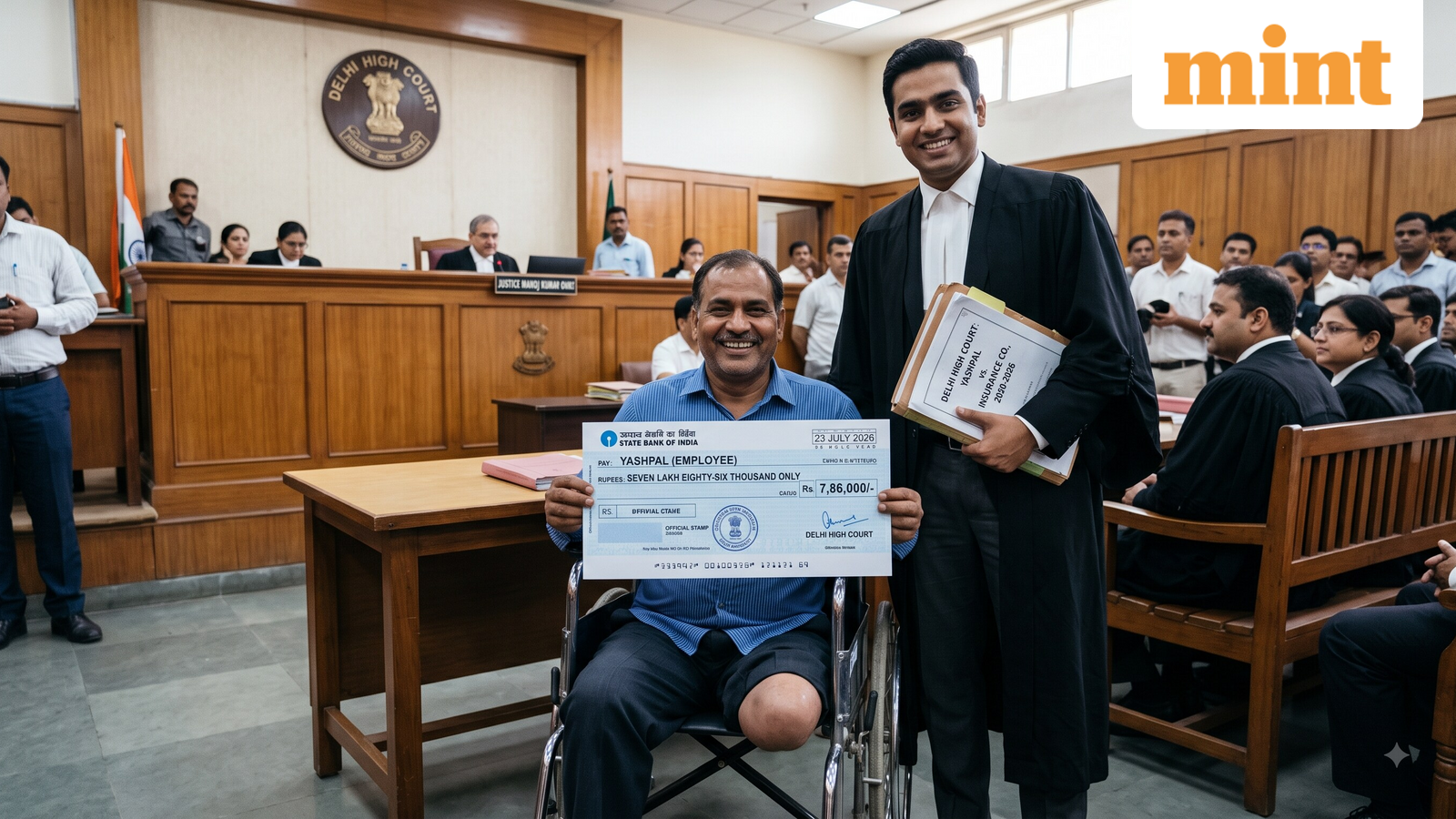
Accidents during lunch at work covered under employment laws? Employee gets ₹7.86 lakh compensation after 16 years
Yashpal, a supervisor at a construction company in Bhalswa, was having just another workday in Delhi on 22 June 2010 when things took a turn for the worse during his lunch break. An iron rod fell upon him from a mobile cane, resulting in the amputation of his left leg.
Since the accident occurred at his place of employment and the resultant injuries hindered his abilities, Yashpal filed an application seeking compensation.
Under the Employees’ Compensation Act, 1923, the insurance company was directed to pay Yashpal ₹7.86 lakh at 12% per annum, with effect from 22 July 2010, according to a 2016 order of the Commissioner of Employees’ Compensation, Delhi.
However, to avoid paying the compensation, the insurance company referred to the following legal grounds:
- No employee-employer relationship with the crane owner.
- Lack of finding relating to whether the accident arose out of and during the course of employment.
- Claim of losing 75% of earning capacity, but no disability certificate.
- Yashpal was a ‘Supervisor’ and did not fall within the definition of an “employee” under Section 2(dd).
- The accident occurred during his lunch break and had no nexus with his employment.
They also challenged the calculation of his assessment of monthly wages and the award of interest.
Delhi HC rules in favour of Yashpal
According to the Economic Times (ET), Delhi High Court Justice Manoj Kumar Ohri on 23 July 2026 ruled that the insurance company must pay compensation to Yashpal as determined by the commissioner — ₹7.86 lakh with 12% interest.
The judge observed that the accident during the lunch break would be treated as arising out of and in the course of employment under the Employee’s Compensation Act, 1923.
“Mere ‘Supervisor’ designation is not conclusive to exclude Yashpal from employees,” the court said, adding that mere designation assigned to a workman is not conclusive.
“A temporary break for taking meals does not, by itself, sever the nexus between employment and the accident,” the court said, noting that the accident admittedly occurred at the work site while Yashpal was present there in connection with his employment.
The high court also rejected the insurance company’s objections about Yashpal’s 75% disability claim, and like the commissioner, the judge accepted the medical evidence and assessed the loss of earning capacity accordingly.
Why did Yashpal win the case?
Advocate Mayank Parashar from Clasis Law told ET that the Delhi High Court ruled in Yashpal’s favour and awarded compensation because the unfortunate accident occurred during his lunch break.
The court clarified that the construction site where the employee was working and having lunch falls within the scope of his employment.
Parashar said the insurer’s argument that the injured employee was given the title of supervisor was rejected because the high court held that, in such cases, the actual nature of the employee’s work, rather than his designation, must be considered.
The advocate said that the high court accepted the Commissioner of Employees Compensation’s reliance on the medical evidence, which says that the employee suffered 75% disability as his left leg had to be amputated.
He added that under the new Labour Code — Occupational Safety, Health and Working Conditions Code, 2020 — the law places a greater emphasis on preventive safety measures.