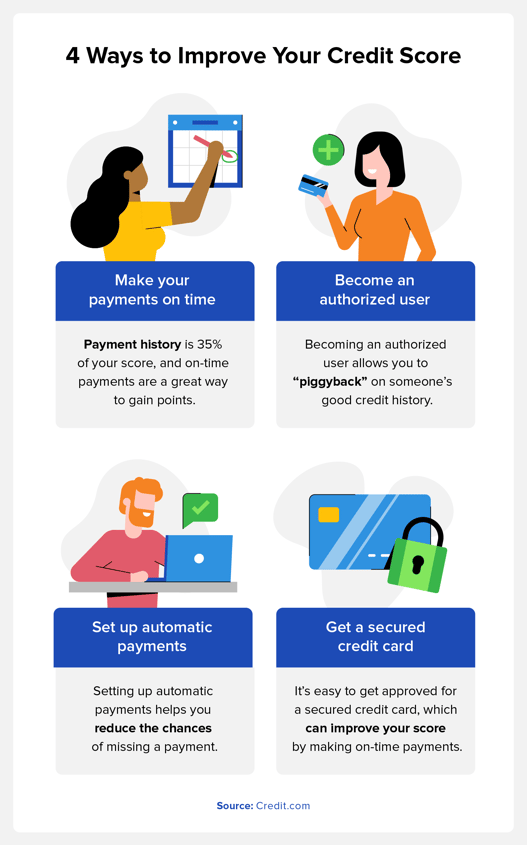
Payment history: A history of overdue and missed payments may signal that you are a bigger risk to creditors. Thus, this factor has the greatest negative effect on your credit score, making up about 35%.
Amount of debt: Debt is 30% of your FICO Score and also weighs heavily on other credit scoring models. This is also known as your credit utilization, and ideally, you want to keep it below 30% of your max credit limit.
Age of accounts: Creditors like to see a proven record of borrowing, utilizing, and repaying credit. If you’re new to credit and borrowing, there isn’t a lot of data to go on. This makes up 15% of your score.
Account mix: Making 10% of your score, lenders want to make sure you can handle both revolving and installment credit. This means credit cards that you continue to use after repaying and loans that are closed upon full repayment.
History of credit applications: Multiple hard inquiries on your credit may look to lenders like you are overextending yourself financially. This will lower your score. Credit inquiries make up 10% of your score.
Your credit report is the best place to start if you want to improve your credit score. Your credit report will show you your account balances, any derogatory marks you may have, and hard credit inquiries. This will help you see where to start, and you can also find out if there are any errors on your credit report.
Below, we’ve answered some of the most common questions people have about how to quickly improve their credit score.
The best way to improve your credit score quickly is to pay down your outstanding balances. If you can’t pay off your credit card in full, try to make more than the minimum payment on each credit card and loan you have. The lower your balance is, the more your score may improve.
Everyone’s credit and financial situation is different, and the amount of time it will take to rebuild your credit can vary. If you’re taking on more debt and aren’t paying off your balances, it may take longer to rebuild your credit.
However, you may be able to rebuild your credit faster if you make more than the minimum monthly payment on your debts, only open lines of credit or take on loans that you truly need, and keep older accounts open.
If you’re trying to pay off accounts in collections, requesting a pay-to-delete agreement with your creditors could help you boost your score. This agreement removes the derogatory mark on your credit report once you pay off the balance in full.
Without that derogatory mark on your credit report, you’ll likely see an improvement in your credit score.
A good credit score typically falls around 700 and higher, depending on the type of score you’re looking at. The higher your score is, the easier it will be to qualify for new loans, credit cards, and other products.
Raising your credit score to 800 isn’t easy, but several benefits make it worthwhile, including:
Easier approval for credit applications.
Lower interest rates on loans and credit cards.
Higher credit limits on credit cards.
Access to better credit card products.
Lower insurance premiums.
Improved rental prospects.
Peace of mind.
Open revolving credit accounts: These lines of credit include credit cards, home equity lines of credit, and personal lines of credit. If you max out the line of credit, you won’t be able to use it again until you pay it off at least a little.
Open installment accounts: These lines of credit include personal loans, mortgages, student loans, and auto loans.
Make payments on time each month: Make at least the minimum required payment each month for every line of credit you have.
14. Negotiate a Lower Interest Rate
Potential impact: Negotiating a lower interest rate could help you pay off your debt and lower your credit utilization ratio, potentially boosting your score.
You may be able to negotiate a lower interest rate with your credit card issuer by speaking with them and requesting a rate reduction. If awarded, that lower rate could help you pay off what you owe faster.
Steps to take:
Contact your credit issuer: You may be able to request a rate reduction online or by calling your card’s customer service line.
Request the reduction: Explain that you want a rate reduction on your card and be ready to explain why.
Wait for their decision: Credit card issuers will review your request and make a decision based on your history with them.
Continue making payments: Keep making the same monthly payment you were before negotiating a lower interest rate. This could help you pay your card’s balance off faster.
Pay off the balance: When you pay off that outstanding balance, your total credit utilization ratio may decrease, further boosting your credit score.
When working on improving your credit score, it’s helpful to know how your score is calculated so you know which factors are the most important. You can then make a plan for where you should start. Here are the major credit scoring factors and how each one can impact your credit score:
Payment history: A history of overdue and missed payments may signal that you are a bigger risk to creditors. Thus, this factor has the greatest negative effect on your credit score, making up about 35%.
Amount of debt: Debt is 30% of your FICO Score and also weighs heavily on other credit scoring models. This is also known as your credit utilization, and ideally, you want to keep it below 30% of your max credit limit.
Age of accounts: Creditors like to see a proven record of borrowing, utilizing, and repaying credit. If you’re new to credit and borrowing, there isn’t a lot of data to go on. This makes up 15% of your score.
Account mix: Making 10% of your score, lenders want to make sure you can handle both revolving and installment credit. This means credit cards that you continue to use after repaying and loans that are closed upon full repayment.
History of credit applications: Multiple hard inquiries on your credit may look to lenders like you are overextending yourself financially. This will lower your score. Credit inquiries make up 10% of your score.
Your credit report is the best place to start if you want to improve your credit score. Your credit report will show you your account balances, any derogatory marks you may have, and hard credit inquiries. This will help you see where to start, and you can also find out if there are any errors on your credit report.
Below, we’ve answered some of the most common questions people have about how to quickly improve their credit score.
The best way to improve your credit score quickly is to pay down your outstanding balances. If you can’t pay off your credit card in full, try to make more than the minimum payment on each credit card and loan you have. The lower your balance is, the more your score may improve.
Everyone’s credit and financial situation is different, and the amount of time it will take to rebuild your credit can vary. If you’re taking on more debt and aren’t paying off your balances, it may take longer to rebuild your credit.
However, you may be able to rebuild your credit faster if you make more than the minimum monthly payment on your debts, only open lines of credit or take on loans that you truly need, and keep older accounts open.
If you’re trying to pay off accounts in collections, requesting a pay-to-delete agreement with your creditors could help you boost your score. This agreement removes the derogatory mark on your credit report once you pay off the balance in full.
Without that derogatory mark on your credit report, you’ll likely see an improvement in your credit score.
A good credit score typically falls around 700 and higher, depending on the type of score you’re looking at. The higher your score is, the easier it will be to qualify for new loans, credit cards, and other products.
Raising your credit score to 800 isn’t easy, but several benefits make it worthwhile, including:
Easier approval for credit applications.
Lower interest rates on loans and credit cards.
Higher credit limits on credit cards.
Access to better credit card products.
Lower insurance premiums.
Improved rental prospects.
Peace of mind.
Review your accounts: Identify which credit accounts you still have.
Use your credit: Card issuers close accounts for lack of activity. Use your old cards for small purchases and pay them off in full each month.
13. Diversify Your Credit Mix
Potential impact: By taking on different types of debt, you’ll improve your credit mix, which makes up 10% of your FICO score.
Credit mix refers to the different types of credit accounts you have associated with your credit report. Your total credit mix makes up about 10% of your FICO score, and the more diverse that mix is, the better your score could be. If possible, you’ll want to have both revolving credit accounts and installment credit accounts.
Steps to take:
Open revolving credit accounts: These lines of credit include credit cards, home equity lines of credit, and personal lines of credit. If you max out the line of credit, you won’t be able to use it again until you pay it off at least a little.
Open installment accounts: These lines of credit include personal loans, mortgages, student loans, and auto loans.
Make payments on time each month: Make at least the minimum required payment each month for every line of credit you have.
14. Negotiate a Lower Interest Rate
Potential impact: Negotiating a lower interest rate could help you pay off your debt and lower your credit utilization ratio, potentially boosting your score.
You may be able to negotiate a lower interest rate with your credit card issuer by speaking with them and requesting a rate reduction. If awarded, that lower rate could help you pay off what you owe faster.
Steps to take:
Contact your credit issuer: You may be able to request a rate reduction online or by calling your card’s customer service line.
Request the reduction: Explain that you want a rate reduction on your card and be ready to explain why.
Wait for their decision: Credit card issuers will review your request and make a decision based on your history with them.
Continue making payments: Keep making the same monthly payment you were before negotiating a lower interest rate. This could help you pay your card’s balance off faster.
Pay off the balance: When you pay off that outstanding balance, your total credit utilization ratio may decrease, further boosting your credit score.
When working on improving your credit score, it’s helpful to know how your score is calculated so you know which factors are the most important. You can then make a plan for where you should start. Here are the major credit scoring factors and how each one can impact your credit score:
Payment history: A history of overdue and missed payments may signal that you are a bigger risk to creditors. Thus, this factor has the greatest negative effect on your credit score, making up about 35%.
Amount of debt: Debt is 30% of your FICO Score and also weighs heavily on other credit scoring models. This is also known as your credit utilization, and ideally, you want to keep it below 30% of your max credit limit.
Age of accounts: Creditors like to see a proven record of borrowing, utilizing, and repaying credit. If you’re new to credit and borrowing, there isn’t a lot of data to go on. This makes up 15% of your score.
Account mix: Making 10% of your score, lenders want to make sure you can handle both revolving and installment credit. This means credit cards that you continue to use after repaying and loans that are closed upon full repayment.
History of credit applications: Multiple hard inquiries on your credit may look to lenders like you are overextending yourself financially. This will lower your score. Credit inquiries make up 10% of your score.
Your credit report is the best place to start if you want to improve your credit score. Your credit report will show you your account balances, any derogatory marks you may have, and hard credit inquiries. This will help you see where to start, and you can also find out if there are any errors on your credit report.
Below, we’ve answered some of the most common questions people have about how to quickly improve their credit score.
The best way to improve your credit score quickly is to pay down your outstanding balances. If you can’t pay off your credit card in full, try to make more than the minimum payment on each credit card and loan you have. The lower your balance is, the more your score may improve.
Everyone’s credit and financial situation is different, and the amount of time it will take to rebuild your credit can vary. If you’re taking on more debt and aren’t paying off your balances, it may take longer to rebuild your credit.
However, you may be able to rebuild your credit faster if you make more than the minimum monthly payment on your debts, only open lines of credit or take on loans that you truly need, and keep older accounts open.
If you’re trying to pay off accounts in collections, requesting a pay-to-delete agreement with your creditors could help you boost your score. This agreement removes the derogatory mark on your credit report once you pay off the balance in full.
Without that derogatory mark on your credit report, you’ll likely see an improvement in your credit score.
A good credit score typically falls around 700 and higher, depending on the type of score you’re looking at. The higher your score is, the easier it will be to qualify for new loans, credit cards, and other products.
Raising your credit score to 800 isn’t easy, but several benefits make it worthwhile, including:
Easier approval for credit applications.
Lower interest rates on loans and credit cards.
Higher credit limits on credit cards.
Access to better credit card products.
Lower insurance premiums.
Improved rental prospects.
Peace of mind.
Make sure you need the card: Before applying, make sure you truly need a new credit card.
Apply for the card that meets your needs: Only apply for the credit card you’re most interested in and that you think you’ll qualify for.
Use the card responsibly: Avoid maxing the card out or carrying a balance when possible to keep your credit utilization ratio lower.
12. Keep Your Oldest Account Open
Potential impact: Holding on to older accounts preserves your credit history, which prevents your average age of credit from negatively affecting your credit score.
Credit history length, or the age of your oldest credit account, is worth 15% of your FICO score, and the older it is, the better. Rather than closing out a credit card you don’t use often, keep the account open as long as you can. This will increase the average age of your accounts, which can help you keep your credit score higher.
Steps to take:
Review your accounts: Identify which credit accounts you still have.
Use your credit: Card issuers close accounts for lack of activity. Use your old cards for small purchases and pay them off in full each month.
13. Diversify Your Credit Mix
Potential impact: By taking on different types of debt, you’ll improve your credit mix, which makes up 10% of your FICO score.
Credit mix refers to the different types of credit accounts you have associated with your credit report. Your total credit mix makes up about 10% of your FICO score, and the more diverse that mix is, the better your score could be. If possible, you’ll want to have both revolving credit accounts and installment credit accounts.
Steps to take:
Open revolving credit accounts: These lines of credit include credit cards, home equity lines of credit, and personal lines of credit. If you max out the line of credit, you won’t be able to use it again until you pay it off at least a little.
Open installment accounts: These lines of credit include personal loans, mortgages, student loans, and auto loans.
Make payments on time each month: Make at least the minimum required payment each month for every line of credit you have.
14. Negotiate a Lower Interest Rate
Potential impact: Negotiating a lower interest rate could help you pay off your debt and lower your credit utilization ratio, potentially boosting your score.
You may be able to negotiate a lower interest rate with your credit card issuer by speaking with them and requesting a rate reduction. If awarded, that lower rate could help you pay off what you owe faster.
Steps to take:
Contact your credit issuer: You may be able to request a rate reduction online or by calling your card’s customer service line.
Request the reduction: Explain that you want a rate reduction on your card and be ready to explain why.
Wait for their decision: Credit card issuers will review your request and make a decision based on your history with them.
Continue making payments: Keep making the same monthly payment you were before negotiating a lower interest rate. This could help you pay your card’s balance off faster.
Pay off the balance: When you pay off that outstanding balance, your total credit utilization ratio may decrease, further boosting your credit score.
When working on improving your credit score, it’s helpful to know how your score is calculated so you know which factors are the most important. You can then make a plan for where you should start. Here are the major credit scoring factors and how each one can impact your credit score:
Payment history: A history of overdue and missed payments may signal that you are a bigger risk to creditors. Thus, this factor has the greatest negative effect on your credit score, making up about 35%.
Amount of debt: Debt is 30% of your FICO Score and also weighs heavily on other credit scoring models. This is also known as your credit utilization, and ideally, you want to keep it below 30% of your max credit limit.
Age of accounts: Creditors like to see a proven record of borrowing, utilizing, and repaying credit. If you’re new to credit and borrowing, there isn’t a lot of data to go on. This makes up 15% of your score.
Account mix: Making 10% of your score, lenders want to make sure you can handle both revolving and installment credit. This means credit cards that you continue to use after repaying and loans that are closed upon full repayment.
History of credit applications: Multiple hard inquiries on your credit may look to lenders like you are overextending yourself financially. This will lower your score. Credit inquiries make up 10% of your score.
Your credit report is the best place to start if you want to improve your credit score. Your credit report will show you your account balances, any derogatory marks you may have, and hard credit inquiries. This will help you see where to start, and you can also find out if there are any errors on your credit report.
Below, we’ve answered some of the most common questions people have about how to quickly improve their credit score.
The best way to improve your credit score quickly is to pay down your outstanding balances. If you can’t pay off your credit card in full, try to make more than the minimum payment on each credit card and loan you have. The lower your balance is, the more your score may improve.
Everyone’s credit and financial situation is different, and the amount of time it will take to rebuild your credit can vary. If you’re taking on more debt and aren’t paying off your balances, it may take longer to rebuild your credit.
However, you may be able to rebuild your credit faster if you make more than the minimum monthly payment on your debts, only open lines of credit or take on loans that you truly need, and keep older accounts open.
If you’re trying to pay off accounts in collections, requesting a pay-to-delete agreement with your creditors could help you boost your score. This agreement removes the derogatory mark on your credit report once you pay off the balance in full.
Without that derogatory mark on your credit report, you’ll likely see an improvement in your credit score.
A good credit score typically falls around 700 and higher, depending on the type of score you’re looking at. The higher your score is, the easier it will be to qualify for new loans, credit cards, and other products.
Raising your credit score to 800 isn’t easy, but several benefits make it worthwhile, including:
Easier approval for credit applications.
Lower interest rates on loans and credit cards.
Higher credit limits on credit cards.
Access to better credit card products.
Lower insurance premiums.
Improved rental prospects.
Peace of mind.
Log in to your online account with each credit card issuer: You’ll need to set up automatic payments for every card you have.
Follow the prompts: Follow the prompts on each credit card issuer’s site and link your bank account to your credit card.
Pick a date: Choose your automatic payment date for each card.
10. Have Your Utilities Reported
Potential impact: Reporting additional on-time payments could help you improve your credit report’s payment history. This may increase your credit score over time. The lower your score is, the bigger the credit score increase you may see.
Utility companies don’t typically report payments to the credit bureaus, but adding your payments on time each month can strengthen your credit history and positively impact your credit score. There are different ways to add your utility payments to your credit report but using reporting services can be the simplest method.
11. Limit New Credit Card Applications
Potential impact: Reducing the number of hard credit inquiries on your credit report can help maintain your credit score even if nothing changes. Your score could increase if you make payments and reduce your total debt.
The more credit cards and loans you apply for, the more hard credit inquiries you’ll have on your credit report and the more your score could drop. Instead of applying for loans and credit cards whenever you think you’ll get a good deal, only apply for new lines of credit and loans when you know your score can handle the hit.
Steps to take:
Make sure you need the card: Before applying, make sure you truly need a new credit card.
Apply for the card that meets your needs: Only apply for the credit card you’re most interested in and that you think you’ll qualify for.
Use the card responsibly: Avoid maxing the card out or carrying a balance when possible to keep your credit utilization ratio lower.
12. Keep Your Oldest Account Open
Potential impact: Holding on to older accounts preserves your credit history, which prevents your average age of credit from negatively affecting your credit score.
Credit history length, or the age of your oldest credit account, is worth 15% of your FICO score, and the older it is, the better. Rather than closing out a credit card you don’t use often, keep the account open as long as you can. This will increase the average age of your accounts, which can help you keep your credit score higher.
Steps to take:
Review your accounts: Identify which credit accounts you still have.
Use your credit: Card issuers close accounts for lack of activity. Use your old cards for small purchases and pay them off in full each month.
13. Diversify Your Credit Mix
Potential impact: By taking on different types of debt, you’ll improve your credit mix, which makes up 10% of your FICO score.
Credit mix refers to the different types of credit accounts you have associated with your credit report. Your total credit mix makes up about 10% of your FICO score, and the more diverse that mix is, the better your score could be. If possible, you’ll want to have both revolving credit accounts and installment credit accounts.
Steps to take:
Open revolving credit accounts: These lines of credit include credit cards, home equity lines of credit, and personal lines of credit. If you max out the line of credit, you won’t be able to use it again until you pay it off at least a little.
Open installment accounts: These lines of credit include personal loans, mortgages, student loans, and auto loans.
Make payments on time each month: Make at least the minimum required payment each month for every line of credit you have.
14. Negotiate a Lower Interest Rate
Potential impact: Negotiating a lower interest rate could help you pay off your debt and lower your credit utilization ratio, potentially boosting your score.
You may be able to negotiate a lower interest rate with your credit card issuer by speaking with them and requesting a rate reduction. If awarded, that lower rate could help you pay off what you owe faster.
Steps to take:
Contact your credit issuer: You may be able to request a rate reduction online or by calling your card’s customer service line.
Request the reduction: Explain that you want a rate reduction on your card and be ready to explain why.
Wait for their decision: Credit card issuers will review your request and make a decision based on your history with them.
Continue making payments: Keep making the same monthly payment you were before negotiating a lower interest rate. This could help you pay your card’s balance off faster.
Pay off the balance: When you pay off that outstanding balance, your total credit utilization ratio may decrease, further boosting your credit score.
When working on improving your credit score, it’s helpful to know how your score is calculated so you know which factors are the most important. You can then make a plan for where you should start. Here are the major credit scoring factors and how each one can impact your credit score:
Payment history: A history of overdue and missed payments may signal that you are a bigger risk to creditors. Thus, this factor has the greatest negative effect on your credit score, making up about 35%.
Amount of debt: Debt is 30% of your FICO Score and also weighs heavily on other credit scoring models. This is also known as your credit utilization, and ideally, you want to keep it below 30% of your max credit limit.
Age of accounts: Creditors like to see a proven record of borrowing, utilizing, and repaying credit. If you’re new to credit and borrowing, there isn’t a lot of data to go on. This makes up 15% of your score.
Account mix: Making 10% of your score, lenders want to make sure you can handle both revolving and installment credit. This means credit cards that you continue to use after repaying and loans that are closed upon full repayment.
History of credit applications: Multiple hard inquiries on your credit may look to lenders like you are overextending yourself financially. This will lower your score. Credit inquiries make up 10% of your score.
Your credit report is the best place to start if you want to improve your credit score. Your credit report will show you your account balances, any derogatory marks you may have, and hard credit inquiries. This will help you see where to start, and you can also find out if there are any errors on your credit report.
Below, we’ve answered some of the most common questions people have about how to quickly improve their credit score.
The best way to improve your credit score quickly is to pay down your outstanding balances. If you can’t pay off your credit card in full, try to make more than the minimum payment on each credit card and loan you have. The lower your balance is, the more your score may improve.
Everyone’s credit and financial situation is different, and the amount of time it will take to rebuild your credit can vary. If you’re taking on more debt and aren’t paying off your balances, it may take longer to rebuild your credit.
However, you may be able to rebuild your credit faster if you make more than the minimum monthly payment on your debts, only open lines of credit or take on loans that you truly need, and keep older accounts open.
If you’re trying to pay off accounts in collections, requesting a pay-to-delete agreement with your creditors could help you boost your score. This agreement removes the derogatory mark on your credit report once you pay off the balance in full.
Without that derogatory mark on your credit report, you’ll likely see an improvement in your credit score.
A good credit score typically falls around 700 and higher, depending on the type of score you’re looking at. The higher your score is, the easier it will be to qualify for new loans, credit cards, and other products.
Raising your credit score to 800 isn’t easy, but several benefits make it worthwhile, including:
Easier approval for credit applications.
Lower interest rates on loans and credit cards.
Higher credit limits on credit cards.
Access to better credit card products.
Lower insurance premiums.
Improved rental prospects.
Peace of mind.
Contact your credit card issuer: Typically, you’ll need to request a credit limit increase from each card issuer you work with.
Ask for the increase: Let your card issuer know that you’re interested in increasing your limit.
Wait for their decision: They’ll review your payment history, credit score, and current credit utilization ratio to determine if a rate increase is appropriate.
9. Set Up Automatic Payments
Potential impact: Automatic payments will help you reduce the risk of late or missed payments, improving your payment history. This could improve your credit score.
Having a good payment history is one of the best ways to improve your credit score because your payment history accounts for 35% of your FICO score. One of the simplest ways to do this is to set up automatic payments. Simply go to your credit card company’s website, make an account, and set up automatic payments for the minimum each month.
This way, you never have to worry about forgetting your payment.
Steps to take:
Log in to your online account with each credit card issuer: You’ll need to set up automatic payments for every card you have.
Follow the prompts: Follow the prompts on each credit card issuer’s site and link your bank account to your credit card.
Pick a date: Choose your automatic payment date for each card.
10. Have Your Utilities Reported
Potential impact: Reporting additional on-time payments could help you improve your credit report’s payment history. This may increase your credit score over time. The lower your score is, the bigger the credit score increase you may see.
Utility companies don’t typically report payments to the credit bureaus, but adding your payments on time each month can strengthen your credit history and positively impact your credit score. There are different ways to add your utility payments to your credit report but using reporting services can be the simplest method.
11. Limit New Credit Card Applications
Potential impact: Reducing the number of hard credit inquiries on your credit report can help maintain your credit score even if nothing changes. Your score could increase if you make payments and reduce your total debt.
The more credit cards and loans you apply for, the more hard credit inquiries you’ll have on your credit report and the more your score could drop. Instead of applying for loans and credit cards whenever you think you’ll get a good deal, only apply for new lines of credit and loans when you know your score can handle the hit.
Steps to take:
Make sure you need the card: Before applying, make sure you truly need a new credit card.
Apply for the card that meets your needs: Only apply for the credit card you’re most interested in and that you think you’ll qualify for.
Use the card responsibly: Avoid maxing the card out or carrying a balance when possible to keep your credit utilization ratio lower.
12. Keep Your Oldest Account Open
Potential impact: Holding on to older accounts preserves your credit history, which prevents your average age of credit from negatively affecting your credit score.
Credit history length, or the age of your oldest credit account, is worth 15% of your FICO score, and the older it is, the better. Rather than closing out a credit card you don’t use often, keep the account open as long as you can. This will increase the average age of your accounts, which can help you keep your credit score higher.
Steps to take:
Review your accounts: Identify which credit accounts you still have.
Use your credit: Card issuers close accounts for lack of activity. Use your old cards for small purchases and pay them off in full each month.
13. Diversify Your Credit Mix
Potential impact: By taking on different types of debt, you’ll improve your credit mix, which makes up 10% of your FICO score.
Credit mix refers to the different types of credit accounts you have associated with your credit report. Your total credit mix makes up about 10% of your FICO score, and the more diverse that mix is, the better your score could be. If possible, you’ll want to have both revolving credit accounts and installment credit accounts.
Steps to take:
Open revolving credit accounts: These lines of credit include credit cards, home equity lines of credit, and personal lines of credit. If you max out the line of credit, you won’t be able to use it again until you pay it off at least a little.
Open installment accounts: These lines of credit include personal loans, mortgages, student loans, and auto loans.
Make payments on time each month: Make at least the minimum required payment each month for every line of credit you have.
14. Negotiate a Lower Interest Rate
Potential impact: Negotiating a lower interest rate could help you pay off your debt and lower your credit utilization ratio, potentially boosting your score.
You may be able to negotiate a lower interest rate with your credit card issuer by speaking with them and requesting a rate reduction. If awarded, that lower rate could help you pay off what you owe faster.
Steps to take:
Contact your credit issuer: You may be able to request a rate reduction online or by calling your card’s customer service line.
Request the reduction: Explain that you want a rate reduction on your card and be ready to explain why.
Wait for their decision: Credit card issuers will review your request and make a decision based on your history with them.
Continue making payments: Keep making the same monthly payment you were before negotiating a lower interest rate. This could help you pay your card’s balance off faster.
Pay off the balance: When you pay off that outstanding balance, your total credit utilization ratio may decrease, further boosting your credit score.
When working on improving your credit score, it’s helpful to know how your score is calculated so you know which factors are the most important. You can then make a plan for where you should start. Here are the major credit scoring factors and how each one can impact your credit score:
Payment history: A history of overdue and missed payments may signal that you are a bigger risk to creditors. Thus, this factor has the greatest negative effect on your credit score, making up about 35%.
Amount of debt: Debt is 30% of your FICO Score and also weighs heavily on other credit scoring models. This is also known as your credit utilization, and ideally, you want to keep it below 30% of your max credit limit.
Age of accounts: Creditors like to see a proven record of borrowing, utilizing, and repaying credit. If you’re new to credit and borrowing, there isn’t a lot of data to go on. This makes up 15% of your score.
Account mix: Making 10% of your score, lenders want to make sure you can handle both revolving and installment credit. This means credit cards that you continue to use after repaying and loans that are closed upon full repayment.
History of credit applications: Multiple hard inquiries on your credit may look to lenders like you are overextending yourself financially. This will lower your score. Credit inquiries make up 10% of your score.
Your credit report is the best place to start if you want to improve your credit score. Your credit report will show you your account balances, any derogatory marks you may have, and hard credit inquiries. This will help you see where to start, and you can also find out if there are any errors on your credit report.
Below, we’ve answered some of the most common questions people have about how to quickly improve their credit score.
The best way to improve your credit score quickly is to pay down your outstanding balances. If you can’t pay off your credit card in full, try to make more than the minimum payment on each credit card and loan you have. The lower your balance is, the more your score may improve.
Everyone’s credit and financial situation is different, and the amount of time it will take to rebuild your credit can vary. If you’re taking on more debt and aren’t paying off your balances, it may take longer to rebuild your credit.
However, you may be able to rebuild your credit faster if you make more than the minimum monthly payment on your debts, only open lines of credit or take on loans that you truly need, and keep older accounts open.
If you’re trying to pay off accounts in collections, requesting a pay-to-delete agreement with your creditors could help you boost your score. This agreement removes the derogatory mark on your credit report once you pay off the balance in full.
Without that derogatory mark on your credit report, you’ll likely see an improvement in your credit score.
A good credit score typically falls around 700 and higher, depending on the type of score you’re looking at. The higher your score is, the easier it will be to qualify for new loans, credit cards, and other products.
Raising your credit score to 800 isn’t easy, but several benefits make it worthwhile, including:
Easier approval for credit applications.
Lower interest rates on loans and credit cards.
Higher credit limits on credit cards.
Access to better credit card products.
Lower insurance premiums.
Improved rental prospects.
Peace of mind.
Look at your current credit utilization ratio: See how much of your available credit you’re using.
Pay down existing credit card balances: Experts recommend keeping your credit utilization ratio at around 30%. If your ratio is higher, focus on paying down balances until you reach that 30% threshold.
8. Increase Your Credit Limits
Potential impact: Your credit limit impacts your credit utilization ratio. A higher limit will lower your ratio, positively affecting your credit score.
As discussed above, a low credit utilization ratio is ideal, and increasing your credit limits is one way to improve your credit utilization.
Using the same $10,000 example, $4,000 of debt would be a 40% credit utilization ratio. If you increase your credit limit to $15,000, that same $4,000 debt would only be 26%. But keep in mind that this could trigger an inquiry and will also impact your score.
Steps to take:
Contact your credit card issuer: Typically, you’ll need to request a credit limit increase from each card issuer you work with.
Ask for the increase: Let your card issuer know that you’re interested in increasing your limit.
Wait for their decision: They’ll review your payment history, credit score, and current credit utilization ratio to determine if a rate increase is appropriate.
9. Set Up Automatic Payments
Potential impact: Automatic payments will help you reduce the risk of late or missed payments, improving your payment history. This could improve your credit score.
Having a good payment history is one of the best ways to improve your credit score because your payment history accounts for 35% of your FICO score. One of the simplest ways to do this is to set up automatic payments. Simply go to your credit card company’s website, make an account, and set up automatic payments for the minimum each month.
This way, you never have to worry about forgetting your payment.
Steps to take:
Log in to your online account with each credit card issuer: You’ll need to set up automatic payments for every card you have.
Follow the prompts: Follow the prompts on each credit card issuer’s site and link your bank account to your credit card.
Pick a date: Choose your automatic payment date for each card.
10. Have Your Utilities Reported
Potential impact: Reporting additional on-time payments could help you improve your credit report’s payment history. This may increase your credit score over time. The lower your score is, the bigger the credit score increase you may see.
Utility companies don’t typically report payments to the credit bureaus, but adding your payments on time each month can strengthen your credit history and positively impact your credit score. There are different ways to add your utility payments to your credit report but using reporting services can be the simplest method.
11. Limit New Credit Card Applications
Potential impact: Reducing the number of hard credit inquiries on your credit report can help maintain your credit score even if nothing changes. Your score could increase if you make payments and reduce your total debt.
The more credit cards and loans you apply for, the more hard credit inquiries you’ll have on your credit report and the more your score could drop. Instead of applying for loans and credit cards whenever you think you’ll get a good deal, only apply for new lines of credit and loans when you know your score can handle the hit.
Steps to take:
Make sure you need the card: Before applying, make sure you truly need a new credit card.
Apply for the card that meets your needs: Only apply for the credit card you’re most interested in and that you think you’ll qualify for.
Use the card responsibly: Avoid maxing the card out or carrying a balance when possible to keep your credit utilization ratio lower.
12. Keep Your Oldest Account Open
Potential impact: Holding on to older accounts preserves your credit history, which prevents your average age of credit from negatively affecting your credit score.
Credit history length, or the age of your oldest credit account, is worth 15% of your FICO score, and the older it is, the better. Rather than closing out a credit card you don’t use often, keep the account open as long as you can. This will increase the average age of your accounts, which can help you keep your credit score higher.
Steps to take:
Review your accounts: Identify which credit accounts you still have.
Use your credit: Card issuers close accounts for lack of activity. Use your old cards for small purchases and pay them off in full each month.
13. Diversify Your Credit Mix
Potential impact: By taking on different types of debt, you’ll improve your credit mix, which makes up 10% of your FICO score.
Credit mix refers to the different types of credit accounts you have associated with your credit report. Your total credit mix makes up about 10% of your FICO score, and the more diverse that mix is, the better your score could be. If possible, you’ll want to have both revolving credit accounts and installment credit accounts.
Steps to take:
Open revolving credit accounts: These lines of credit include credit cards, home equity lines of credit, and personal lines of credit. If you max out the line of credit, you won’t be able to use it again until you pay it off at least a little.
Open installment accounts: These lines of credit include personal loans, mortgages, student loans, and auto loans.
Make payments on time each month: Make at least the minimum required payment each month for every line of credit you have.
14. Negotiate a Lower Interest Rate
Potential impact: Negotiating a lower interest rate could help you pay off your debt and lower your credit utilization ratio, potentially boosting your score.
You may be able to negotiate a lower interest rate with your credit card issuer by speaking with them and requesting a rate reduction. If awarded, that lower rate could help you pay off what you owe faster.
Steps to take:
Contact your credit issuer: You may be able to request a rate reduction online or by calling your card’s customer service line.
Request the reduction: Explain that you want a rate reduction on your card and be ready to explain why.
Wait for their decision: Credit card issuers will review your request and make a decision based on your history with them.
Continue making payments: Keep making the same monthly payment you were before negotiating a lower interest rate. This could help you pay your card’s balance off faster.
Pay off the balance: When you pay off that outstanding balance, your total credit utilization ratio may decrease, further boosting your credit score.
When working on improving your credit score, it’s helpful to know how your score is calculated so you know which factors are the most important. You can then make a plan for where you should start. Here are the major credit scoring factors and how each one can impact your credit score:
Payment history: A history of overdue and missed payments may signal that you are a bigger risk to creditors. Thus, this factor has the greatest negative effect on your credit score, making up about 35%.
Amount of debt: Debt is 30% of your FICO Score and also weighs heavily on other credit scoring models. This is also known as your credit utilization, and ideally, you want to keep it below 30% of your max credit limit.
Age of accounts: Creditors like to see a proven record of borrowing, utilizing, and repaying credit. If you’re new to credit and borrowing, there isn’t a lot of data to go on. This makes up 15% of your score.
Account mix: Making 10% of your score, lenders want to make sure you can handle both revolving and installment credit. This means credit cards that you continue to use after repaying and loans that are closed upon full repayment.
History of credit applications: Multiple hard inquiries on your credit may look to lenders like you are overextending yourself financially. This will lower your score. Credit inquiries make up 10% of your score.
Your credit report is the best place to start if you want to improve your credit score. Your credit report will show you your account balances, any derogatory marks you may have, and hard credit inquiries. This will help you see where to start, and you can also find out if there are any errors on your credit report.
Below, we’ve answered some of the most common questions people have about how to quickly improve their credit score.
The best way to improve your credit score quickly is to pay down your outstanding balances. If you can’t pay off your credit card in full, try to make more than the minimum payment on each credit card and loan you have. The lower your balance is, the more your score may improve.
Everyone’s credit and financial situation is different, and the amount of time it will take to rebuild your credit can vary. If you’re taking on more debt and aren’t paying off your balances, it may take longer to rebuild your credit.
However, you may be able to rebuild your credit faster if you make more than the minimum monthly payment on your debts, only open lines of credit or take on loans that you truly need, and keep older accounts open.
If you’re trying to pay off accounts in collections, requesting a pay-to-delete agreement with your creditors could help you boost your score. This agreement removes the derogatory mark on your credit report once you pay off the balance in full.
Without that derogatory mark on your credit report, you’ll likely see an improvement in your credit score.
A good credit score typically falls around 700 and higher, depending on the type of score you’re looking at. The higher your score is, the easier it will be to qualify for new loans, credit cards, and other products.
Raising your credit score to 800 isn’t easy, but several benefits make it worthwhile, including:
Easier approval for credit applications.
Lower interest rates on loans and credit cards.
Higher credit limits on credit cards.
Access to better credit card products.
Lower insurance premiums.
Improved rental prospects.
Peace of mind.
Choose a secured credit card issuer: Banks are more likely to approve you for a secured credit card because it’s less of a risk. Compare the terms offered by several banks and open a card with the one you like best.
Use the card responsibly: Using your secured card and repaying it in full will help you establish a positive credit history.
Make payments on time: Your payments on the card are reported to the credit bureaus, and if you make those payments on time, this can help you raise your credit score.
7. Be Mindful of Your Credit Utilization
Potential impact: Your credit utilization makes up 30% of your credit score. By reducing what you owe, you can increase your score over time.
Your score can suffer if you carry a large amount of debt compared to your available credit. Credit utilization accounts for 30% of your credit score.
So, if your total available credit on all of your credit cards is $10,000, and you’re currently using $8,000 of it, paying down those balances can potentially increase your score by decreasing your total credit utilization.
Steps to take:
Look at your current credit utilization ratio: See how much of your available credit you’re using.
Pay down existing credit card balances: Experts recommend keeping your credit utilization ratio at around 30%. If your ratio is higher, focus on paying down balances until you reach that 30% threshold.
8. Increase Your Credit Limits
Potential impact: Your credit limit impacts your credit utilization ratio. A higher limit will lower your ratio, positively affecting your credit score.
As discussed above, a low credit utilization ratio is ideal, and increasing your credit limits is one way to improve your credit utilization.
Using the same $10,000 example, $4,000 of debt would be a 40% credit utilization ratio. If you increase your credit limit to $15,000, that same $4,000 debt would only be 26%. But keep in mind that this could trigger an inquiry and will also impact your score.
Steps to take:
Contact your credit card issuer: Typically, you’ll need to request a credit limit increase from each card issuer you work with.
Ask for the increase: Let your card issuer know that you’re interested in increasing your limit.
Wait for their decision: They’ll review your payment history, credit score, and current credit utilization ratio to determine if a rate increase is appropriate.
9. Set Up Automatic Payments
Potential impact: Automatic payments will help you reduce the risk of late or missed payments, improving your payment history. This could improve your credit score.
Having a good payment history is one of the best ways to improve your credit score because your payment history accounts for 35% of your FICO score. One of the simplest ways to do this is to set up automatic payments. Simply go to your credit card company’s website, make an account, and set up automatic payments for the minimum each month.
This way, you never have to worry about forgetting your payment.
Steps to take:
Log in to your online account with each credit card issuer: You’ll need to set up automatic payments for every card you have.
Follow the prompts: Follow the prompts on each credit card issuer’s site and link your bank account to your credit card.
Pick a date: Choose your automatic payment date for each card.
10. Have Your Utilities Reported
Potential impact: Reporting additional on-time payments could help you improve your credit report’s payment history. This may increase your credit score over time. The lower your score is, the bigger the credit score increase you may see.
Utility companies don’t typically report payments to the credit bureaus, but adding your payments on time each month can strengthen your credit history and positively impact your credit score. There are different ways to add your utility payments to your credit report but using reporting services can be the simplest method.
11. Limit New Credit Card Applications
Potential impact: Reducing the number of hard credit inquiries on your credit report can help maintain your credit score even if nothing changes. Your score could increase if you make payments and reduce your total debt.
The more credit cards and loans you apply for, the more hard credit inquiries you’ll have on your credit report and the more your score could drop. Instead of applying for loans and credit cards whenever you think you’ll get a good deal, only apply for new lines of credit and loans when you know your score can handle the hit.
Steps to take:
Make sure you need the card: Before applying, make sure you truly need a new credit card.
Apply for the card that meets your needs: Only apply for the credit card you’re most interested in and that you think you’ll qualify for.
Use the card responsibly: Avoid maxing the card out or carrying a balance when possible to keep your credit utilization ratio lower.
12. Keep Your Oldest Account Open
Potential impact: Holding on to older accounts preserves your credit history, which prevents your average age of credit from negatively affecting your credit score.
Credit history length, or the age of your oldest credit account, is worth 15% of your FICO score, and the older it is, the better. Rather than closing out a credit card you don’t use often, keep the account open as long as you can. This will increase the average age of your accounts, which can help you keep your credit score higher.
Steps to take:
Review your accounts: Identify which credit accounts you still have.
Use your credit: Card issuers close accounts for lack of activity. Use your old cards for small purchases and pay them off in full each month.
13. Diversify Your Credit Mix
Potential impact: By taking on different types of debt, you’ll improve your credit mix, which makes up 10% of your FICO score.
Credit mix refers to the different types of credit accounts you have associated with your credit report. Your total credit mix makes up about 10% of your FICO score, and the more diverse that mix is, the better your score could be. If possible, you’ll want to have both revolving credit accounts and installment credit accounts.
Steps to take:
Open revolving credit accounts: These lines of credit include credit cards, home equity lines of credit, and personal lines of credit. If you max out the line of credit, you won’t be able to use it again until you pay it off at least a little.
Open installment accounts: These lines of credit include personal loans, mortgages, student loans, and auto loans.
Make payments on time each month: Make at least the minimum required payment each month for every line of credit you have.
14. Negotiate a Lower Interest Rate
Potential impact: Negotiating a lower interest rate could help you pay off your debt and lower your credit utilization ratio, potentially boosting your score.
You may be able to negotiate a lower interest rate with your credit card issuer by speaking with them and requesting a rate reduction. If awarded, that lower rate could help you pay off what you owe faster.
Steps to take:
Contact your credit issuer: You may be able to request a rate reduction online or by calling your card’s customer service line.
Request the reduction: Explain that you want a rate reduction on your card and be ready to explain why.
Wait for their decision: Credit card issuers will review your request and make a decision based on your history with them.
Continue making payments: Keep making the same monthly payment you were before negotiating a lower interest rate. This could help you pay your card’s balance off faster.
Pay off the balance: When you pay off that outstanding balance, your total credit utilization ratio may decrease, further boosting your credit score.
When working on improving your credit score, it’s helpful to know how your score is calculated so you know which factors are the most important. You can then make a plan for where you should start. Here are the major credit scoring factors and how each one can impact your credit score:
Payment history: A history of overdue and missed payments may signal that you are a bigger risk to creditors. Thus, this factor has the greatest negative effect on your credit score, making up about 35%.
Amount of debt: Debt is 30% of your FICO Score and also weighs heavily on other credit scoring models. This is also known as your credit utilization, and ideally, you want to keep it below 30% of your max credit limit.
Age of accounts: Creditors like to see a proven record of borrowing, utilizing, and repaying credit. If you’re new to credit and borrowing, there isn’t a lot of data to go on. This makes up 15% of your score.
Account mix: Making 10% of your score, lenders want to make sure you can handle both revolving and installment credit. This means credit cards that you continue to use after repaying and loans that are closed upon full repayment.
History of credit applications: Multiple hard inquiries on your credit may look to lenders like you are overextending yourself financially. This will lower your score. Credit inquiries make up 10% of your score.
Your credit report is the best place to start if you want to improve your credit score. Your credit report will show you your account balances, any derogatory marks you may have, and hard credit inquiries. This will help you see where to start, and you can also find out if there are any errors on your credit report.
Below, we’ve answered some of the most common questions people have about how to quickly improve their credit score.
The best way to improve your credit score quickly is to pay down your outstanding balances. If you can’t pay off your credit card in full, try to make more than the minimum payment on each credit card and loan you have. The lower your balance is, the more your score may improve.
Everyone’s credit and financial situation is different, and the amount of time it will take to rebuild your credit can vary. If you’re taking on more debt and aren’t paying off your balances, it may take longer to rebuild your credit.
However, you may be able to rebuild your credit faster if you make more than the minimum monthly payment on your debts, only open lines of credit or take on loans that you truly need, and keep older accounts open.
If you’re trying to pay off accounts in collections, requesting a pay-to-delete agreement with your creditors could help you boost your score. This agreement removes the derogatory mark on your credit report once you pay off the balance in full.
Without that derogatory mark on your credit report, you’ll likely see an improvement in your credit score.
A good credit score typically falls around 700 and higher, depending on the type of score you’re looking at. The higher your score is, the easier it will be to qualify for new loans, credit cards, and other products.
Raising your credit score to 800 isn’t easy, but several benefits make it worthwhile, including:
Easier approval for credit applications.
Lower interest rates on loans and credit cards.
Higher credit limits on credit cards.
Access to better credit card products.
Lower insurance premiums.
Improved rental prospects.
Peace of mind.
Come to an agreement: Negotiate your repayment terms with each creditor.
Request a pay-to-delete letter: This letter states that the creditor will have the derogatory information removed from your credit report.
6. Open a Secured Credit Card
Potential impact: Making full, on-time payments can help you boost your score. Payment history makes up 35% of your FICO® score, and those on-time payments can help you build your score quickly.
Having and using a credit card can help you build credit, but it’s difficult to get approved for a credit card when you have a low credit score, which is where secured credit cards become useful. Unlike a typical unsecured credit card, where you are given a credit line based on your credit alone, you can open a secured credit card by depositing money, which becomes your credit limit.
Steps to take:
Choose a secured credit card issuer: Banks are more likely to approve you for a secured credit card because it’s less of a risk. Compare the terms offered by several banks and open a card with the one you like best.
Use the card responsibly: Using your secured card and repaying it in full will help you establish a positive credit history.
Make payments on time: Your payments on the card are reported to the credit bureaus, and if you make those payments on time, this can help you raise your credit score.
7. Be Mindful of Your Credit Utilization
Potential impact: Your credit utilization makes up 30% of your credit score. By reducing what you owe, you can increase your score over time.
Your score can suffer if you carry a large amount of debt compared to your available credit. Credit utilization accounts for 30% of your credit score.
So, if your total available credit on all of your credit cards is $10,000, and you’re currently using $8,000 of it, paying down those balances can potentially increase your score by decreasing your total credit utilization.
Steps to take:
Look at your current credit utilization ratio: See how much of your available credit you’re using.
Pay down existing credit card balances: Experts recommend keeping your credit utilization ratio at around 30%. If your ratio is higher, focus on paying down balances until you reach that 30% threshold.
8. Increase Your Credit Limits
Potential impact: Your credit limit impacts your credit utilization ratio. A higher limit will lower your ratio, positively affecting your credit score.
As discussed above, a low credit utilization ratio is ideal, and increasing your credit limits is one way to improve your credit utilization.
Using the same $10,000 example, $4,000 of debt would be a 40% credit utilization ratio. If you increase your credit limit to $15,000, that same $4,000 debt would only be 26%. But keep in mind that this could trigger an inquiry and will also impact your score.
Steps to take:
Contact your credit card issuer: Typically, you’ll need to request a credit limit increase from each card issuer you work with.
Ask for the increase: Let your card issuer know that you’re interested in increasing your limit.
Wait for their decision: They’ll review your payment history, credit score, and current credit utilization ratio to determine if a rate increase is appropriate.
9. Set Up Automatic Payments
Potential impact: Automatic payments will help you reduce the risk of late or missed payments, improving your payment history. This could improve your credit score.
Having a good payment history is one of the best ways to improve your credit score because your payment history accounts for 35% of your FICO score. One of the simplest ways to do this is to set up automatic payments. Simply go to your credit card company’s website, make an account, and set up automatic payments for the minimum each month.
This way, you never have to worry about forgetting your payment.
Steps to take:
Log in to your online account with each credit card issuer: You’ll need to set up automatic payments for every card you have.
Follow the prompts: Follow the prompts on each credit card issuer’s site and link your bank account to your credit card.
Pick a date: Choose your automatic payment date for each card.
10. Have Your Utilities Reported
Potential impact: Reporting additional on-time payments could help you improve your credit report’s payment history. This may increase your credit score over time. The lower your score is, the bigger the credit score increase you may see.
Utility companies don’t typically report payments to the credit bureaus, but adding your payments on time each month can strengthen your credit history and positively impact your credit score. There are different ways to add your utility payments to your credit report but using reporting services can be the simplest method.
11. Limit New Credit Card Applications
Potential impact: Reducing the number of hard credit inquiries on your credit report can help maintain your credit score even if nothing changes. Your score could increase if you make payments and reduce your total debt.
The more credit cards and loans you apply for, the more hard credit inquiries you’ll have on your credit report and the more your score could drop. Instead of applying for loans and credit cards whenever you think you’ll get a good deal, only apply for new lines of credit and loans when you know your score can handle the hit.
Steps to take:
Make sure you need the card: Before applying, make sure you truly need a new credit card.
Apply for the card that meets your needs: Only apply for the credit card you’re most interested in and that you think you’ll qualify for.
Use the card responsibly: Avoid maxing the card out or carrying a balance when possible to keep your credit utilization ratio lower.
12. Keep Your Oldest Account Open
Potential impact: Holding on to older accounts preserves your credit history, which prevents your average age of credit from negatively affecting your credit score.
Credit history length, or the age of your oldest credit account, is worth 15% of your FICO score, and the older it is, the better. Rather than closing out a credit card you don’t use often, keep the account open as long as you can. This will increase the average age of your accounts, which can help you keep your credit score higher.
Steps to take:
Review your accounts: Identify which credit accounts you still have.
Use your credit: Card issuers close accounts for lack of activity. Use your old cards for small purchases and pay them off in full each month.
13. Diversify Your Credit Mix
Potential impact: By taking on different types of debt, you’ll improve your credit mix, which makes up 10% of your FICO score.
Credit mix refers to the different types of credit accounts you have associated with your credit report. Your total credit mix makes up about 10% of your FICO score, and the more diverse that mix is, the better your score could be. If possible, you’ll want to have both revolving credit accounts and installment credit accounts.
Steps to take:
Open revolving credit accounts: These lines of credit include credit cards, home equity lines of credit, and personal lines of credit. If you max out the line of credit, you won’t be able to use it again until you pay it off at least a little.
Open installment accounts: These lines of credit include personal loans, mortgages, student loans, and auto loans.
Make payments on time each month: Make at least the minimum required payment each month for every line of credit you have.
14. Negotiate a Lower Interest Rate
Potential impact: Negotiating a lower interest rate could help you pay off your debt and lower your credit utilization ratio, potentially boosting your score.
You may be able to negotiate a lower interest rate with your credit card issuer by speaking with them and requesting a rate reduction. If awarded, that lower rate could help you pay off what you owe faster.
Steps to take:
Contact your credit issuer: You may be able to request a rate reduction online or by calling your card’s customer service line.
Request the reduction: Explain that you want a rate reduction on your card and be ready to explain why.
Wait for their decision: Credit card issuers will review your request and make a decision based on your history with them.
Continue making payments: Keep making the same monthly payment you were before negotiating a lower interest rate. This could help you pay your card’s balance off faster.
Pay off the balance: When you pay off that outstanding balance, your total credit utilization ratio may decrease, further boosting your credit score.
When working on improving your credit score, it’s helpful to know how your score is calculated so you know which factors are the most important. You can then make a plan for where you should start. Here are the major credit scoring factors and how each one can impact your credit score:
Payment history: A history of overdue and missed payments may signal that you are a bigger risk to creditors. Thus, this factor has the greatest negative effect on your credit score, making up about 35%.
Amount of debt: Debt is 30% of your FICO Score and also weighs heavily on other credit scoring models. This is also known as your credit utilization, and ideally, you want to keep it below 30% of your max credit limit.
Age of accounts: Creditors like to see a proven record of borrowing, utilizing, and repaying credit. If you’re new to credit and borrowing, there isn’t a lot of data to go on. This makes up 15% of your score.
Account mix: Making 10% of your score, lenders want to make sure you can handle both revolving and installment credit. This means credit cards that you continue to use after repaying and loans that are closed upon full repayment.
History of credit applications: Multiple hard inquiries on your credit may look to lenders like you are overextending yourself financially. This will lower your score. Credit inquiries make up 10% of your score.
Your credit report is the best place to start if you want to improve your credit score. Your credit report will show you your account balances, any derogatory marks you may have, and hard credit inquiries. This will help you see where to start, and you can also find out if there are any errors on your credit report.
Below, we’ve answered some of the most common questions people have about how to quickly improve their credit score.
The best way to improve your credit score quickly is to pay down your outstanding balances. If you can’t pay off your credit card in full, try to make more than the minimum payment on each credit card and loan you have. The lower your balance is, the more your score may improve.
Everyone’s credit and financial situation is different, and the amount of time it will take to rebuild your credit can vary. If you’re taking on more debt and aren’t paying off your balances, it may take longer to rebuild your credit.
However, you may be able to rebuild your credit faster if you make more than the minimum monthly payment on your debts, only open lines of credit or take on loans that you truly need, and keep older accounts open.
If you’re trying to pay off accounts in collections, requesting a pay-to-delete agreement with your creditors could help you boost your score. This agreement removes the derogatory mark on your credit report once you pay off the balance in full.
Without that derogatory mark on your credit report, you’ll likely see an improvement in your credit score.
A good credit score typically falls around 700 and higher, depending on the type of score you’re looking at. The higher your score is, the easier it will be to qualify for new loans, credit cards, and other products.
Raising your credit score to 800 isn’t easy, but several benefits make it worthwhile, including:
Easier approval for credit applications.
Lower interest rates on loans and credit cards.
Higher credit limits on credit cards.
Access to better credit card products.
Lower insurance premiums.
Improved rental prospects.
Peace of mind.
Speak with a family member or close friend: Ask someone you trust with good credit if you can become an authorized user on their card.
Establish terms for repaying what you borrow: The other person is ultimately responsible for repaying the money you spend. Figure out how you’ll repay them before you become an authorized user.
Use your card responsibly: Only borrow what you can afford to repay. Missing payments can harm the other person’s credit score and vice versa.
5. Clear Any Outstanding Collection Accounts
Potential impact: Once the debt is removed from your credit report, your score will likely increase. The extent of the increase will depend on how much debt you have.
Contacting your creditors about paying off your debt is a great way to raise your credit score fast. Depending on the creditor, you may be able to negotiate a debt settlement that decreases your total balance, making it easier for you to afford your payments. Make sure they agree to remove the negative hit to your credit report if you repay it in full—and get it in writing. If this agreement isn’t made, there will likely be no impact to your credit.
Steps to take:
Come to an agreement: Negotiate your repayment terms with each creditor.
Request a pay-to-delete letter: This letter states that the creditor will have the derogatory information removed from your credit report.
6. Open a Secured Credit Card
Potential impact: Making full, on-time payments can help you boost your score. Payment history makes up 35% of your FICO® score, and those on-time payments can help you build your score quickly.
Having and using a credit card can help you build credit, but it’s difficult to get approved for a credit card when you have a low credit score, which is where secured credit cards become useful. Unlike a typical unsecured credit card, where you are given a credit line based on your credit alone, you can open a secured credit card by depositing money, which becomes your credit limit.
Steps to take:
Choose a secured credit card issuer: Banks are more likely to approve you for a secured credit card because it’s less of a risk. Compare the terms offered by several banks and open a card with the one you like best.
Use the card responsibly: Using your secured card and repaying it in full will help you establish a positive credit history.
Make payments on time: Your payments on the card are reported to the credit bureaus, and if you make those payments on time, this can help you raise your credit score.
7. Be Mindful of Your Credit Utilization
Potential impact: Your credit utilization makes up 30% of your credit score. By reducing what you owe, you can increase your score over time.
Your score can suffer if you carry a large amount of debt compared to your available credit. Credit utilization accounts for 30% of your credit score.
So, if your total available credit on all of your credit cards is $10,000, and you’re currently using $8,000 of it, paying down those balances can potentially increase your score by decreasing your total credit utilization.
Steps to take:
Look at your current credit utilization ratio: See how much of your available credit you’re using.
Pay down existing credit card balances: Experts recommend keeping your credit utilization ratio at around 30%. If your ratio is higher, focus on paying down balances until you reach that 30% threshold.
8. Increase Your Credit Limits
Potential impact: Your credit limit impacts your credit utilization ratio. A higher limit will lower your ratio, positively affecting your credit score.
As discussed above, a low credit utilization ratio is ideal, and increasing your credit limits is one way to improve your credit utilization.
Using the same $10,000 example, $4,000 of debt would be a 40% credit utilization ratio. If you increase your credit limit to $15,000, that same $4,000 debt would only be 26%. But keep in mind that this could trigger an inquiry and will also impact your score.
Steps to take:
Contact your credit card issuer: Typically, you’ll need to request a credit limit increase from each card issuer you work with.
Ask for the increase: Let your card issuer know that you’re interested in increasing your limit.
Wait for their decision: They’ll review your payment history, credit score, and current credit utilization ratio to determine if a rate increase is appropriate.
9. Set Up Automatic Payments
Potential impact: Automatic payments will help you reduce the risk of late or missed payments, improving your payment history. This could improve your credit score.
Having a good payment history is one of the best ways to improve your credit score because your payment history accounts for 35% of your FICO score. One of the simplest ways to do this is to set up automatic payments. Simply go to your credit card company’s website, make an account, and set up automatic payments for the minimum each month.
This way, you never have to worry about forgetting your payment.
Steps to take:
Log in to your online account with each credit card issuer: You’ll need to set up automatic payments for every card you have.
Follow the prompts: Follow the prompts on each credit card issuer’s site and link your bank account to your credit card.
Pick a date: Choose your automatic payment date for each card.
10. Have Your Utilities Reported
Potential impact: Reporting additional on-time payments could help you improve your credit report’s payment history. This may increase your credit score over time. The lower your score is, the bigger the credit score increase you may see.
Utility companies don’t typically report payments to the credit bureaus, but adding your payments on time each month can strengthen your credit history and positively impact your credit score. There are different ways to add your utility payments to your credit report but using reporting services can be the simplest method.
11. Limit New Credit Card Applications
Potential impact: Reducing the number of hard credit inquiries on your credit report can help maintain your credit score even if nothing changes. Your score could increase if you make payments and reduce your total debt.
The more credit cards and loans you apply for, the more hard credit inquiries you’ll have on your credit report and the more your score could drop. Instead of applying for loans and credit cards whenever you think you’ll get a good deal, only apply for new lines of credit and loans when you know your score can handle the hit.
Steps to take:
Make sure you need the card: Before applying, make sure you truly need a new credit card.
Apply for the card that meets your needs: Only apply for the credit card you’re most interested in and that you think you’ll qualify for.
Use the card responsibly: Avoid maxing the card out or carrying a balance when possible to keep your credit utilization ratio lower.
12. Keep Your Oldest Account Open
Potential impact: Holding on to older accounts preserves your credit history, which prevents your average age of credit from negatively affecting your credit score.
Credit history length, or the age of your oldest credit account, is worth 15% of your FICO score, and the older it is, the better. Rather than closing out a credit card you don’t use often, keep the account open as long as you can. This will increase the average age of your accounts, which can help you keep your credit score higher.
Steps to take:
Review your accounts: Identify which credit accounts you still have.
Use your credit: Card issuers close accounts for lack of activity. Use your old cards for small purchases and pay them off in full each month.
13. Diversify Your Credit Mix
Potential impact: By taking on different types of debt, you’ll improve your credit mix, which makes up 10% of your FICO score.
Credit mix refers to the different types of credit accounts you have associated with your credit report. Your total credit mix makes up about 10% of your FICO score, and the more diverse that mix is, the better your score could be. If possible, you’ll want to have both revolving credit accounts and installment credit accounts.
Steps to take:
Open revolving credit accounts: These lines of credit include credit cards, home equity lines of credit, and personal lines of credit. If you max out the line of credit, you won’t be able to use it again until you pay it off at least a little.
Open installment accounts: These lines of credit include personal loans, mortgages, student loans, and auto loans.
Make payments on time each month: Make at least the minimum required payment each month for every line of credit you have.
14. Negotiate a Lower Interest Rate
Potential impact: Negotiating a lower interest rate could help you pay off your debt and lower your credit utilization ratio, potentially boosting your score.
You may be able to negotiate a lower interest rate with your credit card issuer by speaking with them and requesting a rate reduction. If awarded, that lower rate could help you pay off what you owe faster.
Steps to take:
Contact your credit issuer: You may be able to request a rate reduction online or by calling your card’s customer service line.
Request the reduction: Explain that you want a rate reduction on your card and be ready to explain why.
Wait for their decision: Credit card issuers will review your request and make a decision based on your history with them.
Continue making payments: Keep making the same monthly payment you were before negotiating a lower interest rate. This could help you pay your card’s balance off faster.
Pay off the balance: When you pay off that outstanding balance, your total credit utilization ratio may decrease, further boosting your credit score.
When working on improving your credit score, it’s helpful to know how your score is calculated so you know which factors are the most important. You can then make a plan for where you should start. Here are the major credit scoring factors and how each one can impact your credit score:
Payment history: A history of overdue and missed payments may signal that you are a bigger risk to creditors. Thus, this factor has the greatest negative effect on your credit score, making up about 35%.
Amount of debt: Debt is 30% of your FICO Score and also weighs heavily on other credit scoring models. This is also known as your credit utilization, and ideally, you want to keep it below 30% of your max credit limit.
Age of accounts: Creditors like to see a proven record of borrowing, utilizing, and repaying credit. If you’re new to credit and borrowing, there isn’t a lot of data to go on. This makes up 15% of your score.
Account mix: Making 10% of your score, lenders want to make sure you can handle both revolving and installment credit. This means credit cards that you continue to use after repaying and loans that are closed upon full repayment.
History of credit applications: Multiple hard inquiries on your credit may look to lenders like you are overextending yourself financially. This will lower your score. Credit inquiries make up 10% of your score.
Your credit report is the best place to start if you want to improve your credit score. Your credit report will show you your account balances, any derogatory marks you may have, and hard credit inquiries. This will help you see where to start, and you can also find out if there are any errors on your credit report.
Below, we’ve answered some of the most common questions people have about how to quickly improve their credit score.
The best way to improve your credit score quickly is to pay down your outstanding balances. If you can’t pay off your credit card in full, try to make more than the minimum payment on each credit card and loan you have. The lower your balance is, the more your score may improve.
Everyone’s credit and financial situation is different, and the amount of time it will take to rebuild your credit can vary. If you’re taking on more debt and aren’t paying off your balances, it may take longer to rebuild your credit.
However, you may be able to rebuild your credit faster if you make more than the minimum monthly payment on your debts, only open lines of credit or take on loans that you truly need, and keep older accounts open.
If you’re trying to pay off accounts in collections, requesting a pay-to-delete agreement with your creditors could help you boost your score. This agreement removes the derogatory mark on your credit report once you pay off the balance in full.
Without that derogatory mark on your credit report, you’ll likely see an improvement in your credit score.
A good credit score typically falls around 700 and higher, depending on the type of score you’re looking at. The higher your score is, the easier it will be to qualify for new loans, credit cards, and other products.
Raising your credit score to 800 isn’t easy, but several benefits make it worthwhile, including:
Easier approval for credit applications.
Lower interest rates on loans and credit cards.
Higher credit limits on credit cards.
Access to better credit card products.
Lower insurance premiums.
Improved rental prospects.
Peace of mind.
Speak with your creditors: Creditors may forgive one late payment if you have a history of on-time payments. Ask your creditor if they’d be willing to forgive a late payment.
Pay attention to payment due dates: Prevent late payments in the future by keeping track of when payments are due each month. Make payments before the due date so you’re never late.
4. Get Added as an Authorized User
Potential impact: As long as you and the primary cardholder stay current on payments, you’ll likely see an increase in your credit score.
You can become an authorized user for a credit card account if you have a friend or family member with a good credit history. Even if you don’t use the credit card, your credit reports will leverage the person’s credit history of on-time payments, which may help you boost your score.
Steps to take:
Speak with a family member or close friend: Ask someone you trust with good credit if you can become an authorized user on their card.
Establish terms for repaying what you borrow: The other person is ultimately responsible for repaying the money you spend. Figure out how you’ll repay them before you become an authorized user.
Use your card responsibly: Only borrow what you can afford to repay. Missing payments can harm the other person’s credit score and vice versa.
5. Clear Any Outstanding Collection Accounts
Potential impact: Once the debt is removed from your credit report, your score will likely increase. The extent of the increase will depend on how much debt you have.
Contacting your creditors about paying off your debt is a great way to raise your credit score fast. Depending on the creditor, you may be able to negotiate a debt settlement that decreases your total balance, making it easier for you to afford your payments. Make sure they agree to remove the negative hit to your credit report if you repay it in full—and get it in writing. If this agreement isn’t made, there will likely be no impact to your credit.
Steps to take:
Come to an agreement: Negotiate your repayment terms with each creditor.
Request a pay-to-delete letter: This letter states that the creditor will have the derogatory information removed from your credit report.
6. Open a Secured Credit Card
Potential impact: Making full, on-time payments can help you boost your score. Payment history makes up 35% of your FICO® score, and those on-time payments can help you build your score quickly.
Having and using a credit card can help you build credit, but it’s difficult to get approved for a credit card when you have a low credit score, which is where secured credit cards become useful. Unlike a typical unsecured credit card, where you are given a credit line based on your credit alone, you can open a secured credit card by depositing money, which becomes your credit limit.
Steps to take:
Choose a secured credit card issuer: Banks are more likely to approve you for a secured credit card because it’s less of a risk. Compare the terms offered by several banks and open a card with the one you like best.
Use the card responsibly: Using your secured card and repaying it in full will help you establish a positive credit history.
Make payments on time: Your payments on the card are reported to the credit bureaus, and if you make those payments on time, this can help you raise your credit score.
7. Be Mindful of Your Credit Utilization
Potential impact: Your credit utilization makes up 30% of your credit score. By reducing what you owe, you can increase your score over time.
Your score can suffer if you carry a large amount of debt compared to your available credit. Credit utilization accounts for 30% of your credit score.
So, if your total available credit on all of your credit cards is $10,000, and you’re currently using $8,000 of it, paying down those balances can potentially increase your score by decreasing your total credit utilization.
Steps to take:
Look at your current credit utilization ratio: See how much of your available credit you’re using.
Pay down existing credit card balances: Experts recommend keeping your credit utilization ratio at around 30%. If your ratio is higher, focus on paying down balances until you reach that 30% threshold.
8. Increase Your Credit Limits
Potential impact: Your credit limit impacts your credit utilization ratio. A higher limit will lower your ratio, positively affecting your credit score.
As discussed above, a low credit utilization ratio is ideal, and increasing your credit limits is one way to improve your credit utilization.
Using the same $10,000 example, $4,000 of debt would be a 40% credit utilization ratio. If you increase your credit limit to $15,000, that same $4,000 debt would only be 26%. But keep in mind that this could trigger an inquiry and will also impact your score.
Steps to take:
Contact your credit card issuer: Typically, you’ll need to request a credit limit increase from each card issuer you work with.
Ask for the increase: Let your card issuer know that you’re interested in increasing your limit.
Wait for their decision: They’ll review your payment history, credit score, and current credit utilization ratio to determine if a rate increase is appropriate.
9. Set Up Automatic Payments
Potential impact: Automatic payments will help you reduce the risk of late or missed payments, improving your payment history. This could improve your credit score.
Having a good payment history is one of the best ways to improve your credit score because your payment history accounts for 35% of your FICO score. One of the simplest ways to do this is to set up automatic payments. Simply go to your credit card company’s website, make an account, and set up automatic payments for the minimum each month.
This way, you never have to worry about forgetting your payment.
Steps to take:
Log in to your online account with each credit card issuer: You’ll need to set up automatic payments for every card you have.
Follow the prompts: Follow the prompts on each credit card issuer’s site and link your bank account to your credit card.
Pick a date: Choose your automatic payment date for each card.
10. Have Your Utilities Reported
Potential impact: Reporting additional on-time payments could help you improve your credit report’s payment history. This may increase your credit score over time. The lower your score is, the bigger the credit score increase you may see.
Utility companies don’t typically report payments to the credit bureaus, but adding your payments on time each month can strengthen your credit history and positively impact your credit score. There are different ways to add your utility payments to your credit report but using reporting services can be the simplest method.
11. Limit New Credit Card Applications
Potential impact: Reducing the number of hard credit inquiries on your credit report can help maintain your credit score even if nothing changes. Your score could increase if you make payments and reduce your total debt.
The more credit cards and loans you apply for, the more hard credit inquiries you’ll have on your credit report and the more your score could drop. Instead of applying for loans and credit cards whenever you think you’ll get a good deal, only apply for new lines of credit and loans when you know your score can handle the hit.
Steps to take:
Make sure you need the card: Before applying, make sure you truly need a new credit card.
Apply for the card that meets your needs: Only apply for the credit card you’re most interested in and that you think you’ll qualify for.
Use the card responsibly: Avoid maxing the card out or carrying a balance when possible to keep your credit utilization ratio lower.
12. Keep Your Oldest Account Open
Potential impact: Holding on to older accounts preserves your credit history, which prevents your average age of credit from negatively affecting your credit score.
Credit history length, or the age of your oldest credit account, is worth 15% of your FICO score, and the older it is, the better. Rather than closing out a credit card you don’t use often, keep the account open as long as you can. This will increase the average age of your accounts, which can help you keep your credit score higher.
Steps to take:
Review your accounts: Identify which credit accounts you still have.
Use your credit: Card issuers close accounts for lack of activity. Use your old cards for small purchases and pay them off in full each month.
13. Diversify Your Credit Mix
Potential impact: By taking on different types of debt, you’ll improve your credit mix, which makes up 10% of your FICO score.
Credit mix refers to the different types of credit accounts you have associated with your credit report. Your total credit mix makes up about 10% of your FICO score, and the more diverse that mix is, the better your score could be. If possible, you’ll want to have both revolving credit accounts and installment credit accounts.
Steps to take:
Open revolving credit accounts: These lines of credit include credit cards, home equity lines of credit, and personal lines of credit. If you max out the line of credit, you won’t be able to use it again until you pay it off at least a little.
Open installment accounts: These lines of credit include personal loans, mortgages, student loans, and auto loans.
Make payments on time each month: Make at least the minimum required payment each month for every line of credit you have.
14. Negotiate a Lower Interest Rate
Potential impact: Negotiating a lower interest rate could help you pay off your debt and lower your credit utilization ratio, potentially boosting your score.
You may be able to negotiate a lower interest rate with your credit card issuer by speaking with them and requesting a rate reduction. If awarded, that lower rate could help you pay off what you owe faster.
Steps to take:
Contact your credit issuer: You may be able to request a rate reduction online or by calling your card’s customer service line.
Request the reduction: Explain that you want a rate reduction on your card and be ready to explain why.
Wait for their decision: Credit card issuers will review your request and make a decision based on your history with them.
Continue making payments: Keep making the same monthly payment you were before negotiating a lower interest rate. This could help you pay your card’s balance off faster.
Pay off the balance: When you pay off that outstanding balance, your total credit utilization ratio may decrease, further boosting your credit score.
When working on improving your credit score, it’s helpful to know how your score is calculated so you know which factors are the most important. You can then make a plan for where you should start. Here are the major credit scoring factors and how each one can impact your credit score:
Payment history: A history of overdue and missed payments may signal that you are a bigger risk to creditors. Thus, this factor has the greatest negative effect on your credit score, making up about 35%.
Amount of debt: Debt is 30% of your FICO Score and also weighs heavily on other credit scoring models. This is also known as your credit utilization, and ideally, you want to keep it below 30% of your max credit limit.
Age of accounts: Creditors like to see a proven record of borrowing, utilizing, and repaying credit. If you’re new to credit and borrowing, there isn’t a lot of data to go on. This makes up 15% of your score.
Account mix: Making 10% of your score, lenders want to make sure you can handle both revolving and installment credit. This means credit cards that you continue to use after repaying and loans that are closed upon full repayment.
History of credit applications: Multiple hard inquiries on your credit may look to lenders like you are overextending yourself financially. This will lower your score. Credit inquiries make up 10% of your score.
Your credit report is the best place to start if you want to improve your credit score. Your credit report will show you your account balances, any derogatory marks you may have, and hard credit inquiries. This will help you see where to start, and you can also find out if there are any errors on your credit report.
Below, we’ve answered some of the most common questions people have about how to quickly improve their credit score.
The best way to improve your credit score quickly is to pay down your outstanding balances. If you can’t pay off your credit card in full, try to make more than the minimum payment on each credit card and loan you have. The lower your balance is, the more your score may improve.
Everyone’s credit and financial situation is different, and the amount of time it will take to rebuild your credit can vary. If you’re taking on more debt and aren’t paying off your balances, it may take longer to rebuild your credit.
However, you may be able to rebuild your credit faster if you make more than the minimum monthly payment on your debts, only open lines of credit or take on loans that you truly need, and keep older accounts open.
If you’re trying to pay off accounts in collections, requesting a pay-to-delete agreement with your creditors could help you boost your score. This agreement removes the derogatory mark on your credit report once you pay off the balance in full.
Without that derogatory mark on your credit report, you’ll likely see an improvement in your credit score.
A good credit score typically falls around 700 and higher, depending on the type of score you’re looking at. The higher your score is, the easier it will be to qualify for new loans, credit cards, and other products.
Raising your credit score to 800 isn’t easy, but several benefits make it worthwhile, including:
Easier approval for credit applications.
Lower interest rates on loans and credit cards.
Higher credit limits on credit cards.
Access to better credit card products.
Lower insurance premiums.
Improved rental prospects.
Peace of mind.
Request a copy of your credit report: Get copies of your credit report from each major credit bureau.
Review the report in detail: Look for errors and identify the main factors that are impacting your score like total debt, average credit age, and total hard inquiries.
Create your plan: Once you know which areas need improvement, you can figure out the best place to start improving your score.
3. Fix Your Late Payments
Potential impact: Removing late payments from your credit report could cause your score to increase.
Late and missed payments can stay on your credit report for seven years. These derogatory marks lower your credit score and make you appear as a bigger risk to lenders.
Steps to take:
Speak with your creditors: Creditors may forgive one late payment if you have a history of on-time payments. Ask your creditor if they’d be willing to forgive a late payment.
Pay attention to payment due dates: Prevent late payments in the future by keeping track of when payments are due each month. Make payments before the due date so you’re never late.
4. Get Added as an Authorized User
Potential impact: As long as you and the primary cardholder stay current on payments, you’ll likely see an increase in your credit score.
You can become an authorized user for a credit card account if you have a friend or family member with a good credit history. Even if you don’t use the credit card, your credit reports will leverage the person’s credit history of on-time payments, which may help you boost your score.
Steps to take:
Speak with a family member or close friend: Ask someone you trust with good credit if you can become an authorized user on their card.
Establish terms for repaying what you borrow: The other person is ultimately responsible for repaying the money you spend. Figure out how you’ll repay them before you become an authorized user.
Use your card responsibly: Only borrow what you can afford to repay. Missing payments can harm the other person’s credit score and vice versa.
5. Clear Any Outstanding Collection Accounts
Potential impact: Once the debt is removed from your credit report, your score will likely increase. The extent of the increase will depend on how much debt you have.
Contacting your creditors about paying off your debt is a great way to raise your credit score fast. Depending on the creditor, you may be able to negotiate a debt settlement that decreases your total balance, making it easier for you to afford your payments. Make sure they agree to remove the negative hit to your credit report if you repay it in full—and get it in writing. If this agreement isn’t made, there will likely be no impact to your credit.
Steps to take:
Come to an agreement: Negotiate your repayment terms with each creditor.
Request a pay-to-delete letter: This letter states that the creditor will have the derogatory information removed from your credit report.
6. Open a Secured Credit Card
Potential impact: Making full, on-time payments can help you boost your score. Payment history makes up 35% of your FICO® score, and those on-time payments can help you build your score quickly.
Having and using a credit card can help you build credit, but it’s difficult to get approved for a credit card when you have a low credit score, which is where secured credit cards become useful. Unlike a typical unsecured credit card, where you are given a credit line based on your credit alone, you can open a secured credit card by depositing money, which becomes your credit limit.
Steps to take:
Choose a secured credit card issuer: Banks are more likely to approve you for a secured credit card because it’s less of a risk. Compare the terms offered by several banks and open a card with the one you like best.
Use the card responsibly: Using your secured card and repaying it in full will help you establish a positive credit history.
Make payments on time: Your payments on the card are reported to the credit bureaus, and if you make those payments on time, this can help you raise your credit score.
7. Be Mindful of Your Credit Utilization
Potential impact: Your credit utilization makes up 30% of your credit score. By reducing what you owe, you can increase your score over time.
Your score can suffer if you carry a large amount of debt compared to your available credit. Credit utilization accounts for 30% of your credit score.
So, if your total available credit on all of your credit cards is $10,000, and you’re currently using $8,000 of it, paying down those balances can potentially increase your score by decreasing your total credit utilization.
Steps to take:
Look at your current credit utilization ratio: See how much of your available credit you’re using.
Pay down existing credit card balances: Experts recommend keeping your credit utilization ratio at around 30%. If your ratio is higher, focus on paying down balances until you reach that 30% threshold.
8. Increase Your Credit Limits
Potential impact: Your credit limit impacts your credit utilization ratio. A higher limit will lower your ratio, positively affecting your credit score.
As discussed above, a low credit utilization ratio is ideal, and increasing your credit limits is one way to improve your credit utilization.
Using the same $10,000 example, $4,000 of debt would be a 40% credit utilization ratio. If you increase your credit limit to $15,000, that same $4,000 debt would only be 26%. But keep in mind that this could trigger an inquiry and will also impact your score.
Steps to take:
Contact your credit card issuer: Typically, you’ll need to request a credit limit increase from each card issuer you work with.
Ask for the increase: Let your card issuer know that you’re interested in increasing your limit.
Wait for their decision: They’ll review your payment history, credit score, and current credit utilization ratio to determine if a rate increase is appropriate.
9. Set Up Automatic Payments
Potential impact: Automatic payments will help you reduce the risk of late or missed payments, improving your payment history. This could improve your credit score.
Having a good payment history is one of the best ways to improve your credit score because your payment history accounts for 35% of your FICO score. One of the simplest ways to do this is to set up automatic payments. Simply go to your credit card company’s website, make an account, and set up automatic payments for the minimum each month.
This way, you never have to worry about forgetting your payment.
Steps to take:
Log in to your online account with each credit card issuer: You’ll need to set up automatic payments for every card you have.
Follow the prompts: Follow the prompts on each credit card issuer’s site and link your bank account to your credit card.
Pick a date: Choose your automatic payment date for each card.
10. Have Your Utilities Reported
Potential impact: Reporting additional on-time payments could help you improve your credit report’s payment history. This may increase your credit score over time. The lower your score is, the bigger the credit score increase you may see.
Utility companies don’t typically report payments to the credit bureaus, but adding your payments on time each month can strengthen your credit history and positively impact your credit score. There are different ways to add your utility payments to your credit report but using reporting services can be the simplest method.
11. Limit New Credit Card Applications
Potential impact: Reducing the number of hard credit inquiries on your credit report can help maintain your credit score even if nothing changes. Your score could increase if you make payments and reduce your total debt.
The more credit cards and loans you apply for, the more hard credit inquiries you’ll have on your credit report and the more your score could drop. Instead of applying for loans and credit cards whenever you think you’ll get a good deal, only apply for new lines of credit and loans when you know your score can handle the hit.
Steps to take:
Make sure you need the card: Before applying, make sure you truly need a new credit card.
Apply for the card that meets your needs: Only apply for the credit card you’re most interested in and that you think you’ll qualify for.
Use the card responsibly: Avoid maxing the card out or carrying a balance when possible to keep your credit utilization ratio lower.
12. Keep Your Oldest Account Open
Potential impact: Holding on to older accounts preserves your credit history, which prevents your average age of credit from negatively affecting your credit score.
Credit history length, or the age of your oldest credit account, is worth 15% of your FICO score, and the older it is, the better. Rather than closing out a credit card you don’t use often, keep the account open as long as you can. This will increase the average age of your accounts, which can help you keep your credit score higher.
Steps to take:
Review your accounts: Identify which credit accounts you still have.
Use your credit: Card issuers close accounts for lack of activity. Use your old cards for small purchases and pay them off in full each month.
13. Diversify Your Credit Mix
Potential impact: By taking on different types of debt, you’ll improve your credit mix, which makes up 10% of your FICO score.
Credit mix refers to the different types of credit accounts you have associated with your credit report. Your total credit mix makes up about 10% of your FICO score, and the more diverse that mix is, the better your score could be. If possible, you’ll want to have both revolving credit accounts and installment credit accounts.
Steps to take:
Open revolving credit accounts: These lines of credit include credit cards, home equity lines of credit, and personal lines of credit. If you max out the line of credit, you won’t be able to use it again until you pay it off at least a little.
Open installment accounts: These lines of credit include personal loans, mortgages, student loans, and auto loans.
Make payments on time each month: Make at least the minimum required payment each month for every line of credit you have.
14. Negotiate a Lower Interest Rate
Potential impact: Negotiating a lower interest rate could help you pay off your debt and lower your credit utilization ratio, potentially boosting your score.
You may be able to negotiate a lower interest rate with your credit card issuer by speaking with them and requesting a rate reduction. If awarded, that lower rate could help you pay off what you owe faster.
Steps to take:
Contact your credit issuer: You may be able to request a rate reduction online or by calling your card’s customer service line.
Request the reduction: Explain that you want a rate reduction on your card and be ready to explain why.
Wait for their decision: Credit card issuers will review your request and make a decision based on your history with them.
Continue making payments: Keep making the same monthly payment you were before negotiating a lower interest rate. This could help you pay your card’s balance off faster.
Pay off the balance: When you pay off that outstanding balance, your total credit utilization ratio may decrease, further boosting your credit score.
When working on improving your credit score, it’s helpful to know how your score is calculated so you know which factors are the most important. You can then make a plan for where you should start. Here are the major credit scoring factors and how each one can impact your credit score:
Payment history: A history of overdue and missed payments may signal that you are a bigger risk to creditors. Thus, this factor has the greatest negative effect on your credit score, making up about 35%.
Amount of debt: Debt is 30% of your FICO Score and also weighs heavily on other credit scoring models. This is also known as your credit utilization, and ideally, you want to keep it below 30% of your max credit limit.
Age of accounts: Creditors like to see a proven record of borrowing, utilizing, and repaying credit. If you’re new to credit and borrowing, there isn’t a lot of data to go on. This makes up 15% of your score.
Account mix: Making 10% of your score, lenders want to make sure you can handle both revolving and installment credit. This means credit cards that you continue to use after repaying and loans that are closed upon full repayment.
History of credit applications: Multiple hard inquiries on your credit may look to lenders like you are overextending yourself financially. This will lower your score. Credit inquiries make up 10% of your score.
Your credit report is the best place to start if you want to improve your credit score. Your credit report will show you your account balances, any derogatory marks you may have, and hard credit inquiries. This will help you see where to start, and you can also find out if there are any errors on your credit report.
Below, we’ve answered some of the most common questions people have about how to quickly improve their credit score.
The best way to improve your credit score quickly is to pay down your outstanding balances. If you can’t pay off your credit card in full, try to make more than the minimum payment on each credit card and loan you have. The lower your balance is, the more your score may improve.
Everyone’s credit and financial situation is different, and the amount of time it will take to rebuild your credit can vary. If you’re taking on more debt and aren’t paying off your balances, it may take longer to rebuild your credit.
However, you may be able to rebuild your credit faster if you make more than the minimum monthly payment on your debts, only open lines of credit or take on loans that you truly need, and keep older accounts open.
If you’re trying to pay off accounts in collections, requesting a pay-to-delete agreement with your creditors could help you boost your score. This agreement removes the derogatory mark on your credit report once you pay off the balance in full.
Without that derogatory mark on your credit report, you’ll likely see an improvement in your credit score.
A good credit score typically falls around 700 and higher, depending on the type of score you’re looking at. The higher your score is, the easier it will be to qualify for new loans, credit cards, and other products.
Raising your credit score to 800 isn’t easy, but several benefits make it worthwhile, including:
Easier approval for credit applications.
Lower interest rates on loans and credit cards.
Higher credit limits on credit cards.
Access to better credit card products.
Lower insurance premiums.
Improved rental prospects.
Peace of mind.
Dispute errors: If you find an error, file a dispute with each credit bureau. If there are multiple errors on your credit reports, you’ll need to dispute each of those individually.
Remove derogatory marks: Every derogatory mark on your credit report could cause your score to drop, and removing those marks gives your score a chance to improve.
Dispute hard credit inquiries: If you notice any hard inquiries that you didn’t authorize, you may be able to dispute those inquiries and get them removed. This can boost your score slightly.
2. Target the Areas You Need to Improve
Potential impact: You’ll gain a clear understanding of where your credit score falls so you can build a strategy to help you boost the score over time.
Checking your credit reports from each of the three main credit reporting agencies is easy. Under the Fair Credit Reporting Act, you have the right to obtain a free copy of all three credit reports once each year. You can access free copies of your report with each of the three bureaus through AnnualCreditReport.com. You can also check your credit through our free credit report card, which provides a snapshot of your credit and a letter grade for each of the factors that drive your score.
Steps to take:
Request a copy of your credit report: Get copies of your credit report from each major credit bureau.
Review the report in detail: Look for errors and identify the main factors that are impacting your score like total debt, average credit age, and total hard inquiries.
Create your plan: Once you know which areas need improvement, you can figure out the best place to start improving your score.
3. Fix Your Late Payments
Potential impact: Removing late payments from your credit report could cause your score to increase.
Late and missed payments can stay on your credit report for seven years. These derogatory marks lower your credit score and make you appear as a bigger risk to lenders.
Steps to take:
Speak with your creditors: Creditors may forgive one late payment if you have a history of on-time payments. Ask your creditor if they’d be willing to forgive a late payment.
Pay attention to payment due dates: Prevent late payments in the future by keeping track of when payments are due each month. Make payments before the due date so you’re never late.
4. Get Added as an Authorized User
Potential impact: As long as you and the primary cardholder stay current on payments, you’ll likely see an increase in your credit score.
You can become an authorized user for a credit card account if you have a friend or family member with a good credit history. Even if you don’t use the credit card, your credit reports will leverage the person’s credit history of on-time payments, which may help you boost your score.
Steps to take:
Speak with a family member or close friend: Ask someone you trust with good credit if you can become an authorized user on their card.
Establish terms for repaying what you borrow: The other person is ultimately responsible for repaying the money you spend. Figure out how you’ll repay them before you become an authorized user.
Use your card responsibly: Only borrow what you can afford to repay. Missing payments can harm the other person’s credit score and vice versa.
5. Clear Any Outstanding Collection Accounts
Potential impact: Once the debt is removed from your credit report, your score will likely increase. The extent of the increase will depend on how much debt you have.
Contacting your creditors about paying off your debt is a great way to raise your credit score fast. Depending on the creditor, you may be able to negotiate a debt settlement that decreases your total balance, making it easier for you to afford your payments. Make sure they agree to remove the negative hit to your credit report if you repay it in full—and get it in writing. If this agreement isn’t made, there will likely be no impact to your credit.
Steps to take:
Come to an agreement: Negotiate your repayment terms with each creditor.
Request a pay-to-delete letter: This letter states that the creditor will have the derogatory information removed from your credit report.
6. Open a Secured Credit Card
Potential impact: Making full, on-time payments can help you boost your score. Payment history makes up 35% of your FICO® score, and those on-time payments can help you build your score quickly.
Having and using a credit card can help you build credit, but it’s difficult to get approved for a credit card when you have a low credit score, which is where secured credit cards become useful. Unlike a typical unsecured credit card, where you are given a credit line based on your credit alone, you can open a secured credit card by depositing money, which becomes your credit limit.
Steps to take:
Choose a secured credit card issuer: Banks are more likely to approve you for a secured credit card because it’s less of a risk. Compare the terms offered by several banks and open a card with the one you like best.
Use the card responsibly: Using your secured card and repaying it in full will help you establish a positive credit history.
Make payments on time: Your payments on the card are reported to the credit bureaus, and if you make those payments on time, this can help you raise your credit score.
7. Be Mindful of Your Credit Utilization
Potential impact: Your credit utilization makes up 30% of your credit score. By reducing what you owe, you can increase your score over time.
Your score can suffer if you carry a large amount of debt compared to your available credit. Credit utilization accounts for 30% of your credit score.
So, if your total available credit on all of your credit cards is $10,000, and you’re currently using $8,000 of it, paying down those balances can potentially increase your score by decreasing your total credit utilization.
Steps to take:
Look at your current credit utilization ratio: See how much of your available credit you’re using.
Pay down existing credit card balances: Experts recommend keeping your credit utilization ratio at around 30%. If your ratio is higher, focus on paying down balances until you reach that 30% threshold.
8. Increase Your Credit Limits
Potential impact: Your credit limit impacts your credit utilization ratio. A higher limit will lower your ratio, positively affecting your credit score.
As discussed above, a low credit utilization ratio is ideal, and increasing your credit limits is one way to improve your credit utilization.
Using the same $10,000 example, $4,000 of debt would be a 40% credit utilization ratio. If you increase your credit limit to $15,000, that same $4,000 debt would only be 26%. But keep in mind that this could trigger an inquiry and will also impact your score.
Steps to take:
Contact your credit card issuer: Typically, you’ll need to request a credit limit increase from each card issuer you work with.
Ask for the increase: Let your card issuer know that you’re interested in increasing your limit.
Wait for their decision: They’ll review your payment history, credit score, and current credit utilization ratio to determine if a rate increase is appropriate.
9. Set Up Automatic Payments
Potential impact: Automatic payments will help you reduce the risk of late or missed payments, improving your payment history. This could improve your credit score.
Having a good payment history is one of the best ways to improve your credit score because your payment history accounts for 35% of your FICO score. One of the simplest ways to do this is to set up automatic payments. Simply go to your credit card company’s website, make an account, and set up automatic payments for the minimum each month.
This way, you never have to worry about forgetting your payment.
Steps to take:
Log in to your online account with each credit card issuer: You’ll need to set up automatic payments for every card you have.
Follow the prompts: Follow the prompts on each credit card issuer’s site and link your bank account to your credit card.
Pick a date: Choose your automatic payment date for each card.
10. Have Your Utilities Reported
Potential impact: Reporting additional on-time payments could help you improve your credit report’s payment history. This may increase your credit score over time. The lower your score is, the bigger the credit score increase you may see.
Utility companies don’t typically report payments to the credit bureaus, but adding your payments on time each month can strengthen your credit history and positively impact your credit score. There are different ways to add your utility payments to your credit report but using reporting services can be the simplest method.
11. Limit New Credit Card Applications
Potential impact: Reducing the number of hard credit inquiries on your credit report can help maintain your credit score even if nothing changes. Your score could increase if you make payments and reduce your total debt.
The more credit cards and loans you apply for, the more hard credit inquiries you’ll have on your credit report and the more your score could drop. Instead of applying for loans and credit cards whenever you think you’ll get a good deal, only apply for new lines of credit and loans when you know your score can handle the hit.
Steps to take:
Make sure you need the card: Before applying, make sure you truly need a new credit card.
Apply for the card that meets your needs: Only apply for the credit card you’re most interested in and that you think you’ll qualify for.
Use the card responsibly: Avoid maxing the card out or carrying a balance when possible to keep your credit utilization ratio lower.
12. Keep Your Oldest Account Open
Potential impact: Holding on to older accounts preserves your credit history, which prevents your average age of credit from negatively affecting your credit score.
Credit history length, or the age of your oldest credit account, is worth 15% of your FICO score, and the older it is, the better. Rather than closing out a credit card you don’t use often, keep the account open as long as you can. This will increase the average age of your accounts, which can help you keep your credit score higher.
Steps to take:
Review your accounts: Identify which credit accounts you still have.
Use your credit: Card issuers close accounts for lack of activity. Use your old cards for small purchases and pay them off in full each month.
13. Diversify Your Credit Mix
Potential impact: By taking on different types of debt, you’ll improve your credit mix, which makes up 10% of your FICO score.
Credit mix refers to the different types of credit accounts you have associated with your credit report. Your total credit mix makes up about 10% of your FICO score, and the more diverse that mix is, the better your score could be. If possible, you’ll want to have both revolving credit accounts and installment credit accounts.
Steps to take:
Open revolving credit accounts: These lines of credit include credit cards, home equity lines of credit, and personal lines of credit. If you max out the line of credit, you won’t be able to use it again until you pay it off at least a little.
Open installment accounts: These lines of credit include personal loans, mortgages, student loans, and auto loans.
Make payments on time each month: Make at least the minimum required payment each month for every line of credit you have.
14. Negotiate a Lower Interest Rate
Potential impact: Negotiating a lower interest rate could help you pay off your debt and lower your credit utilization ratio, potentially boosting your score.
You may be able to negotiate a lower interest rate with your credit card issuer by speaking with them and requesting a rate reduction. If awarded, that lower rate could help you pay off what you owe faster.
Steps to take:
Contact your credit issuer: You may be able to request a rate reduction online or by calling your card’s customer service line.
Request the reduction: Explain that you want a rate reduction on your card and be ready to explain why.
Wait for their decision: Credit card issuers will review your request and make a decision based on your history with them.
Continue making payments: Keep making the same monthly payment you were before negotiating a lower interest rate. This could help you pay your card’s balance off faster.
Pay off the balance: When you pay off that outstanding balance, your total credit utilization ratio may decrease, further boosting your credit score.
When working on improving your credit score, it’s helpful to know how your score is calculated so you know which factors are the most important. You can then make a plan for where you should start. Here are the major credit scoring factors and how each one can impact your credit score:
Payment history: A history of overdue and missed payments may signal that you are a bigger risk to creditors. Thus, this factor has the greatest negative effect on your credit score, making up about 35%.
Amount of debt: Debt is 30% of your FICO Score and also weighs heavily on other credit scoring models. This is also known as your credit utilization, and ideally, you want to keep it below 30% of your max credit limit.
Age of accounts: Creditors like to see a proven record of borrowing, utilizing, and repaying credit. If you’re new to credit and borrowing, there isn’t a lot of data to go on. This makes up 15% of your score.
Account mix: Making 10% of your score, lenders want to make sure you can handle both revolving and installment credit. This means credit cards that you continue to use after repaying and loans that are closed upon full repayment.
History of credit applications: Multiple hard inquiries on your credit may look to lenders like you are overextending yourself financially. This will lower your score. Credit inquiries make up 10% of your score.
Your credit report is the best place to start if you want to improve your credit score. Your credit report will show you your account balances, any derogatory marks you may have, and hard credit inquiries. This will help you see where to start, and you can also find out if there are any errors on your credit report.
Below, we’ve answered some of the most common questions people have about how to quickly improve their credit score.
The best way to improve your credit score quickly is to pay down your outstanding balances. If you can’t pay off your credit card in full, try to make more than the minimum payment on each credit card and loan you have. The lower your balance is, the more your score may improve.
Everyone’s credit and financial situation is different, and the amount of time it will take to rebuild your credit can vary. If you’re taking on more debt and aren’t paying off your balances, it may take longer to rebuild your credit.
However, you may be able to rebuild your credit faster if you make more than the minimum monthly payment on your debts, only open lines of credit or take on loans that you truly need, and keep older accounts open.
If you’re trying to pay off accounts in collections, requesting a pay-to-delete agreement with your creditors could help you boost your score. This agreement removes the derogatory mark on your credit report once you pay off the balance in full.
Without that derogatory mark on your credit report, you’ll likely see an improvement in your credit score.
A good credit score typically falls around 700 and higher, depending on the type of score you’re looking at. The higher your score is, the easier it will be to qualify for new loans, credit cards, and other products.
The exact amount of time it will take to improve your credit score will depend on your unique situation. If your score is low and you’re missing debt payments or consistently taking on more debt, your score can take months or years to improve.
You may be able to increase a low score by as much as 100 points in just one month. If your score is higher or you’ve already started to see an increase after improving your financial situation, you could see the same 100-point increase in six months.
How to Increase Your Credit Score Quickly
Wondering where to start? Here are a few tips to help boost your credit score and improve your finances.
1. Check the Accuracy of Your Credit Reports
Potential impact: If the dispute results in the removal of the derogatory mark, your credit score could increase within a month.
Understanding your credit history and figuring out what’s on your credit report is a great place to start. There are three major credit bureaus, Experian®, Equifax®, and TransUnion®, and each has its own credit report and score based on your credit history. That means everyone actually has multiple credit scores.
Steps to take:
Dispute errors: If you find an error, file a dispute with each credit bureau. If there are multiple errors on your credit reports, you’ll need to dispute each of those individually.
Remove derogatory marks: Every derogatory mark on your credit report could cause your score to drop, and removing those marks gives your score a chance to improve.
Dispute hard credit inquiries: If you notice any hard inquiries that you didn’t authorize, you may be able to dispute those inquiries and get them removed. This can boost your score slightly.
2. Target the Areas You Need to Improve
Potential impact: You’ll gain a clear understanding of where your credit score falls so you can build a strategy to help you boost the score over time.
Checking your credit reports from each of the three main credit reporting agencies is easy. Under the Fair Credit Reporting Act, you have the right to obtain a free copy of all three credit reports once each year. You can access free copies of your report with each of the three bureaus through AnnualCreditReport.com. You can also check your credit through our free credit report card, which provides a snapshot of your credit and a letter grade for each of the factors that drive your score.
Steps to take:
Request a copy of your credit report: Get copies of your credit report from each major credit bureau.
Review the report in detail: Look for errors and identify the main factors that are impacting your score like total debt, average credit age, and total hard inquiries.
Create your plan: Once you know which areas need improvement, you can figure out the best place to start improving your score.
3. Fix Your Late Payments
Potential impact: Removing late payments from your credit report could cause your score to increase.
Late and missed payments can stay on your credit report for seven years. These derogatory marks lower your credit score and make you appear as a bigger risk to lenders.
Steps to take:
Speak with your creditors: Creditors may forgive one late payment if you have a history of on-time payments. Ask your creditor if they’d be willing to forgive a late payment.
Pay attention to payment due dates: Prevent late payments in the future by keeping track of when payments are due each month. Make payments before the due date so you’re never late.
4. Get Added as an Authorized User
Potential impact: As long as you and the primary cardholder stay current on payments, you’ll likely see an increase in your credit score.
You can become an authorized user for a credit card account if you have a friend or family member with a good credit history. Even if you don’t use the credit card, your credit reports will leverage the person’s credit history of on-time payments, which may help you boost your score.
Steps to take:
Speak with a family member or close friend: Ask someone you trust with good credit if you can become an authorized user on their card.
Establish terms for repaying what you borrow: The other person is ultimately responsible for repaying the money you spend. Figure out how you’ll repay them before you become an authorized user.
Use your card responsibly: Only borrow what you can afford to repay. Missing payments can harm the other person’s credit score and vice versa.
5. Clear Any Outstanding Collection Accounts
Potential impact: Once the debt is removed from your credit report, your score will likely increase. The extent of the increase will depend on how much debt you have.
Contacting your creditors about paying off your debt is a great way to raise your credit score fast. Depending on the creditor, you may be able to negotiate a debt settlement that decreases your total balance, making it easier for you to afford your payments. Make sure they agree to remove the negative hit to your credit report if you repay it in full—and get it in writing. If this agreement isn’t made, there will likely be no impact to your credit.
Steps to take:
Come to an agreement: Negotiate your repayment terms with each creditor.
Request a pay-to-delete letter: This letter states that the creditor will have the derogatory information removed from your credit report.
6. Open a Secured Credit Card
Potential impact: Making full, on-time payments can help you boost your score. Payment history makes up 35% of your FICO® score, and those on-time payments can help you build your score quickly.
Having and using a credit card can help you build credit, but it’s difficult to get approved for a credit card when you have a low credit score, which is where secured credit cards become useful. Unlike a typical unsecured credit card, where you are given a credit line based on your credit alone, you can open a secured credit card by depositing money, which becomes your credit limit.
Steps to take:
Choose a secured credit card issuer: Banks are more likely to approve you for a secured credit card because it’s less of a risk. Compare the terms offered by several banks and open a card with the one you like best.
Use the card responsibly: Using your secured card and repaying it in full will help you establish a positive credit history.
Make payments on time: Your payments on the card are reported to the credit bureaus, and if you make those payments on time, this can help you raise your credit score.
7. Be Mindful of Your Credit Utilization
Potential impact: Your credit utilization makes up 30% of your credit score. By reducing what you owe, you can increase your score over time.
Your score can suffer if you carry a large amount of debt compared to your available credit. Credit utilization accounts for 30% of your credit score.
So, if your total available credit on all of your credit cards is $10,000, and you’re currently using $8,000 of it, paying down those balances can potentially increase your score by decreasing your total credit utilization.
Steps to take:
Look at your current credit utilization ratio: See how much of your available credit you’re using.
Pay down existing credit card balances: Experts recommend keeping your credit utilization ratio at around 30%. If your ratio is higher, focus on paying down balances until you reach that 30% threshold.
8. Increase Your Credit Limits
Potential impact: Your credit limit impacts your credit utilization ratio. A higher limit will lower your ratio, positively affecting your credit score.
As discussed above, a low credit utilization ratio is ideal, and increasing your credit limits is one way to improve your credit utilization.
Using the same $10,000 example, $4,000 of debt would be a 40% credit utilization ratio. If you increase your credit limit to $15,000, that same $4,000 debt would only be 26%. But keep in mind that this could trigger an inquiry and will also impact your score.
Steps to take:
Contact your credit card issuer: Typically, you’ll need to request a credit limit increase from each card issuer you work with.
Ask for the increase: Let your card issuer know that you’re interested in increasing your limit.
Wait for their decision: They’ll review your payment history, credit score, and current credit utilization ratio to determine if a rate increase is appropriate.
9. Set Up Automatic Payments
Potential impact: Automatic payments will help you reduce the risk of late or missed payments, improving your payment history. This could improve your credit score.
Having a good payment history is one of the best ways to improve your credit score because your payment history accounts for 35% of your FICO score. One of the simplest ways to do this is to set up automatic payments. Simply go to your credit card company’s website, make an account, and set up automatic payments for the minimum each month.
This way, you never have to worry about forgetting your payment.
Steps to take:
Log in to your online account with each credit card issuer: You’ll need to set up automatic payments for every card you have.
Follow the prompts: Follow the prompts on each credit card issuer’s site and link your bank account to your credit card.
Pick a date: Choose your automatic payment date for each card.
10. Have Your Utilities Reported
Potential impact: Reporting additional on-time payments could help you improve your credit report’s payment history. This may increase your credit score over time. The lower your score is, the bigger the credit score increase you may see.
Utility companies don’t typically report payments to the credit bureaus, but adding your payments on time each month can strengthen your credit history and positively impact your credit score. There are different ways to add your utility payments to your credit report but using reporting services can be the simplest method.
11. Limit New Credit Card Applications
Potential impact: Reducing the number of hard credit inquiries on your credit report can help maintain your credit score even if nothing changes. Your score could increase if you make payments and reduce your total debt.
The more credit cards and loans you apply for, the more hard credit inquiries you’ll have on your credit report and the more your score could drop. Instead of applying for loans and credit cards whenever you think you’ll get a good deal, only apply for new lines of credit and loans when you know your score can handle the hit.
Steps to take:
Make sure you need the card: Before applying, make sure you truly need a new credit card.
Apply for the card that meets your needs: Only apply for the credit card you’re most interested in and that you think you’ll qualify for.
Use the card responsibly: Avoid maxing the card out or carrying a balance when possible to keep your credit utilization ratio lower.
12. Keep Your Oldest Account Open
Potential impact: Holding on to older accounts preserves your credit history, which prevents your average age of credit from negatively affecting your credit score.
Credit history length, or the age of your oldest credit account, is worth 15% of your FICO score, and the older it is, the better. Rather than closing out a credit card you don’t use often, keep the account open as long as you can. This will increase the average age of your accounts, which can help you keep your credit score higher.
Steps to take:
Review your accounts: Identify which credit accounts you still have.
Use your credit: Card issuers close accounts for lack of activity. Use your old cards for small purchases and pay them off in full each month.
13. Diversify Your Credit Mix
Potential impact: By taking on different types of debt, you’ll improve your credit mix, which makes up 10% of your FICO score.
Credit mix refers to the different types of credit accounts you have associated with your credit report. Your total credit mix makes up about 10% of your FICO score, and the more diverse that mix is, the better your score could be. If possible, you’ll want to have both revolving credit accounts and installment credit accounts.
Steps to take:
Open revolving credit accounts: These lines of credit include credit cards, home equity lines of credit, and personal lines of credit. If you max out the line of credit, you won’t be able to use it again until you pay it off at least a little.
Open installment accounts: These lines of credit include personal loans, mortgages, student loans, and auto loans.
Make payments on time each month: Make at least the minimum required payment each month for every line of credit you have.
14. Negotiate a Lower Interest Rate
Potential impact: Negotiating a lower interest rate could help you pay off your debt and lower your credit utilization ratio, potentially boosting your score.
You may be able to negotiate a lower interest rate with your credit card issuer by speaking with them and requesting a rate reduction. If awarded, that lower rate could help you pay off what you owe faster.
Steps to take:
Contact your credit issuer: You may be able to request a rate reduction online or by calling your card’s customer service line.
Request the reduction: Explain that you want a rate reduction on your card and be ready to explain why.
Wait for their decision: Credit card issuers will review your request and make a decision based on your history with them.
Continue making payments: Keep making the same monthly payment you were before negotiating a lower interest rate. This could help you pay your card’s balance off faster.
Pay off the balance: When you pay off that outstanding balance, your total credit utilization ratio may decrease, further boosting your credit score.
When working on improving your credit score, it’s helpful to know how your score is calculated so you know which factors are the most important. You can then make a plan for where you should start. Here are the major credit scoring factors and how each one can impact your credit score:
Payment history: A history of overdue and missed payments may signal that you are a bigger risk to creditors. Thus, this factor has the greatest negative effect on your credit score, making up about 35%.
Amount of debt: Debt is 30% of your FICO Score and also weighs heavily on other credit scoring models. This is also known as your credit utilization, and ideally, you want to keep it below 30% of your max credit limit.
Age of accounts: Creditors like to see a proven record of borrowing, utilizing, and repaying credit. If you’re new to credit and borrowing, there isn’t a lot of data to go on. This makes up 15% of your score.
Account mix: Making 10% of your score, lenders want to make sure you can handle both revolving and installment credit. This means credit cards that you continue to use after repaying and loans that are closed upon full repayment.
History of credit applications: Multiple hard inquiries on your credit may look to lenders like you are overextending yourself financially. This will lower your score. Credit inquiries make up 10% of your score.
Your credit report is the best place to start if you want to improve your credit score. Your credit report will show you your account balances, any derogatory marks you may have, and hard credit inquiries. This will help you see where to start, and you can also find out if there are any errors on your credit report.
Below, we’ve answered some of the most common questions people have about how to quickly improve their credit score.
The best way to improve your credit score quickly is to pay down your outstanding balances. If you can’t pay off your credit card in full, try to make more than the minimum payment on each credit card and loan you have. The lower your balance is, the more your score may improve.
Everyone’s credit and financial situation is different, and the amount of time it will take to rebuild your credit can vary. If you’re taking on more debt and aren’t paying off your balances, it may take longer to rebuild your credit.
However, you may be able to rebuild your credit faster if you make more than the minimum monthly payment on your debts, only open lines of credit or take on loans that you truly need, and keep older accounts open.
If you’re trying to pay off accounts in collections, requesting a pay-to-delete agreement with your creditors could help you boost your score. This agreement removes the derogatory mark on your credit report once you pay off the balance in full.
Without that derogatory mark on your credit report, you’ll likely see an improvement in your credit score.
A good credit score typically falls around 700 and higher, depending on the type of score you’re looking at. The higher your score is, the easier it will be to qualify for new loans, credit cards, and other products.
Raising your credit score to 800 isn’t easy, but several benefits make it worthwhile, including:
Easier approval for credit applications.
Lower interest rates on loans and credit cards.
Higher credit limits on credit cards.
Access to better credit card products.
Lower insurance premiums.
Improved rental prospects.
Peace of mind.
Many or all of the products featured here are from our partners who compensate us. This may influence which products we write about and where and how the product appears on a page. However, this does not influence our evaluations.
Improving your credit score quickly is possible, though the strategies you’ll use will depend on your financial situation. To figure out the best ways to boost your score, look at your habits and consider how your payment history, total debt, and other similar factors may impact your current credit score.
Having a bad credit score can make it difficult to qualify for loans, get into a new apartment, and even find a new job in some industries. But that doesn’t mean your credit score needs to be perfect.
In a recent interview, credit expert, John Ulzheimer, said that a score of 760 is not just a good credit score. It gives you more options for where you can live and the loans you can get. Figuring out how to improve your credit score fast and implementing a few key changes can help you get your score back on track.
In this post, we’ll look at 14 different tactics you can use to help you improve your credit score and maintain it in the future.
The exact amount of time it will take to improve your credit score will depend on your unique situation. If your score is low and you’re missing debt payments or consistently taking on more debt, your score can take months or years to improve.
You may be able to increase a low score by as much as 100 points in just one month. If your score is higher or you’ve already started to see an increase after improving your financial situation, you could see the same 100-point increase in six months.
How to Increase Your Credit Score Quickly
Wondering where to start? Here are a few tips to help boost your credit score and improve your finances.
1. Check the Accuracy of Your Credit Reports
Potential impact: If the dispute results in the removal of the derogatory mark, your credit score could increase within a month.
Understanding your credit history and figuring out what’s on your credit report is a great place to start. There are three major credit bureaus, Experian®, Equifax®, and TransUnion®, and each has its own credit report and score based on your credit history. That means everyone actually has multiple credit scores.
Steps to take:
Dispute errors: If you find an error, file a dispute with each credit bureau. If there are multiple errors on your credit reports, you’ll need to dispute each of those individually.
Remove derogatory marks: Every derogatory mark on your credit report could cause your score to drop, and removing those marks gives your score a chance to improve.
Dispute hard credit inquiries: If you notice any hard inquiries that you didn’t authorize, you may be able to dispute those inquiries and get them removed. This can boost your score slightly.
2. Target the Areas You Need to Improve
Potential impact: You’ll gain a clear understanding of where your credit score falls so you can build a strategy to help you boost the score over time.
Checking your credit reports from each of the three main credit reporting agencies is easy. Under the Fair Credit Reporting Act, you have the right to obtain a free copy of all three credit reports once each year. You can access free copies of your report with each of the three bureaus through AnnualCreditReport.com. You can also check your credit through our free credit report card, which provides a snapshot of your credit and a letter grade for each of the factors that drive your score.
Steps to take:
Request a copy of your credit report: Get copies of your credit report from each major credit bureau.
Review the report in detail: Look for errors and identify the main factors that are impacting your score like total debt, average credit age, and total hard inquiries.
Create your plan: Once you know which areas need improvement, you can figure out the best place to start improving your score.
3. Fix Your Late Payments
Potential impact: Removing late payments from your credit report could cause your score to increase.
Late and missed payments can stay on your credit report for seven years. These derogatory marks lower your credit score and make you appear as a bigger risk to lenders.
Steps to take:
Speak with your creditors: Creditors may forgive one late payment if you have a history of on-time payments. Ask your creditor if they’d be willing to forgive a late payment.
Pay attention to payment due dates: Prevent late payments in the future by keeping track of when payments are due each month. Make payments before the due date so you’re never late.
4. Get Added as an Authorized User
Potential impact: As long as you and the primary cardholder stay current on payments, you’ll likely see an increase in your credit score.
You can become an authorized user for a credit card account if you have a friend or family member with a good credit history. Even if you don’t use the credit card, your credit reports will leverage the person’s credit history of on-time payments, which may help you boost your score.
Steps to take:
Speak with a family member or close friend: Ask someone you trust with good credit if you can become an authorized user on their card.
Establish terms for repaying what you borrow: The other person is ultimately responsible for repaying the money you spend. Figure out how you’ll repay them before you become an authorized user.
Use your card responsibly: Only borrow what you can afford to repay. Missing payments can harm the other person’s credit score and vice versa.
5. Clear Any Outstanding Collection Accounts
Potential impact: Once the debt is removed from your credit report, your score will likely increase. The extent of the increase will depend on how much debt you have.
Contacting your creditors about paying off your debt is a great way to raise your credit score fast. Depending on the creditor, you may be able to negotiate a debt settlement that decreases your total balance, making it easier for you to afford your payments. Make sure they agree to remove the negative hit to your credit report if you repay it in full—and get it in writing. If this agreement isn’t made, there will likely be no impact to your credit.
Steps to take:
Come to an agreement: Negotiate your repayment terms with each creditor.
Request a pay-to-delete letter: This letter states that the creditor will have the derogatory information removed from your credit report.
6. Open a Secured Credit Card
Potential impact: Making full, on-time payments can help you boost your score. Payment history makes up 35% of your FICO® score, and those on-time payments can help you build your score quickly.
Having and using a credit card can help you build credit, but it’s difficult to get approved for a credit card when you have a low credit score, which is where secured credit cards become useful. Unlike a typical unsecured credit card, where you are given a credit line based on your credit alone, you can open a secured credit card by depositing money, which becomes your credit limit.
Steps to take:
Choose a secured credit card issuer: Banks are more likely to approve you for a secured credit card because it’s less of a risk. Compare the terms offered by several banks and open a card with the one you like best.
Use the card responsibly: Using your secured card and repaying it in full will help you establish a positive credit history.
Make payments on time: Your payments on the card are reported to the credit bureaus, and if you make those payments on time, this can help you raise your credit score.
7. Be Mindful of Your Credit Utilization
Potential impact: Your credit utilization makes up 30% of your credit score. By reducing what you owe, you can increase your score over time.
Your score can suffer if you carry a large amount of debt compared to your available credit. Credit utilization accounts for 30% of your credit score.
So, if your total available credit on all of your credit cards is $10,000, and you’re currently using $8,000 of it, paying down those balances can potentially increase your score by decreasing your total credit utilization.
Steps to take:
Look at your current credit utilization ratio: See how much of your available credit you’re using.
Pay down existing credit card balances: Experts recommend keeping your credit utilization ratio at around 30%. If your ratio is higher, focus on paying down balances until you reach that 30% threshold.
8. Increase Your Credit Limits
Potential impact: Your credit limit impacts your credit utilization ratio. A higher limit will lower your ratio, positively affecting your credit score.
As discussed above, a low credit utilization ratio is ideal, and increasing your credit limits is one way to improve your credit utilization.
Using the same $10,000 example, $4,000 of debt would be a 40% credit utilization ratio. If you increase your credit limit to $15,000, that same $4,000 debt would only be 26%. But keep in mind that this could trigger an inquiry and will also impact your score.
Steps to take:
Contact your credit card issuer: Typically, you’ll need to request a credit limit increase from each card issuer you work with.
Ask for the increase: Let your card issuer know that you’re interested in increasing your limit.
Wait for their decision: They’ll review your payment history, credit score, and current credit utilization ratio to determine if a rate increase is appropriate.
9. Set Up Automatic Payments
Potential impact: Automatic payments will help you reduce the risk of late or missed payments, improving your payment history. This could improve your credit score.
Having a good payment history is one of the best ways to improve your credit score because your payment history accounts for 35% of your FICO score. One of the simplest ways to do this is to set up automatic payments. Simply go to your credit card company’s website, make an account, and set up automatic payments for the minimum each month.
This way, you never have to worry about forgetting your payment.
Steps to take:
Log in to your online account with each credit card issuer: You’ll need to set up automatic payments for every card you have.
Follow the prompts: Follow the prompts on each credit card issuer’s site and link your bank account to your credit card.
Pick a date: Choose your automatic payment date for each card.
10. Have Your Utilities Reported
Potential impact: Reporting additional on-time payments could help you improve your credit report’s payment history. This may increase your credit score over time. The lower your score is, the bigger the credit score increase you may see.
Utility companies don’t typically report payments to the credit bureaus, but adding your payments on time each month can strengthen your credit history and positively impact your credit score. There are different ways to add your utility payments to your credit report but using reporting services can be the simplest method.
11. Limit New Credit Card Applications
Potential impact: Reducing the number of hard credit inquiries on your credit report can help maintain your credit score even if nothing changes. Your score could increase if you make payments and reduce your total debt.
The more credit cards and loans you apply for, the more hard credit inquiries you’ll have on your credit report and the more your score could drop. Instead of applying for loans and credit cards whenever you think you’ll get a good deal, only apply for new lines of credit and loans when you know your score can handle the hit.
Steps to take:
Make sure you need the card: Before applying, make sure you truly need a new credit card.
Apply for the card that meets your needs: Only apply for the credit card you’re most interested in and that you think you’ll qualify for.
Use the card responsibly: Avoid maxing the card out or carrying a balance when possible to keep your credit utilization ratio lower.
12. Keep Your Oldest Account Open
Potential impact: Holding on to older accounts preserves your credit history, which prevents your average age of credit from negatively affecting your credit score.
Credit history length, or the age of your oldest credit account, is worth 15% of your FICO score, and the older it is, the better. Rather than closing out a credit card you don’t use often, keep the account open as long as you can. This will increase the average age of your accounts, which can help you keep your credit score higher.
Steps to take:
Review your accounts: Identify which credit accounts you still have.
Use your credit: Card issuers close accounts for lack of activity. Use your old cards for small purchases and pay them off in full each month.
13. Diversify Your Credit Mix
Potential impact: By taking on different types of debt, you’ll improve your credit mix, which makes up 10% of your FICO score.
Credit mix refers to the different types of credit accounts you have associated with your credit report. Your total credit mix makes up about 10% of your FICO score, and the more diverse that mix is, the better your score could be. If possible, you’ll want to have both revolving credit accounts and installment credit accounts.
Steps to take:
Open revolving credit accounts: These lines of credit include credit cards, home equity lines of credit, and personal lines of credit. If you max out the line of credit, you won’t be able to use it again until you pay it off at least a little.
Open installment accounts: These lines of credit include personal loans, mortgages, student loans, and auto loans.
Make payments on time each month: Make at least the minimum required payment each month for every line of credit you have.
14. Negotiate a Lower Interest Rate
Potential impact: Negotiating a lower interest rate could help you pay off your debt and lower your credit utilization ratio, potentially boosting your score.
You may be able to negotiate a lower interest rate with your credit card issuer by speaking with them and requesting a rate reduction. If awarded, that lower rate could help you pay off what you owe faster.
Steps to take:
Contact your credit issuer: You may be able to request a rate reduction online or by calling your card’s customer service line.
Request the reduction: Explain that you want a rate reduction on your card and be ready to explain why.
Wait for their decision: Credit card issuers will review your request and make a decision based on your history with them.
Continue making payments: Keep making the same monthly payment you were before negotiating a lower interest rate. This could help you pay your card’s balance off faster.
Pay off the balance: When you pay off that outstanding balance, your total credit utilization ratio may decrease, further boosting your credit score.
When working on improving your credit score, it’s helpful to know how your score is calculated so you know which factors are the most important. You can then make a plan for where you should start. Here are the major credit scoring factors and how each one can impact your credit score:
Payment history: A history of overdue and missed payments may signal that you are a bigger risk to creditors. Thus, this factor has the greatest negative effect on your credit score, making up about 35%.
Amount of debt: Debt is 30% of your FICO Score and also weighs heavily on other credit scoring models. This is also known as your credit utilization, and ideally, you want to keep it below 30% of your max credit limit.
Age of accounts: Creditors like to see a proven record of borrowing, utilizing, and repaying credit. If you’re new to credit and borrowing, there isn’t a lot of data to go on. This makes up 15% of your score.
Account mix: Making 10% of your score, lenders want to make sure you can handle both revolving and installment credit. This means credit cards that you continue to use after repaying and loans that are closed upon full repayment.
History of credit applications: Multiple hard inquiries on your credit may look to lenders like you are overextending yourself financially. This will lower your score. Credit inquiries make up 10% of your score.
Your credit report is the best place to start if you want to improve your credit score. Your credit report will show you your account balances, any derogatory marks you may have, and hard credit inquiries. This will help you see where to start, and you can also find out if there are any errors on your credit report.
Below, we’ve answered some of the most common questions people have about how to quickly improve their credit score.
The best way to improve your credit score quickly is to pay down your outstanding balances. If you can’t pay off your credit card in full, try to make more than the minimum payment on each credit card and loan you have. The lower your balance is, the more your score may improve.
Everyone’s credit and financial situation is different, and the amount of time it will take to rebuild your credit can vary. If you’re taking on more debt and aren’t paying off your balances, it may take longer to rebuild your credit.
However, you may be able to rebuild your credit faster if you make more than the minimum monthly payment on your debts, only open lines of credit or take on loans that you truly need, and keep older accounts open.
If you’re trying to pay off accounts in collections, requesting a pay-to-delete agreement with your creditors could help you boost your score. This agreement removes the derogatory mark on your credit report once you pay off the balance in full.
Without that derogatory mark on your credit report, you’ll likely see an improvement in your credit score.
A good credit score typically falls around 700 and higher, depending on the type of score you’re looking at. The higher your score is, the easier it will be to qualify for new loans, credit cards, and other products.
Raising your credit score to 800 isn’t easy, but several benefits make it worthwhile, including:
Easier approval for credit applications.
Lower interest rates on loans and credit cards.
Higher credit limits on credit cards.
Access to better credit card products.
Lower insurance premiums.
Improved rental prospects.
Peace of mind.
Many or all of the products featured here are from our partners who compensate us. This may influence which products we write about and where and how the product appears on a page. However, this does not influence our evaluations.
Improving your credit score quickly is possible, though the strategies you’ll use will depend on your financial situation. To figure out the best ways to boost your score, look at your habits and consider how your payment history, total debt, and other similar factors may impact your current credit score.
Having a bad credit score can make it difficult to qualify for loans, get into a new apartment, and even find a new job in some industries. But that doesn’t mean your credit score needs to be perfect.
In a recent interview, credit expert, John Ulzheimer, said that a score of 760 is not just a good credit score. It gives you more options for where you can live and the loans you can get. Figuring out how to improve your credit score fast and implementing a few key changes can help you get your score back on track.
In this post, we’ll look at 14 different tactics you can use to help you improve your credit score and maintain it in the future.
The exact amount of time it will take to improve your credit score will depend on your unique situation. If your score is low and you’re missing debt payments or consistently taking on more debt, your score can take months or years to improve.
You may be able to increase a low score by as much as 100 points in just one month. If your score is higher or you’ve already started to see an increase after improving your financial situation, you could see the same 100-point increase in six months.
How to Increase Your Credit Score Quickly
Wondering where to start? Here are a few tips to help boost your credit score and improve your finances.
1. Check the Accuracy of Your Credit Reports
Potential impact: If the dispute results in the removal of the derogatory mark, your credit score could increase within a month.
Understanding your credit history and figuring out what’s on your credit report is a great place to start. There are three major credit bureaus, Experian®, Equifax®, and TransUnion®, and each has its own credit report and score based on your credit history. That means everyone actually has multiple credit scores.
Steps to take:
Dispute errors: If you find an error, file a dispute with each credit bureau. If there are multiple errors on your credit reports, you’ll need to dispute each of those individually.
Remove derogatory marks: Every derogatory mark on your credit report could cause your score to drop, and removing those marks gives your score a chance to improve.
Dispute hard credit inquiries: If you notice any hard inquiries that you didn’t authorize, you may be able to dispute those inquiries and get them removed. This can boost your score slightly.
2. Target the Areas You Need to Improve
Potential impact: You’ll gain a clear understanding of where your credit score falls so you can build a strategy to help you boost the score over time.
Checking your credit reports from each of the three main credit reporting agencies is easy. Under the Fair Credit Reporting Act, you have the right to obtain a free copy of all three credit reports once each year. You can access free copies of your report with each of the three bureaus through AnnualCreditReport.com. You can also check your credit through our free credit report card, which provides a snapshot of your credit and a letter grade for each of the factors that drive your score.
Steps to take:
Request a copy of your credit report: Get copies of your credit report from each major credit bureau.
Review the report in detail: Look for errors and identify the main factors that are impacting your score like total debt, average credit age, and total hard inquiries.
Create your plan: Once you know which areas need improvement, you can figure out the best place to start improving your score.
3. Fix Your Late Payments
Potential impact: Removing late payments from your credit report could cause your score to increase.
Late and missed payments can stay on your credit report for seven years. These derogatory marks lower your credit score and make you appear as a bigger risk to lenders.
Steps to take:
Speak with your creditors: Creditors may forgive one late payment if you have a history of on-time payments. Ask your creditor if they’d be willing to forgive a late payment.
Pay attention to payment due dates: Prevent late payments in the future by keeping track of when payments are due each month. Make payments before the due date so you’re never late.
4. Get Added as an Authorized User
Potential impact: As long as you and the primary cardholder stay current on payments, you’ll likely see an increase in your credit score.
You can become an authorized user for a credit card account if you have a friend or family member with a good credit history. Even if you don’t use the credit card, your credit reports will leverage the person’s credit history of on-time payments, which may help you boost your score.
Steps to take:
Speak with a family member or close friend: Ask someone you trust with good credit if you can become an authorized user on their card.
Establish terms for repaying what you borrow: The other person is ultimately responsible for repaying the money you spend. Figure out how you’ll repay them before you become an authorized user.
Use your card responsibly: Only borrow what you can afford to repay. Missing payments can harm the other person’s credit score and vice versa.
5. Clear Any Outstanding Collection Accounts
Potential impact: Once the debt is removed from your credit report, your score will likely increase. The extent of the increase will depend on how much debt you have.
Contacting your creditors about paying off your debt is a great way to raise your credit score fast. Depending on the creditor, you may be able to negotiate a debt settlement that decreases your total balance, making it easier for you to afford your payments. Make sure they agree to remove the negative hit to your credit report if you repay it in full—and get it in writing. If this agreement isn’t made, there will likely be no impact to your credit.
Steps to take:
Come to an agreement: Negotiate your repayment terms with each creditor.
Request a pay-to-delete letter: This letter states that the creditor will have the derogatory information removed from your credit report.
6. Open a Secured Credit Card
Potential impact: Making full, on-time payments can help you boost your score. Payment history makes up 35% of your FICO® score, and those on-time payments can help you build your score quickly.
Having and using a credit card can help you build credit, but it’s difficult to get approved for a credit card when you have a low credit score, which is where secured credit cards become useful. Unlike a typical unsecured credit card, where you are given a credit line based on your credit alone, you can open a secured credit card by depositing money, which becomes your credit limit.
Steps to take:
Choose a secured credit card issuer: Banks are more likely to approve you for a secured credit card because it’s less of a risk. Compare the terms offered by several banks and open a card with the one you like best.
Use the card responsibly: Using your secured card and repaying it in full will help you establish a positive credit history.
Make payments on time: Your payments on the card are reported to the credit bureaus, and if you make those payments on time, this can help you raise your credit score.
7. Be Mindful of Your Credit Utilization
Potential impact: Your credit utilization makes up 30% of your credit score. By reducing what you owe, you can increase your score over time.
Your score can suffer if you carry a large amount of debt compared to your available credit. Credit utilization accounts for 30% of your credit score.
So, if your total available credit on all of your credit cards is $10,000, and you’re currently using $8,000 of it, paying down those balances can potentially increase your score by decreasing your total credit utilization.
Steps to take:
Look at your current credit utilization ratio: See how much of your available credit you’re using.
Pay down existing credit card balances: Experts recommend keeping your credit utilization ratio at around 30%. If your ratio is higher, focus on paying down balances until you reach that 30% threshold.
8. Increase Your Credit Limits
Potential impact: Your credit limit impacts your credit utilization ratio. A higher limit will lower your ratio, positively affecting your credit score.
As discussed above, a low credit utilization ratio is ideal, and increasing your credit limits is one way to improve your credit utilization.
Using the same $10,000 example, $4,000 of debt would be a 40% credit utilization ratio. If you increase your credit limit to $15,000, that same $4,000 debt would only be 26%. But keep in mind that this could trigger an inquiry and will also impact your score.
Steps to take:
Contact your credit card issuer: Typically, you’ll need to request a credit limit increase from each card issuer you work with.
Ask for the increase: Let your card issuer know that you’re interested in increasing your limit.
Wait for their decision: They’ll review your payment history, credit score, and current credit utilization ratio to determine if a rate increase is appropriate.
9. Set Up Automatic Payments
Potential impact: Automatic payments will help you reduce the risk of late or missed payments, improving your payment history. This could improve your credit score.
Having a good payment history is one of the best ways to improve your credit score because your payment history accounts for 35% of your FICO score. One of the simplest ways to do this is to set up automatic payments. Simply go to your credit card company’s website, make an account, and set up automatic payments for the minimum each month.
This way, you never have to worry about forgetting your payment.
Steps to take:
Log in to your online account with each credit card issuer: You’ll need to set up automatic payments for every card you have.
Follow the prompts: Follow the prompts on each credit card issuer’s site and link your bank account to your credit card.
Pick a date: Choose your automatic payment date for each card.
10. Have Your Utilities Reported
Potential impact: Reporting additional on-time payments could help you improve your credit report’s payment history. This may increase your credit score over time. The lower your score is, the bigger the credit score increase you may see.
Utility companies don’t typically report payments to the credit bureaus, but adding your payments on time each month can strengthen your credit history and positively impact your credit score. There are different ways to add your utility payments to your credit report but using reporting services can be the simplest method.
11. Limit New Credit Card Applications
Potential impact: Reducing the number of hard credit inquiries on your credit report can help maintain your credit score even if nothing changes. Your score could increase if you make payments and reduce your total debt.
The more credit cards and loans you apply for, the more hard credit inquiries you’ll have on your credit report and the more your score could drop. Instead of applying for loans and credit cards whenever you think you’ll get a good deal, only apply for new lines of credit and loans when you know your score can handle the hit.
Steps to take:
Make sure you need the card: Before applying, make sure you truly need a new credit card.
Apply for the card that meets your needs: Only apply for the credit card you’re most interested in and that you think you’ll qualify for.
Use the card responsibly: Avoid maxing the card out or carrying a balance when possible to keep your credit utilization ratio lower.
12. Keep Your Oldest Account Open
Potential impact: Holding on to older accounts preserves your credit history, which prevents your average age of credit from negatively affecting your credit score.
Credit history length, or the age of your oldest credit account, is worth 15% of your FICO score, and the older it is, the better. Rather than closing out a credit card you don’t use often, keep the account open as long as you can. This will increase the average age of your accounts, which can help you keep your credit score higher.
Steps to take:
Review your accounts: Identify which credit accounts you still have.
Use your credit: Card issuers close accounts for lack of activity. Use your old cards for small purchases and pay them off in full each month.
13. Diversify Your Credit Mix
Potential impact: By taking on different types of debt, you’ll improve your credit mix, which makes up 10% of your FICO score.
Credit mix refers to the different types of credit accounts you have associated with your credit report. Your total credit mix makes up about 10% of your FICO score, and the more diverse that mix is, the better your score could be. If possible, you’ll want to have both revolving credit accounts and installment credit accounts.
Steps to take:
Open revolving credit accounts: These lines of credit include credit cards, home equity lines of credit, and personal lines of credit. If you max out the line of credit, you won’t be able to use it again until you pay it off at least a little.
Open installment accounts: These lines of credit include personal loans, mortgages, student loans, and auto loans.
Make payments on time each month: Make at least the minimum required payment each month for every line of credit you have.
14. Negotiate a Lower Interest Rate
Potential impact: Negotiating a lower interest rate could help you pay off your debt and lower your credit utilization ratio, potentially boosting your score.
You may be able to negotiate a lower interest rate with your credit card issuer by speaking with them and requesting a rate reduction. If awarded, that lower rate could help you pay off what you owe faster.
Steps to take:
Contact your credit issuer: You may be able to request a rate reduction online or by calling your card’s customer service line.
Request the reduction: Explain that you want a rate reduction on your card and be ready to explain why.
Wait for their decision: Credit card issuers will review your request and make a decision based on your history with them.
Continue making payments: Keep making the same monthly payment you were before negotiating a lower interest rate. This could help you pay your card’s balance off faster.
Pay off the balance: When you pay off that outstanding balance, your total credit utilization ratio may decrease, further boosting your credit score.
When working on improving your credit score, it’s helpful to know how your score is calculated so you know which factors are the most important. You can then make a plan for where you should start. Here are the major credit scoring factors and how each one can impact your credit score:
Payment history: A history of overdue and missed payments may signal that you are a bigger risk to creditors. Thus, this factor has the greatest negative effect on your credit score, making up about 35%.
Amount of debt: Debt is 30% of your FICO Score and also weighs heavily on other credit scoring models. This is also known as your credit utilization, and ideally, you want to keep it below 30% of your max credit limit.
Age of accounts: Creditors like to see a proven record of borrowing, utilizing, and repaying credit. If you’re new to credit and borrowing, there isn’t a lot of data to go on. This makes up 15% of your score.
Account mix: Making 10% of your score, lenders want to make sure you can handle both revolving and installment credit. This means credit cards that you continue to use after repaying and loans that are closed upon full repayment.
History of credit applications: Multiple hard inquiries on your credit may look to lenders like you are overextending yourself financially. This will lower your score. Credit inquiries make up 10% of your score.
Your credit report is the best place to start if you want to improve your credit score. Your credit report will show you your account balances, any derogatory marks you may have, and hard credit inquiries. This will help you see where to start, and you can also find out if there are any errors on your credit report.
Below, we’ve answered some of the most common questions people have about how to quickly improve their credit score.
The best way to improve your credit score quickly is to pay down your outstanding balances. If you can’t pay off your credit card in full, try to make more than the minimum payment on each credit card and loan you have. The lower your balance is, the more your score may improve.
Everyone’s credit and financial situation is different, and the amount of time it will take to rebuild your credit can vary. If you’re taking on more debt and aren’t paying off your balances, it may take longer to rebuild your credit.
However, you may be able to rebuild your credit faster if you make more than the minimum monthly payment on your debts, only open lines of credit or take on loans that you truly need, and keep older accounts open.
If you’re trying to pay off accounts in collections, requesting a pay-to-delete agreement with your creditors could help you boost your score. This agreement removes the derogatory mark on your credit report once you pay off the balance in full.
Without that derogatory mark on your credit report, you’ll likely see an improvement in your credit score.
A good credit score typically falls around 700 and higher, depending on the type of score you’re looking at. The higher your score is, the easier it will be to qualify for new loans, credit cards, and other products.
The White House is back to warring with Anthropic. On Monday, President Donald Trump lashed out at Anthropic CEO Dario Amodei after Amodei published an essay urging a slowdown in global frontier AI development. “The Trump Administration has stopped AI ‘people’ from doing bad, or potentially bad, ‘things,’ like Dario (Anthropic!), who is now pretending…
LOS ANGELES, Sept. 11, 2026 /PRNewswire/ — Schall, Brown & Schwartz LLP (“SBS”), a national shareholder rights litigation firm, reminds investors of a class action lawsuit against Cogent Communications Holdings, Inc. (“Cogent” or “the Company”) (NASDAQ: CCOI) for violations of §§10(b) and 20(a) of the Securities Exchange Act of 1934 and Rule 10b-5 promulgated thereunder by the…
Don’t look at your tax refund as extra money, look at it as a strategic opportunity to strengthen your financial foundation and boost your credit score.
This article was written by Follow I’m a self-taught, full-time investor with years of personal capital at work in the stock market. My approach centers around identifying stocks with high upside potential and tightly managed downside risk. I specialize in inflection-point investing, often looking where the market isn’t: misunderstood companies, ignored and/or disruptive sectors, or…
Key Points This year has been an exciting time for the stock market. Despite some short-term downturns related to the Iran conflict and ongoing uncertainty about inflation and rising interest rates, investors seem bullish on stocks. The S&P 500 (SNPINDEX: ^GSPC) recently reached all-time highs and is up about 13% year to date. But how…
The Securities and Exchange Commission today announced the creation of the Retail Fraud Working Group designed to strengthen the Division of Enforcement’s efforts to identify and combat fraud targeting everyday investors. The Retail Fraud Working Group will leverage staff and resources across the Commission to identify fraud and other misconduct targeting retail investors, including offering…