Central govt employees overtime allowance: Does new wage code guarantee double pay for extra hours? Govt clarifies
The new wage code may have introduced a two-times overtime benchmark, but Central government employees should not assume that working beyond regular hours will automatically result in double-rate payment.
The issue came up in the Lok Sabha on 5 August 2026, when the government was asked whether overtime allowance (OTA) for Central government employees had been revised after the implementation of the Code on Wages, 2019. The government was also asked whether overtime benefits could be extended to gazetted employees.
The Department of Personnel and Training (DoPT) said OTA for eligible non-gazetted Central government employees continues to be governed by recommendations of the respective Pay Commissions and applicable government orders.
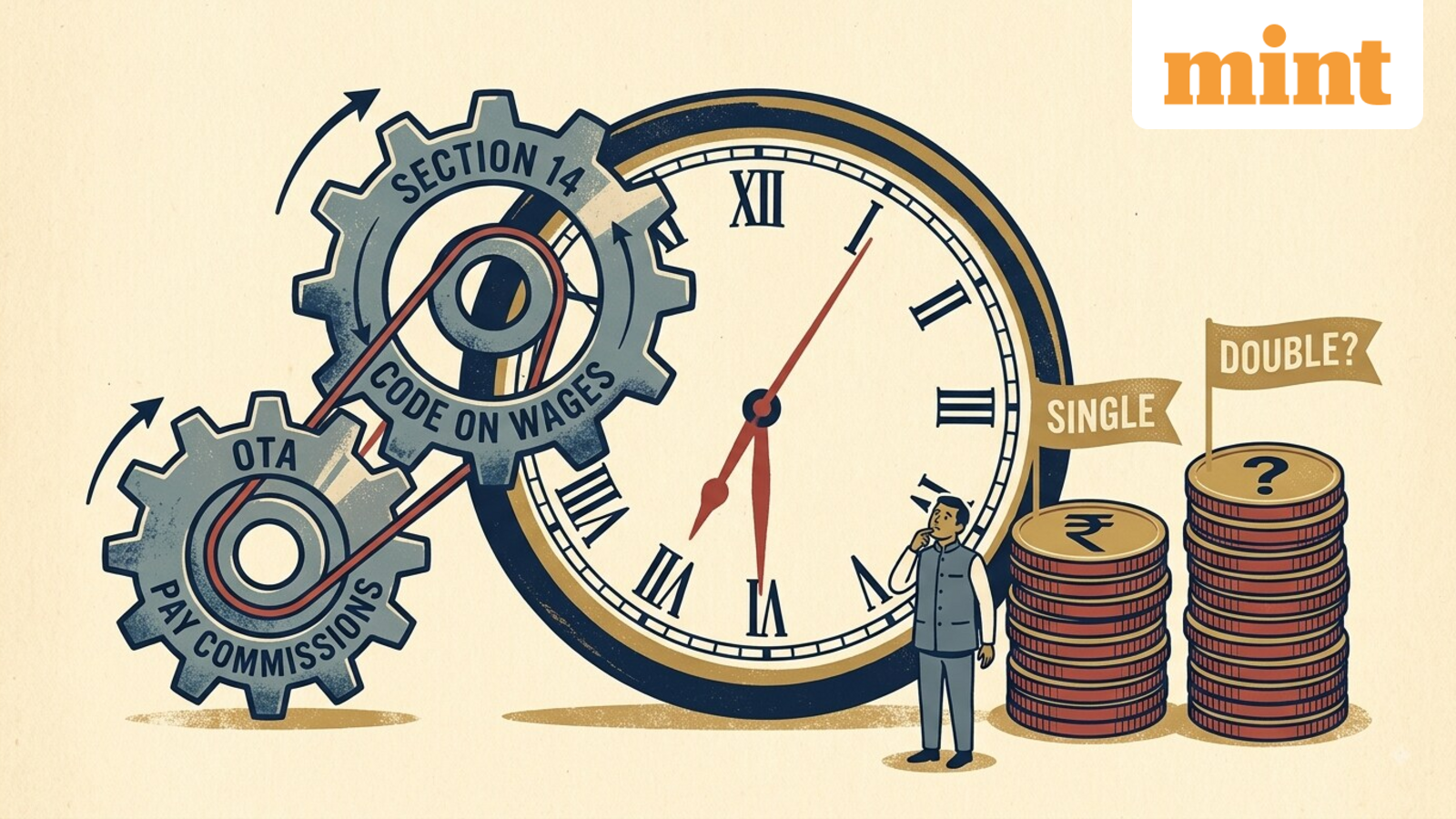
That clarification is important because Section 14 of the Code on Wages provides for overtime at a rate of not less than twice the normal rate of wages when an employee works beyond the hours constituting a normal working day.
What does the Code on Wages say about overtime?
Under Section 14 of the Code on Wages, an employee working beyond the normal working day is entitled to overtime at a rate of at least twice the normal rate of wages, subject to the conditions and coverage of the law.
The Labour Ministry’s compliance handbook also identifies working hours and overtime as part of the provisions covered under Section 14.
This, however, does not mean that every Central government employee who works extra hours gets a new entitlement to double-rate OTA.
The Centre’s response in Parliament indicates that overtime for eligible Central government employees remains linked to the separate rules governing their service. For eligible non-gazetted staff, the applicable OTA continues to be determined by government orders and Pay Commission-related decisions.
The government has also said that the hourly OTA rates applicable to eligible Central government employees were prescribed through an Office Memorandum issued on 19 March 1991. The 1991 order lays down the framework for overtime payments and also provides for compensatory leave in circumstances where overtime work is performed.
Therefore, the wage code’s two-times provision should not be interpreted as an automatic revision of the existing Central government OTA rates.
What does this mean for non-gazetted and gazetted employees?
For eligible non-gazetted employees, the immediate takeaway is that the new wage code has not, by itself, changed their existing OTA entitlement. Employees still have to fall within a category covered by the applicable government rules to claim the allowance.
The question of gazetted employees is different. The Lok Sabha was specifically asked whether OTA should be extended to gazetted Central government employees who are currently outside the benefit.
The government’s response does not announce any such extension. Consequently, gazetted employees cannot currently treat Section 14 of the Code on Wages as a blanket provision creating an OTA entitlement for them.
This distinction matters because the Code on Wages lays down a general overtime standard, while the Centre’s OTA framework determines which Central government employees are actually eligible for the allowance.
The existing government framework also shows that OTA is not simply a payment for every extra hour worked. The 1991 instructions say overtime should generally be avoided through proper work organisation and that, where overtime is unavoidable, it should be authorised by the competent authority.
For Central government employees, therefore, the latest clarification does not mean that overtime payments have suddenly doubled.
The key question remains whether an employee’s category and service rules make them eligible for OTA. Any change in the existing rates or an extension of the benefit to currently excluded categories, including gazetted employees, would require a separate government decision.