Repo rate stays at 5.25%: Why your home loan EMI may still change in 2026 and what historical data shows
On 5 August, the Reserve Bank of India (RBI) kept the repo rate unchanged at 5.25%. The last rate cut came in December 2025, when the central bank reduced the repo rate by 25 basis points to 5.25%.
But does a stable repo rate mean your home loan EMI will remain unchanged in 2026? Not necessarily.
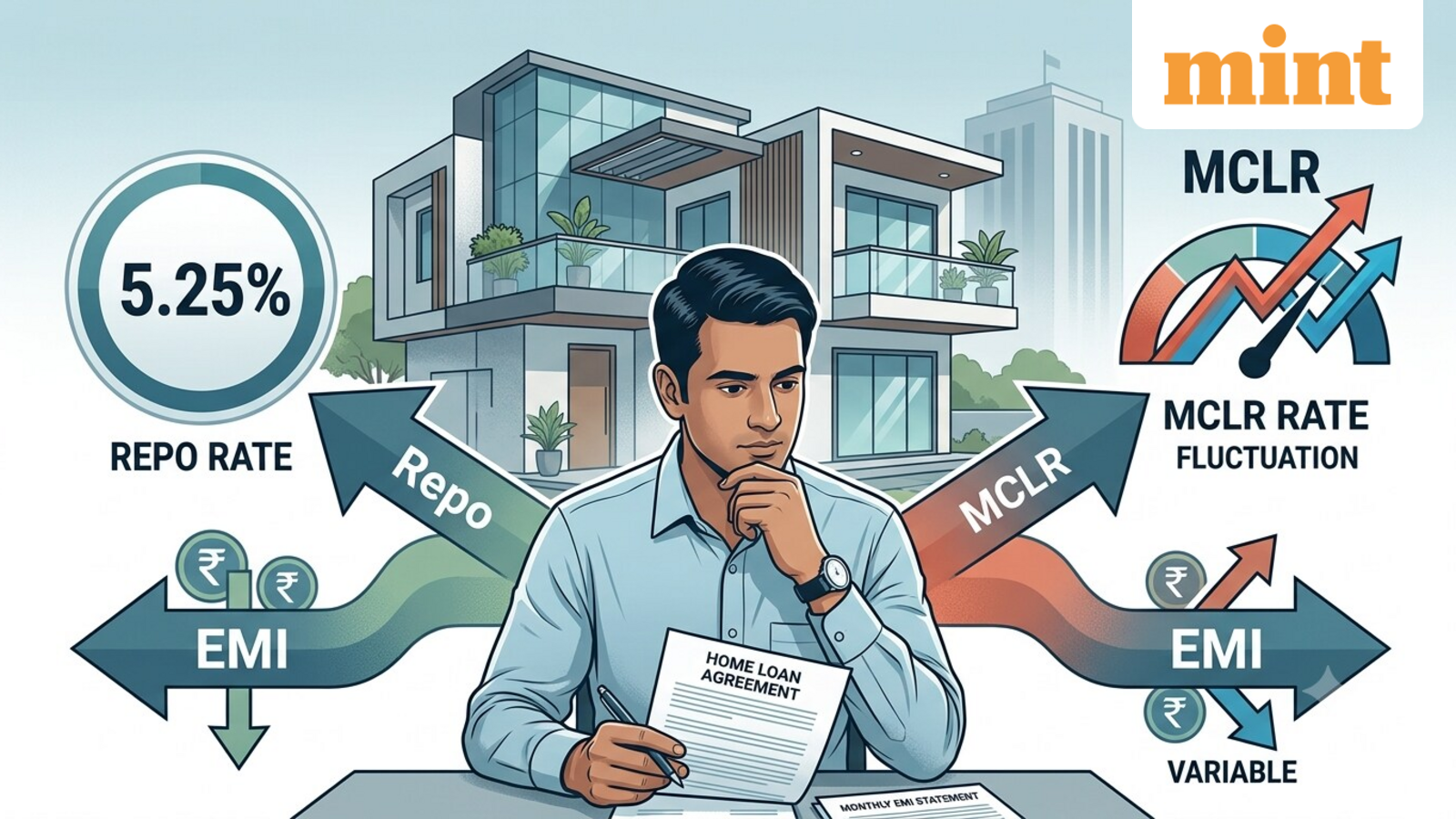
The impact depends on the benchmark linked to your loan. While newer floating-rate home loans are generally linked to an external benchmark such as the repo rate, some existing loans may still be linked to MCLR (Marginal Cost of Funds-based Lending Rate).
What is the difference between repo-linked and MCLR-linked home loans?
A repo-linked loan is tied directly to the RBI’s policy rate. When the repo rate changes, the lending rate can change according to the loan’s reset terms.
However, MCLR is an internal benchmark set by the bank. It reflects factors including the bank’s cost of funds and is reviewed periodically.
Can a repo-linked EMI change even if the policy rate stays at 5.25%?
Yes, depending on the loan’s terms. While the benchmark may remain unchanged, the effective lending rate can change if the applicable spread or margin is revised.
Shiv Garg, Director, Forteasia Realty, explained this using a ₹50 lakh home loan for 20 years:
- Repo rate: 5.25%
- Bank’s margin: 2.50%
- Effective lending rate: 7.75%
- Approximate EMI: ₹41,018
Now suppose the bank increases its margin by 25 basis points:
- New lending rate: 8%
- Approximate EMI: ₹41,822
- Increase in EMI: About ₹804 per month
So, even though the repo rate remains unchanged at 5.25% in 2026, the borrower’s EMI can rise if the applicable margin or spread changes.
How can an MCLR-linked loan EMI change?
Vijay Raundal, Director, Teerth Realties, explained that MCLR-linked borrowers can see changes because the benchmark is determined internally by the bank.
“MCLR is a bank’s own internal benchmark. It’s built from the bank’s cost of funds, and then the bank revises it as it deems fit, usually with a delay somewhere between one and four quarters,” he explained.
Raundal illustrated the impact with a ₹50 lakh home loan:
- Tenure: 20 years
- Old one-year MCLR: 8.70%
- New one-year MCLR: 8.60%
- Change: MCLR falls by 10 basis points
- Impact: EMI could fall by roughly ₹300 a month
This change would happen because the bank revised its MCLR, not because the RBI changed the repo rate.
Hardik Shah, Director, Shyam Group – Dholera SIR, said MCLR borrowers need to watch their bank’s reset cycle. “Their bank reset cycle, usually every 6 to 12 months, can nudge EMIs around even if the RBI is doing nothing. So the RBI pause doesn’t really shield you,” he noted.
What does historical data show?
Garg noted that historical data shows a kind of blunt asymmetry in how MCLR responds to the repo rate.
During the rate-hike cycle, May 2022-November 2024:
- RBI repo rate increased: 250 basis points
- MCLR increased: Around 175 basis points
- Transmission: Around 70%
During the rate-cut cycle, Feb 2025-Dec 2025:
- RBI repo rate cut: 125 basis points
- Repo rate: Fell to 5.25%
- Median one-year MCLR decline: Around 20 basis points by April 2026
- Transmission: Around 16%
This shows that MCLR does not always move in line with the repo rate or by the same magnitude. “Banks tend to shift borrowing prices quicker on the way up, but they don’t mirror it neatly on the way down, because deposit costs stay sticky,” he noted.
“For home-loan borrowers, a rate pause in 2026 does not automatically guarantee a frozen EMI. The benchmark, reset cycle, spread and loan terms all matter,” Garg added.
Shah suggested that MCLR borrowers could shift toward repo-linked loans, because those tend to echo policy moves more quickly. “When interest rates are expected to remain relatively stable, borrowers may benefit from choosing a benchmark that more closely tracks the RBI’s policy rate,” he noted.
Disclaimer: This story is for educational purposes only. The views and recommendations made above are those of individual analysts or broking companies, and not of Mint. We advise investors to check with certified experts before making any investment decisions.
About the Author
Sheetal Goel is a Content Producer at Livemint, where she covers corporate developments, personal finance, business trends, markets, and SEBI-related updates. She focuses on simplifying complex financial concepts and presenting them in a clear, reader-friendly manner, thereby helping audiences better understand investment trends, personal finance, and market developments. Her writing focuses on making finance more accessible to everyday readers while maintaining clarity, accuracy, and relevance.
She holds a degree in Economics (Hons.) along with an MBA in Finance, which has helped her develop a strong foundation in financial analysis, market understanding, and business reporting. Before joining journalism, she worked with finance and broking firms, where she closely followed market developments, investment strategies, and evolving industry trends. This practical exposure strengthened her understanding of financial markets. She has also written content across multiple formats and platforms, including YouTube, LinkedIn, and Instagram.
Over time, she has developed expertise in covering market-linked stories, investor-focused topics, and regulatory updates in a simplified yet informative style. She also enjoys reading and listening to Hindi poetry, reflecting her appreciation for literature and creative expression beyond the world of markets and numbers.