More CMBS Borrowers Are Slamming Into The $65B Maturity Wall
Bond market pressure is forcing the real estate sector to confront current pricing realities, as the rise in 10‑year Treasury yields drives debt costs to levels where most investors can’t afford to wait for a better macroeconomic backdrop.
After years of inaction and stop-gap measures, the rising cost of debt is forcing a reckoning for owners with CMBS debt underwritten before the Federal Reserve’s tightening cycle began in 2022. The number of distressed CMBS loans has begun to tick up again as owners and lenders agree to press ahead on resolutions rather than extensions.
“There’s an inflection point on those deals,” said Michael Kaplan, who manages the San Francisco office at Slatt Capital. Owners that are refinancing properties with already tight operating income today typically have two options to compensate for the run-up in interest rates.
:no_upscale():quality(75))
Photo credit: Bisnow/created with Google Gemini
“Their answer, short of coming in with more equity and right-sizing the loans, is to consider giving it back,” Kaplan said.
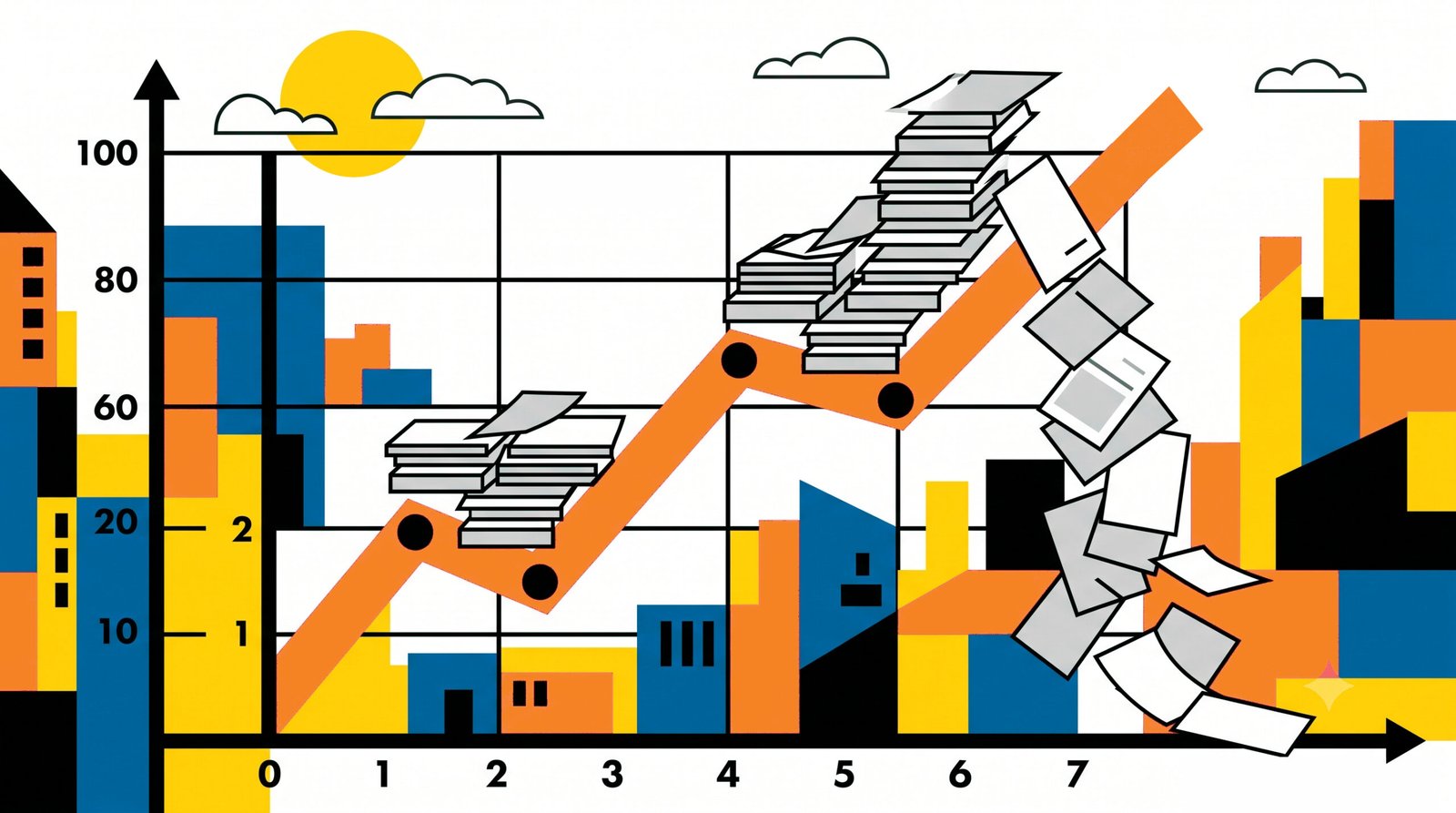
Roughly $65B in CMBS loans are set to mature by the end of the year, including $37B worth of hard maturities that have no remaining extension options. Trepp is tracking 130 loan maturities totaling $5.5B in August alone, including five nonperforming assets, all of which are office buildings.
Just over half the properties with CMBS debt maturing by the end of the year would need some level of new borrower equity to successfully refinance at today’s rate, Trepp found in a July analysis. The deepest gaps can be found in interest-only loans, especially on office assets.
The uptick in debt headed to special servicing could be a signal that lenders are looking to resolve the loans, which in some cases have been on their books for more than a decade and exercised multiple extension options. Many of those owners have been pushing back their maturity dates in the hope of a better rate environment but are now facing a hard maturity.
Lenders might also be more open to forcing an exit this year, with CRE prices in July up 5.2% over the past 12 months, according to Green Street.
“If the market is showing signs of looking better, the servicer will have noticed that, too,” said Darrell Wheeler, head of CMBS research at Moody’s. “They may be more inclined to take legal actions and foreclose, which puts even more impetus on the borrower to make sure they support their property.”
CMBS distress climbed 51 basis points from June to July to hit 7.86%, snapping what had been a flat trend for the last year, according to Trepp data.
The number of seriously delinquent loans, debt that’s 60 days past due, in foreclosure or otherwise underwater, climbed 41 basis points to 7.6%. Foreclosed assets make up the largest portion of delinquent loans, 3% of all CMBS debt, ahead of nonperforming matured debt that has a balloon payment due, at 2.5%, and matured debt that has a balloon payment but is performing, at 1.8%.
Capital is widely available for the right kinds of assets, but owners can no longer rely on the prospect of future interest rate relief to size loans, leaving lenders to focus on cash flow, as in two major New York City deals in the last six months.
New York’s Soloviev family engineered a CMBS deal in May that allowed Soloviev Group to walk away with $526M in cash as part of a $1.8B refinancing of the office tower at 9 W. 57th St. in Manhattan. A few months earlier, SL Green lined up $1.7B in CMBS debt to refinance One Madison Ave. in a deal that included a $308M cash-out.
By contrast, owners of older assets, even a few blocks away, have had to get out their checkbooks. Rithm Capital Corp. last month put in $73M of equity alongside a $415M CMBS loan and an $85M mezzanine loan to refinance a maturing $500M loan at 31 W. 52nd St.
“You can value the building from the cash flows, or you can value the building by cap rate compression at exit — that latter option has gone away” because of the expectation of an elevated rate environment, said Andy Boettcher, the head of research at Trepp.
Volatile bond markets have pressured deal flow, as upward swings in yields directly drag on the dollars originated by the loan. The asset and its performance don’t change over the course of a week, but the 10-year Treasury has been drifting, pushing up interest rates and pulling down the amount of debt an asset can support.
“If Treasuries move up 5 basis points, 10 basis points, in a matter of one or two days while you’re trying to close your transaction, it can have a serious impact on your gross dollars lent,” Kaplan said.
Treasuries have been grinding upward in part because the U.S. war with Iran continues to pressure energy markets and amplify inflation but also because of broader concern about the country’s fiscal health amid tax cuts and deficit spending.
But devaluations go beyond the delta between debt service costs on old and new debt. For office and multifamily operators, the shift in market dynamics since the end of the pandemic has also eaten away at valuations. There are buyers in the market for those properties, but an owner that’s unwilling to take a loss is likely to instead need to come up with cash to make their next loan feasible.
“Is the old owner willing to acknowledge a change in price that has occurred since 2022? If they’re willing to do that, then yes, there’s new equity that’s willing to take out the old situation,” Boettcher said.
A handful of high-profile deals have resulted in significant equity losses for investors. Money managers lost more than half their $240M investment in a CMBS deal backed by a 20-story office building in San Francisco’s financial district after a sale of the asset left just $101M to distribute. Bondholders of a 53-building portfolio of New York City apartments have also grown increasingly worried that losses will stack up amid a rent freeze.
Despite headwinds in some segments, leasing volume and investment sales are both up from the prior year across nearly every commercial real estate sector, and the management of the largest brokerages continued to say momentum was building on recent earnings calls.
“There’s a lot of pent-up demand on the sidelines, and there’s a lot of capital,” JLL Chief Financial Officer Kelly Howe said on her company’s second-quarter earnings call on July 30. “The debt markets are very liquid at the moment, and so we don’t have huge concerns about the interest rate environment going through the rest of the year.”
But a looming maturity can quickly turn a performing asset into a distressed one if revenues don’t support the increased debt service burden of a higher interest rate loan.
August maturities are split roughly a third each between office and multifamily debt. All five of the delinquent CMBS loans set to mature this month are office properties with a combined $1.8B in debt, according to Trepp, and the overall distress rate for office properties is 11.91%, more than 4 percentage points higher than the overall average.
Office owners with a looming maturity are at a crossroads. The appetite from lenders to continue extending loans has waned, and waiting for a better rate environment is no longer an option for owners, Kaplan said.
“I still think there’s some carnage to be had in office and a reset of the basis,” he said. “But you are seeing people that know that product are looking for good opportunities and buying buildings at price points that they haven’t seen in 20 years.”