Quant Mid Cap Fund beats benchmark in short term after years of lag: Expert explains what investors should do
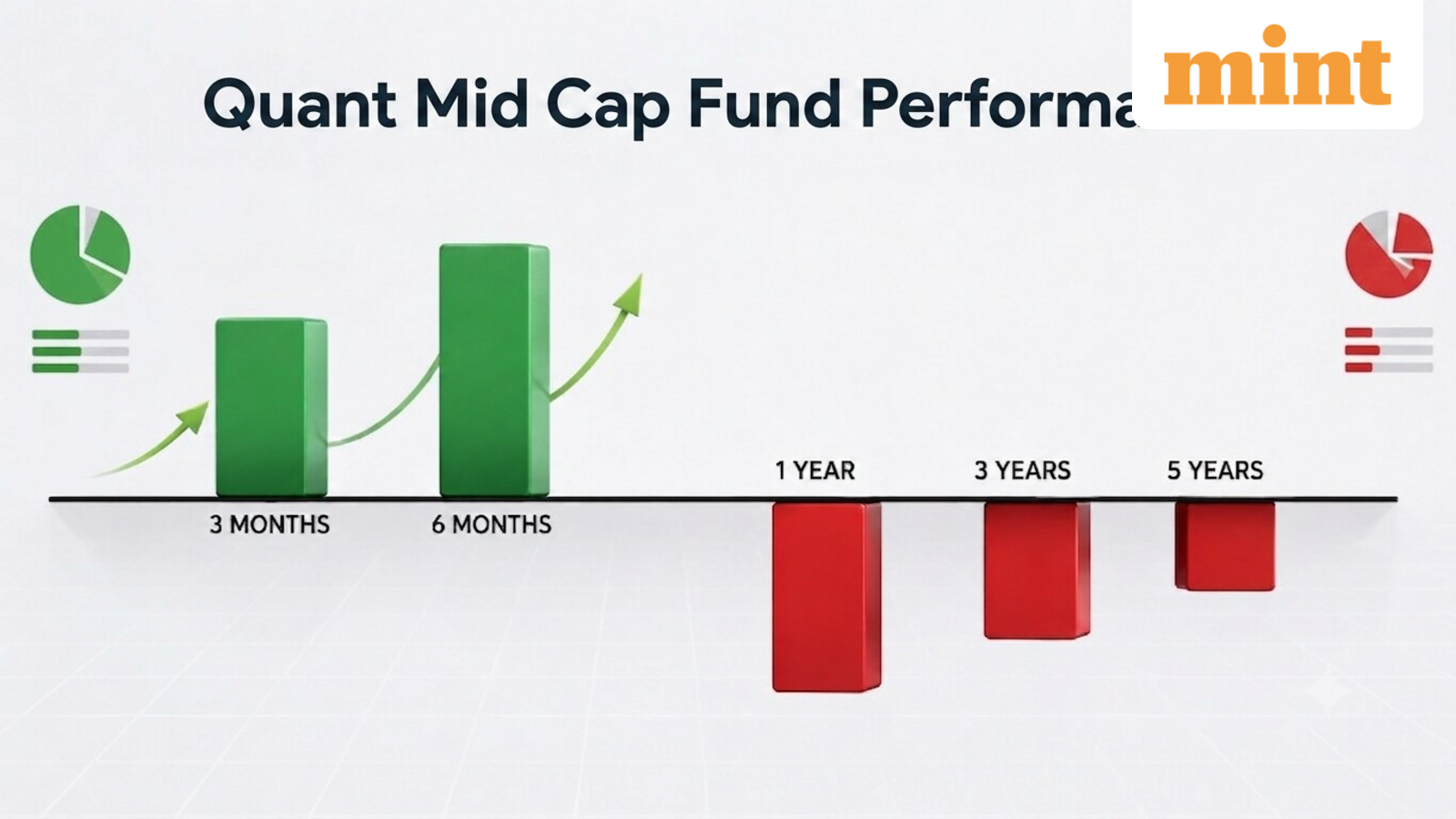
Quant Mid Cap Fund has staged a notable short-term comeback, outperforming its benchmark index over the last 3 and 6 months, according to the July 2026 factsheet. However, the fund has underperformed the benchmark over the last 1, 3 and 5 years.
Here’s what an expert has to say about this turnaround and how investors can distinguish a genuine recovery from a temporary rebound.
Quant Mid Cap Fund: A mixed performance across time horizons
| Returns | 3 Months | 6 Months | 1 Year | 3 Years | 5 Years |
| Quant Mid Cap Fund | 18.18% | 7.07% | 1.26% | 16.95% | 17.93% |
| Benchmark Returns | 17.36% | 3.53% | 4.22% | 20.05% | 18.29% |
| Performance | Outperformed | Outperformed | Underperformed | Underperformed | Underperformed |
*CAGR Returns as on 30 June, 2026, Direct Plans, Source: Quant Mutual Fund Factsheet
Just like its performance against the benchmark, the Quant Mid Cap Fund has outperformed the category average in the last few months but lagged over the longer term.
| Returns | 3 Months | 6 Months | 1 Year | 3 Years | 5 Years |
| Quant Mid Cap Fund | 14.70% | 7.15% | 0.13% | 15.98% | 17.09% |
| Category Average Returns | 14.69% | 3.07% | 6.06% | 20.10% | 17.45% |
| Performance | Outperformed | Outperformed | Underperformed | Underperformed | Underperformed |
*CAGR Returns as on 7 July, 2026, Direct Plans, Source: Value Research
“Quant Mid Cap Fund’s relatively weaker performance over the last 1, 3 and 5 years appears to be largely driven by stock selection and portfolio positioning,” said Bharath Rathore, Executive Director, Anand Rathi Wealth.
He noted that Quant AMC is known for a high-conviction and high portfolio turnover approach, frequently reshaping the portfolio based on its investment framework.
“Such a strategy can underperform when market trends do not favour the fund’s positioning, but it also has the potential to generate strong alpha when those positions begin to play out,” he said.
According to him, the fund has reduced exposure to Reliance Industries over the past year while increasing conviction in stocks such as Tata Communications and Aurobindo Pharma. Healthcare, basic materials and technology have also emerged as key contributors to 6-month performance.
He added that a fund manager change in February 2025 may also have contributed to the transition phase.
Don’t enter or exit a fund based only on recent performance
Rathore said investors should consider reducing exposure only if mid caps have become an outsized portion of the portfolio, such as 70% to 80% of the equity allocation.
He added that investors can exit a fund only if underperformance persists across multiple market cycles, there is a change in the fund manager or investment philosophy, or peers consistently deliver better risk-adjusted returns.
“Investors should avoid making entry or exit decisions based on recent returns, as this often leads to buying high and selling low,” he noted.
Key signs of a genuine turnaround in a mid-cap fund
“Recent performance alone should never be the basis for judging whether a mid-cap fund has genuinely recovered,” Rathore said.
He advised investors to look beyond short-term returns and focus on consistency in rolling returns, sustained alpha generation over the benchmark, improvements in portfolio quality, and stronger risk-adjusted performance through metrics such as the Sharpe ratio and Jensen’s Alpha.
Disclaimer: This story is for educational purposes only. The views and recommendations made above are those of individual analysts or broking companies, and not of Mint. We advise investors to check with certified experts before making any investment decisions.
About the Author
Sheetal Goel is a Content Producer at Livemint, where she covers corporate developments, personal finance, business trends, markets, and SEBI-related updates. She focuses on simplifying complex financial concepts and presenting them in a clear, reader-friendly manner, thereby helping audiences better understand investment trends, personal finance, and market developments. Her writing focuses on making finance more accessible to everyday readers while maintaining clarity, accuracy, and relevance.
She holds a degree in Economics (Hons.) along with an MBA in Finance, which has helped her develop a strong foundation in financial analysis, market understanding, and business reporting. Before joining journalism, she worked with finance and broking firms, where she closely followed market developments, investment strategies, and evolving industry trends. This practical exposure strengthened her understanding of financial markets. She has also written content across multiple formats and platforms, including YouTube, LinkedIn, and Instagram.
Over time, she has developed expertise in covering market-linked stories, investor-focused topics, and regulatory updates in a simplified yet informative style. She also enjoys reading and listening to Hindi poetry, reflecting her appreciation for literature and creative expression beyond the world of markets and numbers.