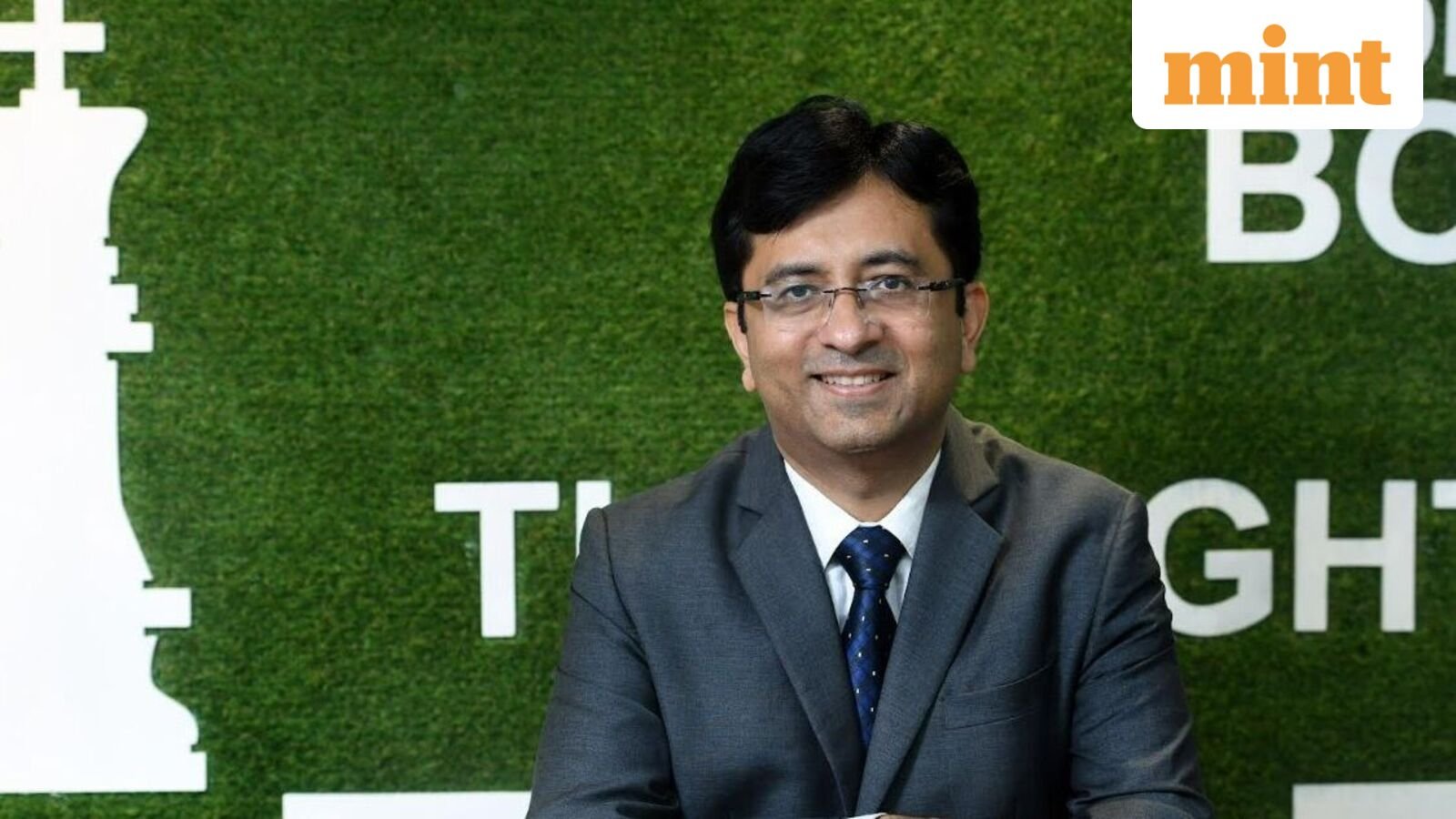
Equity markets have remained range-bound for over 2 years: What PPFAS’ Rajeev Thakkar wants investors to know
Equity markets have remained largely range-bound for around two years, testing investor patience and prompting questions around fund performance, valuations and the outlook for different parts of the market.
In a note to unitholders, Rajeev Thakkar, CIO and director at PPFAS Mutual Fund, addressed some of the concerns surrounding equity markets and the performance of its schemes. He discussed the current market phase, cash levels in the Parag Parikh Flexi Cap Fund, artificial intelligence, private-sector banks, small- and mid-caps and popular investment themes.
Equity markets and PPFAS fund performance
Thakkar said the current period of sideways equity markets is neither unusual in duration nor in the magnitude of the decline from previous peaks. He pointed out that equity markets can remain range-bound or fall, and that the possibility of higher returns than fixed deposits comes with volatility.
He also said PPFAS had been cautious during the exuberance seen in 2024, including by allowing cash levels to rise. After two years of time correction in the broader market and price correction in some segments, Thakkar said the opportunities available to investors are increasing and the outlook for future returns is improving.
On relative performance, he said there would be periods of three months, one year or longer when stocks held by the schemes could either remain subdued or decline. He added that PPFAS often buys stocks and sectors that are out of favour with the market, which can make relative returns look unattractive during such periods.
Cash levels have fallen as opportunities increase
Cash levels in the Parag Parikh Flexi Cap Fund had peaked at about 25%, according to Thakkar, and had fallen to around 14-15%. He said the fund was increasingly finding opportunities to buy and could eventually move to single-digit cash levels.
Thakkar also said that holding cash over the previous two years had not harmed investor returns and had, at the margin, helped during the sideways market.
AI, IT services and the changing technology landscape
Thakkar said PPFAS views the current sell-off in IT services as an opportunity rather than an existential threat. He pointed to previous periods when developments such as Y2K, cloud computing and software-as-a-service were seen as potentially reducing the need for outsourced IT services.
His current assumption is that while AI can write a significant portion of code, the need for implementation does not disappear. He said the outsourced activity could instead involve teams working with AI. He also noted that AI could eliminate some work while creating work in other areas, including cybersecurity.
On AI models, Thakkar noted that the field now includes several competing models and said factors such as sovereignty, access, costs per token and task, speed and data privacy could matter alongside the quality of the model. He said PPFAS has no direct exposure to pure-play AI model companies such as OpenAI or Anthropic.
He also discussed hyperscalers, saying companies such as Microsoft, Amazon and Google have traditional businesses alongside their AI-related operations. While he acknowledged the possibility of over-investment in AI-related capital expenditure, he said any excess capacity would not be permanent and could eventually be absorbed as workloads increase.
PPFAS retains its private-sector bank basket
Thakkar said PPFAS owns a basket of private-sector banks and that the fund’s overall outlook for its four private-sector bank holdings had not changed.
He specifically discussed HDFC Bank, saying the issues reported so far, while undesirable, did not appear to be materially threatening to the bank’s franchise or customer base. He pointed to factors including RBI oversight, diversified ownership and governance mechanisms.
Small-caps, market coupling and popular themes
Thakkar said PPFAS does invest in small- and mid-cap companies but makes investment decisions based on opportunities and risk-reward rather than market-cap labels. He cited 4 August data showing the Nifty 100 at a P/E ratio of 20.8, compared with 30.7 for the Nifty Midcap 150 and 34.6 for the Nifty Smallcap 250.
He also addressed concerns around Indian Energy Exchange and market coupling, noting that IEX is a sub-1% position in the portfolio. He said there was no certainty over how long market coupling would take, what form it would take or which market segments would be affected. PPFAS would revisit its investment thesis as developments and additional data emerged.
On broader market themes, Thakkar said the fund was aware of areas such as defence, energy transition, AI and fintech, but would invest where it found attractive and actionable ideas rather than simply because a theme was fashionable.
Thakkar concluded that investors whose equity investments form part of a well-thought-out asset allocation appropriate to their needs need not worry about the current market phase.