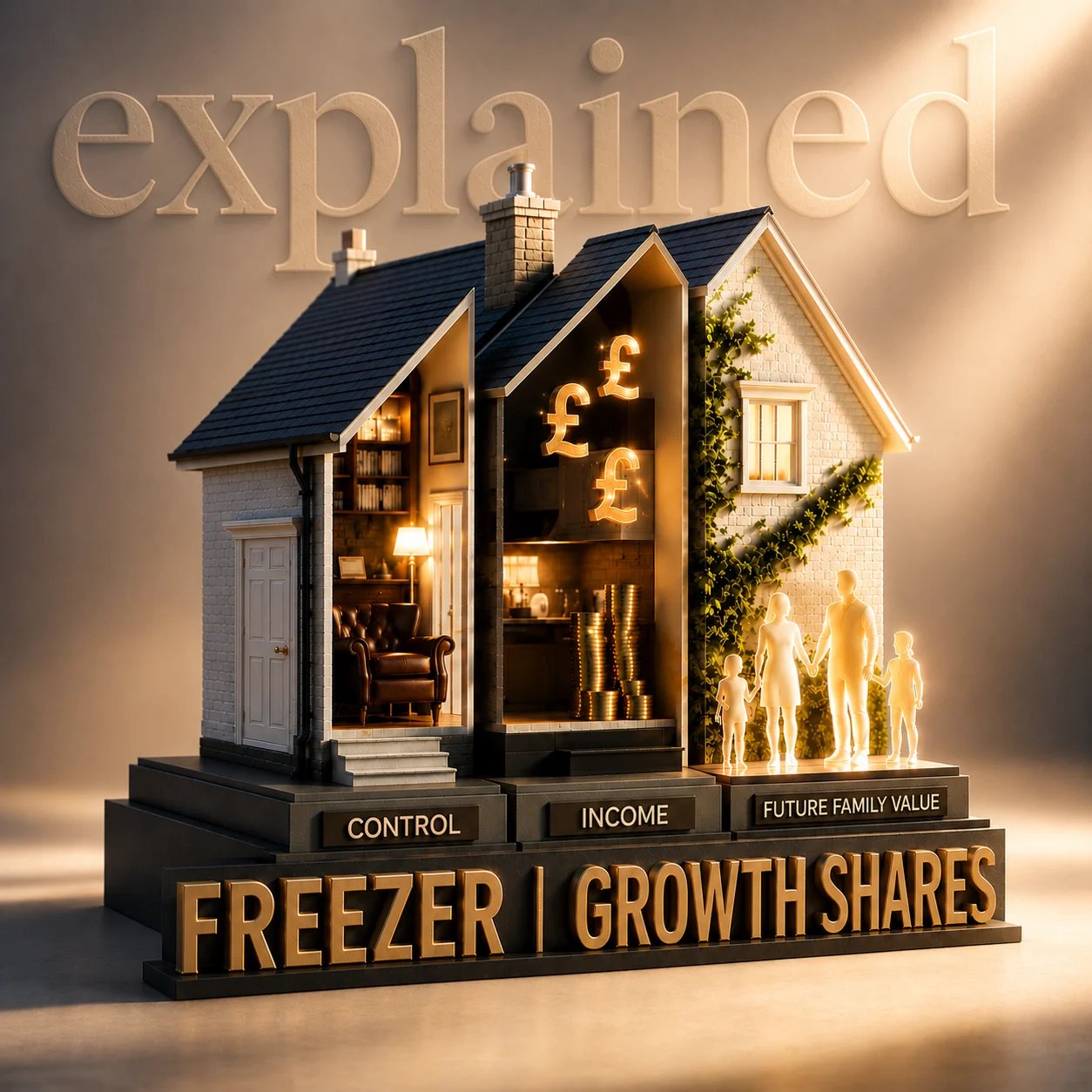
Freezer and growth shares explained: separating control, income and future family value

Incorporating a property business can resolve several immediate commercial challenges, including liability management, refinancing flexibility, business continuity and the practicalities of bringing the next generation into a family enterprise. Incorporation does not, by itself, solve the longer-term succession problem, because a conventional company with a single class of ordinary shares places control, dividend income, existing capital value and all future growth into the same shares.
That can leave founders with an uncomfortable choice. They can retain all the ordinary shares and continue to control the business, but the entire future value of the company remains tied to their personal ownership. Alternatively, they can give ordinary shares to their children, but doing so may transfer control and existing wealth earlier than intended, while exposing those shares to the children’s divorces, financial difficulties or differing personal priorities.
A carefully designed freezer and growth share structure offers a third route. It separates the rights that would ordinarily be bundled together, allowing the founders to retain control, income and the value they have already created, while establishing a controlled framework through which a separate class of shares may participate in defined future capital value.
The existing value does not disappear
The starting point is a valuation of the company and the rights attaching to its shares when the structure is established. In a typical structure, the founders hold A and B shares carrying full voting rights, discretionary dividend rights and the first entitlement to the company’s capital on a winding-up, up to an amount recorded in the company’s articles.
These are commonly described as the freezer shares because the capital entitlement attached to them is fixed by reference to the company’s value at the outset. The description does not mean that the shares are frozen in every respect, or that their existing value has somehow disappeared. The founders continue to own that value, retain control of the company and may continue to receive dividends from its profits.
Where the structure is created alongside the incorporation of an established property business, the A and B shares may also carry the share premium arising from the value of the business transferred to the company. The value accumulated by the founders before the restructuring therefore remains represented by their shares rather than being transferred to the next generation.
The Companies Act recognises that different classes of shares may carry different voting, dividend and capital rights. Terms such as freezer share, dividend share and growth share are merely convenient descriptions. The legal position always depends upon the precise rights written into the company’s articles.
The role of the additional dividend classes
Property118 structures have also commonly included a series of additional share classes, usually identified as C through to P. These shares do not carry voting control and have only nominal capital rights, but the directors may be given discretion to declare dividends on selected classes.
This creates flexibility for the future without requiring the founders to make irreversible decisions at the outset. Subject to the company having distributable profits and the directors complying with their legal duties, different family members may later hold different dividend classes. The company can then recognise their contribution, provide income or support a gradual transition into the family business without transferring voting control or an entitlement to the capital value already built up by the founders.
These dividend classes should not be confused with the growth shares. Their purpose is primarily to create flexibility over income, whereas the growth shares have a much narrower and entirely separate capital entitlement.
What the growth shares actually own
The Q growth shares used within the Property118 structure carry no voting rights, no dividend rights and no entitlement to the capital value already allocated to the A and B shares. They do not give their holders a proportionate interest in the existing property portfolio, the company’s current reserves or the founders’ share premium.
Their rights are limited to participating in residual capital above the amount reserved to the A and B shareholders, and that entitlement crystallises under the articles on a sale or winding-up of the company. The Q shareholders cannot compel the directors to declare a dividend, require the company to sell a property, demand that their shares are redeemed or force the company to be wound up.
This is an important distinction because the expression “growth share” can otherwise create the impression that the holder automatically owns every increase in property prices, rental income or company profits from the date of issue. That is not how these shares operate. Their rights concern the residual capital that remains above the founders’ protected amount when the circumstances specified in the articles occur.
Operating profits remain available for distribution on the A and B shares, or on the additional dividend classes where appropriate. The Q shares are therefore not a substitute for ordinary shares and do not participate in the normal income produced by the property business.
A simplified example
Suppose a family property company has a net value of £3 million when the structure is established. The articles provide that the A and B shareholders are entitled to the first £3 million of capital on a winding-up, reflecting the value already created by the founders. The Q shares have no entitlement to that £3 million.
If the company is eventually wound up and has net distributable capital of £4.2 million after settling its liabilities, taxes and winding-up costs, the first £3 million would be allocated to the A and B shareholders. The remaining £1.2 million would be allocated in accordance with the rights attached to the Q shares.
If the net distributable capital were only £2.7 million, the Q shares would receive nothing because the amount available would not have exceeded the founders’ £3 million capital entitlement. During the company’s trading life, the A and B shareholders would have retained voting control and continued to determine the company’s strategy, financing, property transactions and dividend policy.
The example is deliberately simplified, but it demonstrates why the growth shares cannot sensibly be treated as though they own part of the existing £3 million company. They hold a conditional right relating to a future surplus which may or may not arise and which they cannot compel the company to realise.
Why a discretionary bloodline trust is used
In the structure commonly recommended by Property118, the beneficial interest in the Q growth shares is held for a discretionary bloodline trust rather than being transferred directly to individual children. The founders may remain recorded as the legal shareholders and hold the shares as bare trustees, while the beneficial ownership belongs to the discretionary trust.
The distinction matters. The person whose name appears in the company’s register may hold legal title without owning the underlying economic benefit personally. The declaration of trust and associated documents record who holds the beneficial interest and the capacity in which the registered shareholder acts.
Using a discretionary trust means that no child has an immediate and absolute personal entitlement to the shares or to any eventual proceeds. Instead, the trustees can take account of family circumstances as they develop, including the age and maturity of beneficiaries, divorce, bankruptcy, disability, financial vulnerability and whether a beneficiary is actively involved in the family business.
This can be particularly valuable where the founders want the next generation to benefit from the success of the property business without giving any individual child the power to interfere with its management, sell shares to an outsider or demand that company assets are converted into cash. It also avoids trying to predict decades in advance which family members will be best placed to own, manage or benefit from the business.
The trust does not own the properties directly. The company remains the owner of its properties, subject to its mortgages and other liabilities. The trust owns the beneficial interest in a particular class of shares whose rights are governed by the company’s articles.
Valuation must follow the rights, not the label
The subscription price of a share and its market value are related questions, but they are not necessarily identical. A nominal subscription price does not, by itself, establish the market value of a growth share, just as the word “growth” does not determine what a hypothetical purchaser would pay for it.
For inheritance tax purposes, legislation generally measures value by reference to the price that property might reasonably be expected to fetch in an open-market sale. Where the beneficial interest in growth shares is placed into trust, the analysis must therefore consider the value of the actual rights transferred on the relevant date.
That exercise should reflect all the relevant characteristics of the Q shares, including their lack of voting and dividend rights, their exclusion from the company’s existing capital, the capital hurdle protecting the A and B shareholders, the inability to force a sale or winding-up, any restrictions on transfer, the absence of a ready market, the company’s borrowing, the risks within the property business and the uncertainty surrounding both future growth and the eventual realisation of capital.
It would be equally inappropriate to assume that a Q share has a particular value merely because it is called a growth share, or to value it as though it carried rights which the articles expressly withhold. The appropriate conclusion is case-specific and should be supported by a properly documented analysis of the company, its prospects and the legal rights attached to each class.
The trust has its own continuing legal, administrative and tax obligations, including periodic reviews and reporting where required. These responsibilities should form part of the planning from the outset rather than being treated as an afterthought.
Documentation and conduct must tell the same story
A freezer and growth share structure cannot be created merely by changing a few labels on a company’s share certificates. It requires bespoke articles of association, appropriate shareholder resolutions, an accurately maintained register of members, trust documentation, declarations recording legal and beneficial ownership, and a clear record of the value and commercial objectives at the time of implementation.
The shareholders’ agreement should support the intended governance arrangements, while the articles must describe precisely how dividends, voting rights and capital proceeds are allocated. The company’s subsequent conduct should also remain consistent with those documents.
The House of Lords explained in MacNiven v Westmoreland Investments Ltd that the proper approach is to identify the legal nature of the transactions and then apply the relevant legislation to them. That is why clear drafting and faithful implementation matter more than informal descriptions or marketing terminology.
The founders’ commercial reasons should also be recorded. These may include retaining central control of a substantial property portfolio, protecting the business from fragmentation, establishing an orderly succession plan, providing for younger or vulnerable family members, preserving refinancing flexibility and preventing family shares from passing outside the bloodline through divorce, insolvency or death.
Positive tax outcomes may follow from a properly implemented structure, but the structure should begin with the family’s commercial objectives and the rights they genuinely intend to create.
Who might consider this structure?
A freezer and growth share structure is most relevant to founders who intend to retain and develop a company over the longer term, who want to remain in control during their lifetimes and who have a genuine desire to establish a family succession framework before future decisions are forced upon them by ill health, incapacity or death.
It may be less appropriate where the company is likely to be sold or wound up in the near future, where the founders expect to require all the company’s capital personally, or where there is no settled intention to preserve the business for future generations. The structure must therefore be considered as part of a wider strategic review rather than treated as a standard addition to every property company.
Separating four very different rights
The purpose of the structure is easier to understand when the four principal shareholder rights are considered separately. Those rights are control of the company, access to its income, ownership of the value already created and participation in future capital value.
A conventional ordinary share combines all four. A properly drafted freezer and growth share structure separates them.
The founders retain control, dividend flexibility and the existing capital value represented by the A and B shares. Additional non-voting classes provide controlled flexibility over future family income. The Q shares carry a narrowly defined and conditional entitlement to residual capital above the founders’ protected amount, with the beneficial interest held through a discretionary trust for long-term family succession purposes.
This is not about pretending that the founders’ existing wealth has ceased to exist. It is about deciding, while the founders remain firmly in control, how the ownership and governance of a family property business should develop over the decades ahead.