‘I Learned to Build a Tiny House—the Biggest Obstacles Surprised Me’
Tiny homes have long been viewed as an affordable alternative to traditional abodes—as well as a more flexible means of living. Having first risen to prominence as DIY off-grid cabins, the diminutive dwellings have since evolved into a much more mainstream form of accommodation, so much so that they are now even available for order on Amazon.
But for those who have always dreamed of building their own property, tiny houses also represent something of a foundational learning experience, one that can help them to navigate the complicated waters of homebuilding, building up key skills that they can later funnel into a larger property.
Brooke Morton is one such person. Having long harbored a desire to tackle her own home build, she made the decision to start with learning how to construct a tiny house—from the framing to the zoning and everything in between.
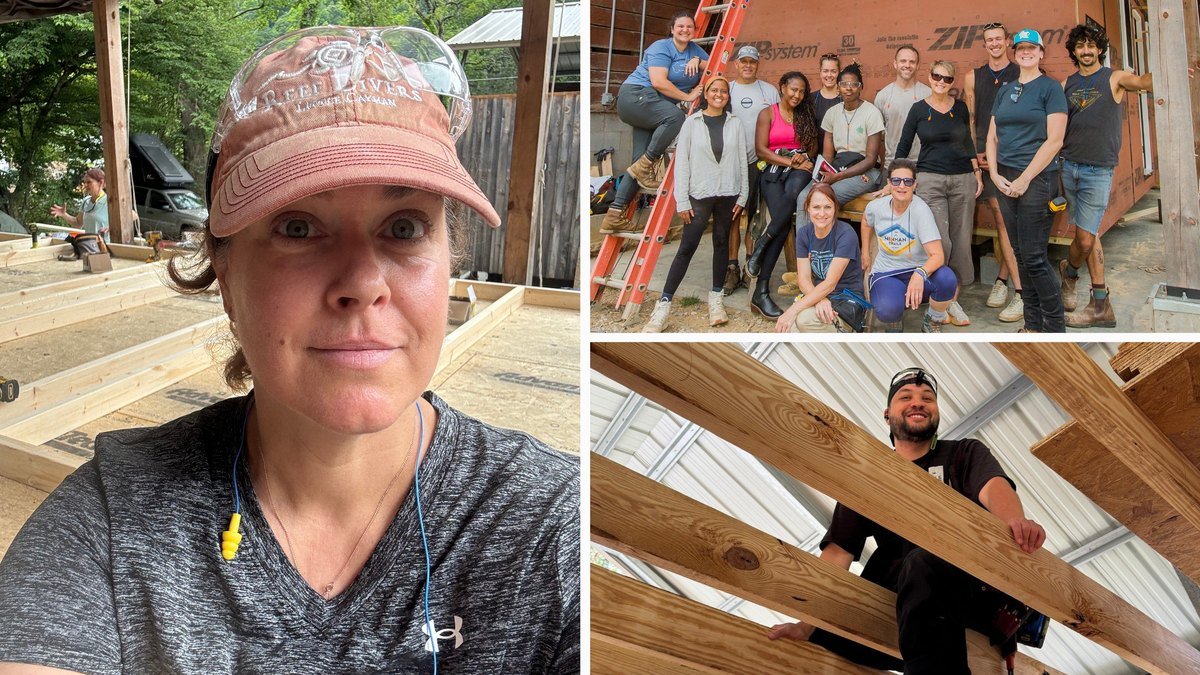
While some enterprising tiny house owners have relied solely on how-to videos on YouTube or adopted a “learn along the way” method, Morton wanted to take in-person instruction from some of the best in the business—which she found at a tiny house workshop run by North Carolina-based company Wild Abundance.
The “intensive” 10-day in-person adventure promises to give participants “the skills they need to build their own tiny house, from local, natural, or conventional materials,” while also introducing them to techniques for installing plumbing, electrical, and even trim work.
What Morton learned very quickly through the course is that tiny homes, while small, still come complete with their fair share of big hurdles that need to be climbed before construction can even get under way. And, while the structure itself might not be so hard to complete, there are a myriad of complications standing between a DIYer and their finished home.
As someone obsessed with the idea of one day building my own home, I knew I needed help. I have built a bookcase out of wood, and even that project, simple as it was, required me to phone a friend (I had no idea at the time that Home Depot lumber is all rough cut and almost never to the exact measurements listed).
Enter Wild Abundance. This woman-owned organization specializes in hands-on classes where students learn real-life skills, from gardening and permaculture to carpentry and timber-framing.
Their 10-day in-person tiny house workshop promises to take anyone from absolute beginner to someone confident enough to tackle a build project. I took this class in June, 2026, and this is what I learned.
Framing a house is not hard.
If you can hang a picture, you can frame a wall. Framing a house requires the repetition of several simple skills: using a circular or chop/miter saw, using a level to make sure 2 x 4s and subfloor are flush or level when installed, hammering in nails, and using an impact driver to secure pieces in place with screws.
If you feel confident in each of these skills, you can frame a shed, tiny house or even a conventionally sized home.
Hammering is complicated.
Hammering in a nail sounds easy, right? Hold hammer, swing. First off, we learned that there are various kinds of hammers. For framing, you want a heavier framing hammer, which provides more oomph.
Second, in the ideal hammer swing, you keep your arm straight, and rely on your whole arm as a lever. It’s more important to keep a rhythm than it is to strike every nail dead on. Keep a loose wrist. Correct form requires mastering technique, much like one does a golf swing. Granted, if you rely on a framing nailgun, you can largely skip old-school hammering–but it’s still a good skill to have in your toolbelt.
You learn economy of space.
You can’t live tiny unless you learn to maximize space. When you consider that a couple or even a family of four can live in 200 to 400 square feet, it helps you see that you can do more with less square footage. Whether you’re living tiny or in a smaller traditional home, you’re probably not making the most of your space.
Tiny homes rely on lofted beds. Most furniture pulls double duty, ie benches and ottomans double as storage. Every inch of space is considered.
Even the kitchen toe-kick spaces can be built to offer slide-out storage. When you invest the time to consider what you really need–do you need a traditional cooktop with four burners or will two do?–it greatly changes your perception of how much space you truly need.
Tiny living is usually part of a bigger dream.
Sometimes people choose tiny out of economic necessity. Sometimes the goal is to reduce housing costs to free up funds for travel or to allow one partner to stay at home. What seems most common, however, is that living tiny encourages time outdoors.
Pair the small indoor living space with a huge outdoor living space and kitchen, and you’ve got an ideal set-up that allows for a life in greater harmony with nature.
Finding land with the right zoning is tricky.
The hardest part of building a tiny house is finding a place to put it. County zoning, city or HOA restrictions often prohibit tiny homes on most land parcels. It’s typical for most parcels to include minimum build requirements of at least 1,000 to 1,500 square feet to maintain the value of the surrounding properties.
Another consideration is that a tiny home is subjected to different regulations depending on whether it is a Tiny House on Wheels (THOW) or if it becomes a permanent structure. Either way, it’s best to search for unrestricted land.
Five states with a relative abundance of lower-cost unrestricted land are Texas, Arkansas, New Mexico, Missouri and West Virginia.
The only way to learn is by doing.
A YouTube video can teach you almost anything, but a video can’t show you what you’re doing wrong. YouTube shows you the best possible scenario–they can’t help you troubleshoot what goes wrong with your build. Mistakes can and will happen.
We misread our plans at one point and had to “flip” one wall we had already attached to the frame. It had already been toe-nailed in, so the easier option was to swap out a few supports rather than rip out a whole wall.
There is no match for in-person learning. My biggest takeaway from this course was the confidence boost gained through 10 days of repetitive practice of these skills. I started the workshop afraid to use a circular saw, and by the end, I found I can’t wait to find another reason to pick it up and start cutting.
Get real estate news in your inbox