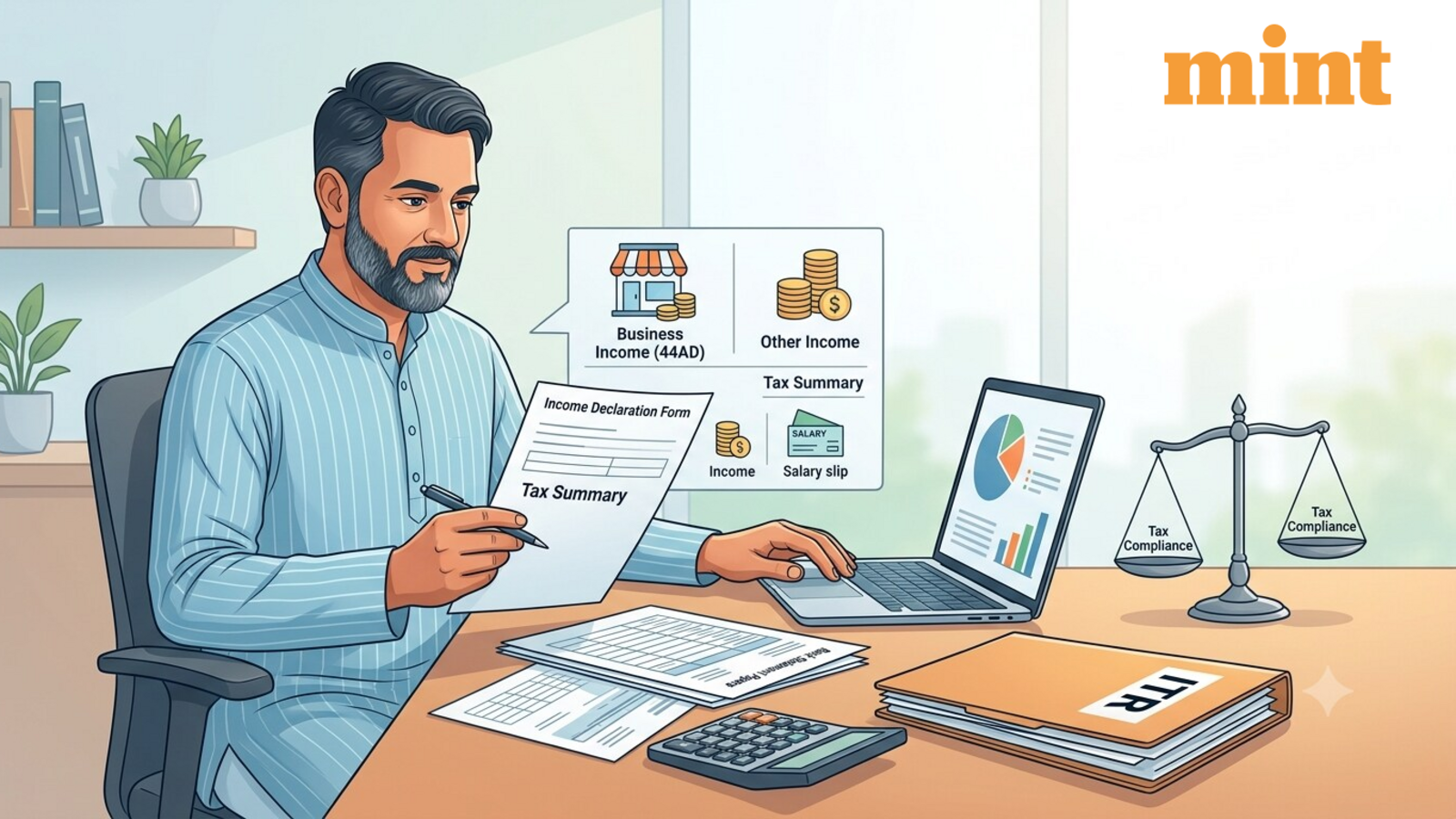
Section 44AD ITR filing: Which income you must disclose — and which need not be reported under the presumptive scheme
Section 44AD of the Income Tax Act allows small business owners to declare income on a presumptive basis without maintaining detailed books of accounts. However, opting for this scheme does not mean that taxpayers can ignore explanations for any specific income.
A ruling by the Income Tax Appellate Tribunal (ITAT), Surat, highlighted this issue. A taxpayer who declared ₹14.57 lakh income under Section 44AD faced an assessment of ₹5.09 crore after the tax officer treated bank deposits and other credits as unexplained income.
The case was highlighted by Sujit Bangar, Founder, TaxBuddy, in a post on X.
What was the case?
Zakir Patel, a fruit market trader from Surat, filed his ITR for FY 2016-17 under the presumptive taxation scheme of Section 44AD. He declared business income of ₹14.57 lakh and did not maintain regular books of accounts, as allowed under the scheme.
His return was selected for scrutiny due to cash deposits during the demonetisation period. During assessment, the tax officer examined his bank accounts and found cash deposits, credits and time deposits totalling ₹2.43 crore.
The officer treated the entire amount as unexplained income. Further additions were made for unsecured loans of ₹71.87 lakh and loans and advances of ₹1.79 crore, taking the assessed income to ₹5.09 crore.
However, during the appeal proceedings, it was pointed out that the actual cash deposits were ₹89.16 lakh and not ₹2.43 crore. It was also argued that some loans related to earlier years and were not part of the relevant assessment year.
The ITAT Surat observed that when a taxpayer declares income under Section 44AD, the entire bank deposits cannot automatically be considered taxable income. The tribunal set aside the matter and allowed the taxpayer another opportunity to explain the transactions.
What does Section 44AD allow?
Siddharth Maurya, Managing Director, Vibhavangal Anukulkara Pvt Ltd, explained that Section 44AD is meant to simplify tax compliance for small business owners.
“Instead of calculating actual profits after maintaining detailed accounts, eligible taxpayers can declare income at a fixed percentage of their turnover,” he said.
Under Section 44AD, eligible business owners can declare 8% of turnover as taxable income. For receipts received through prescribed digital modes, the presumptive tax rate is 6%.
The scheme is available to eligible resident individuals, Hindu Undivided Families (HUFs), and partnership firms (excluding LLPs) business owners. It is not available to businesses engaged in plying, hiring or leasing goods carriages, or agency and commission activities.
Does no books of accounts mean no records are needed?
Maurya said taxpayers opting for Section 44AD do not need to maintain detailed books such as cash books, ledgers, purchase registers or sales registers.
As the income is computed based on the presumptive tax system, the need for detailed profit calculations is also exempted.
“However, this does not mean they should have no supporting records. Taxpayers should retain basic documents such as invoices, bills and receipts to support their turnover and transactions,” he mentioned.
Which incomes should be disclosed while filing ITR?
Under Section 44AD, taxpayers need to report their business turnover and presumptive income. Other sources of taxable income, such as salary, rental income, interest, dividends, capital gains and income from other sources, must also be disclosed separately, Maurya explained.
Business expenses do not need separate reporting because they are already considered while calculating presumptive income.
According to Maurya, business-related cash collections or deposits that form part of declared turnover do not require separate disclosure. However, any receipts which do not relate to business, such as gifts, loans, sale of personal assets or other capital receipts must be reported appropriately.
What should 44AD taxpayers keep in mind?
The ITAT ruling does not mean that all bank deposits are protected under Section 44AD. If deposits relate to unexplained investments, loans, gifts or non-business receipts, taxpayers may still need to explain their source.
Maurya advised taxpayers to keep business and personal transactions separate and ensure that reported turnover matches information available through GST returns, bank statements and other records.
Section 44AD reduces compliance requirements, but accurate reporting and basic documentation remain important to avoid disputes during scrutiny.
Disclaimer: This is only for informational and educational purposes. Please consult a qualified tax expert for the latest laws and regulations.