Can new technology break Mastercard and Visa’s duopoly?
Mastercard and Visa are the dominant global payment networks. Their systems allow you to tap your card to buy a coffee virtually anywhere in the world, and two seconds later you are walking away. It feels effortless, but behind that two-second transaction lies a complex global relay. Your bank confirms funds, the merchant’s bank requests authorisation and fraud systems assess the risk.
To most people, Mastercard (NYSE: MA) and Visa (NYSE: V) are little more than logos on cards. In reality, they represent a global system that allows a payment in Birmingham to work just as easily as one in Bangkok. The infrastructure is so seamless that we never need to think about it, yet it is why these two companies have proved so difficult to disrupt.
The question now is whether this lucrative duopoly, which has fended off challengers for decades, is finally facing a genuine threat. For years, critics have seen rival technologies emerge, only to watch Mastercard and Visa absorb the innovation and become stronger. Yet as we look towards a future of sovereign payment systems, digital currencies and autonomous machine commerce, investors need to consider whether today’s threats are fundamentally different from those of the past. Will new technologies merely change how we pay, or will they replace the invisible pipes through which every transaction flows?
Sign up to Money Morning
Don’t miss the latest investment and personal finances news, market analysis, plus money-saving tips with our free twice-daily newsletter
Don’t miss the latest investment and personal finances news, market analysis, plus money-saving tips with our free twice-daily newsletter
Why Mastercard and Visa’s duopoly is so durable
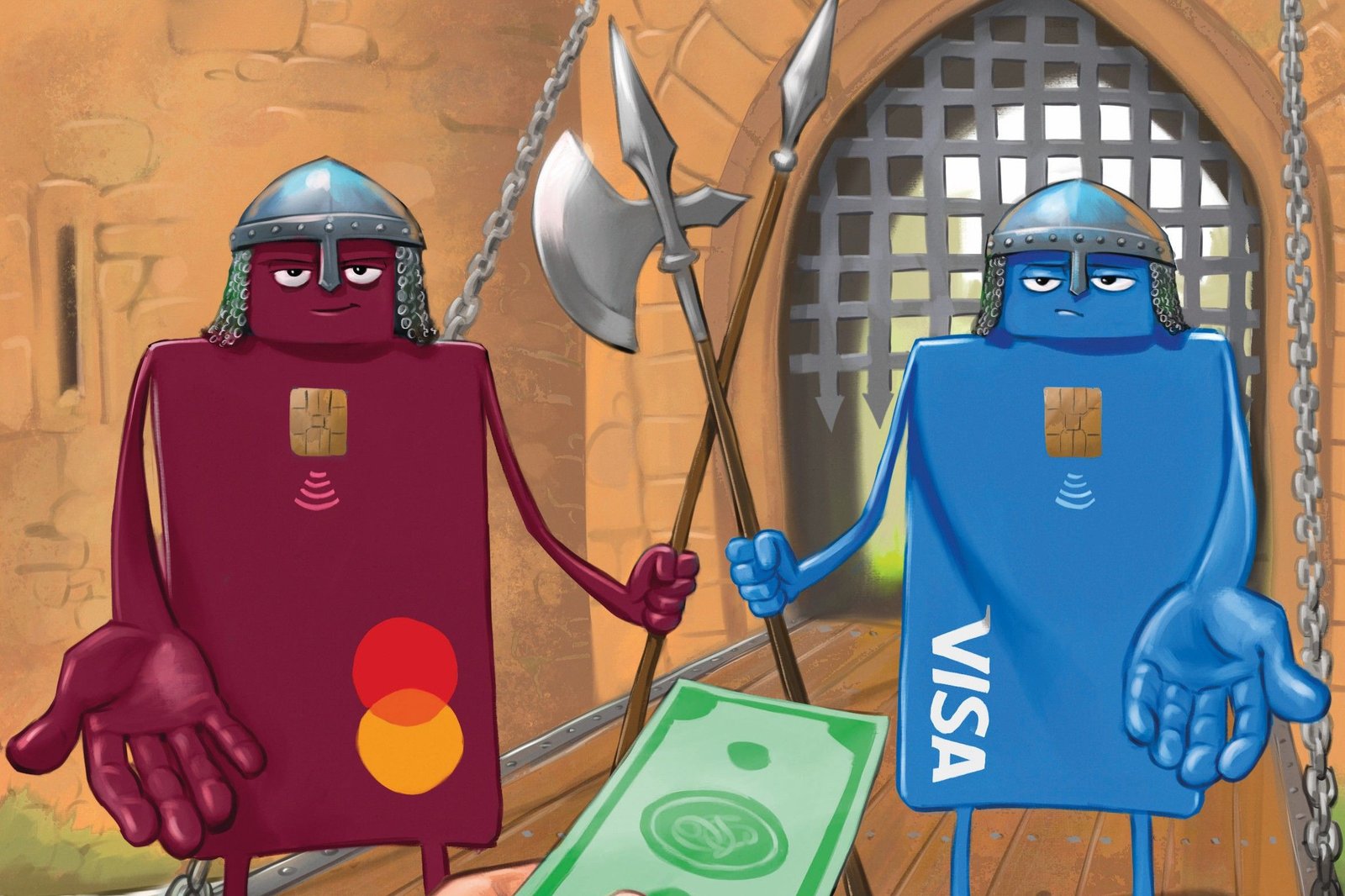
Understanding why this duopoly has proved so durable starts with one misconception. Mastercard and Visa do not lend money, issue most cards, or sign up merchants. They simply provide the trusted communications network linking cardholders, merchants and their banks.
When a payment is made, the merchant’s bank sends an authorisation request through Mastercard or Visa. The network identifies the correct issuing bank and securely routes the request. That bank checks whether the card is valid, confirms that funds or credit are available and carries out fraud checks before approving or declining the transaction.

(Image credit: Matteo Della Torre/NurPhoto via Getty Images)
The decision then travels back through the network to the merchant. Later, Mastercard and Visa coordinate settlement, ensuring that money moves correctly between the financial institutions involved.
The networks do not lend money, take deposits or bear the risk if a customer fails to repay a credit-card balance. Those responsibilities sit with the issuing banks. Mastercard and Visa simply provide the rules, technology and communications network that allow thousands of financial institutions to work together.
This is very different from the model used by firms such as American Express. Amex combines the roles of card issuer, payments network and merchant acquirer within a single business. This gives it greater control over the relationship with the customer, but also means taking on more risk and investing more capital. That integrated model also helps explain why some smaller businesses still refuse American Express. Historically, its merchant fees have often been higher than those charged on Mastercard and Visa transactions.
Mastercard and Visa took the opposite approach. By leaving lending, underwriting and merchant relationships to partner banks, they created an asset-light model that could expand globally without requiring the same balance sheet.
The result is a network that becomes more valuable as more participants join. Any bank can connect its customers to the system. Any merchant can accept payments through it. That structure has allowed Mastercard and Visa to expand into more than 200 countries and territories while avoiding many of the risks carried by traditional financial institutions.
Alternatives exist. American Express has built a successful premium franchise. UnionPay dominates China. JCB is strong in Japan. Discover is well-established in North America. Yet none has matched Mastercard and Visa’s mix of global acceptance, bank partnerships and asset-light economics.

UnionPay dominates in China
(Image credit: Liu Huaiyu/ Costfoto/Future Publishing via Getty Images)
Uniform standards for Mastercard and Visa
This position has made Mastercard and Visa into two of the world’s most valuable technology companies: both are worth over half a trillion dollars. Yet their origins were far more modest.
In the 1950s and 1960s, consumer payments were fragmented. Shoppers often carried multiple store cards, while banks struggled to process payments between different institutions. Master Charge and Bank Americard, the predecessors of Mastercard and Visa respectively, were established to create a common standard that allowed different banks and merchants to participate in the same payment system.
For decades, the networks operated as cooperatives owned by the banks that used them. This worked while electronic payments were still developing, but it became difficult as the industry matured. The member banks were also competitors, fighting for market share in card issuance and lending. Disputes over fees, governance and access became increasingly common. The solution was to separate the infrastructure from the banks. Between 2006 and 2008, Mastercard and Visa demutualised and listed in New York. Freed from competing shareholder interests, they could focus on expanding the network itself. They stopped operating primarily as industry utilities and became technology companies, investing heavily in fraud detection, cybersecurity, data analytics and international expansion.
Although Mastercard and Visa are often discussed together, they are not identical businesses. Visa has historically maintained the larger share of global payments volume, particularly in the US, while Mastercard has often positioned itself as the more international challenger. However, their investment cases are remarkably similar. Both benefit from the same long-term trend: the shift from cash towards digital payments. Neither needs to eliminate the other to succeed. The global payments market has been large enough for both companies to compound alongside one another for decades.
Their role today is often misunderstood. Mastercard and Visa do not need to replace every domestic payment system. Instead, they increasingly act as the common language that allows different systems to work together.
France provides a useful illustration. Many French payment cards carry both the logo of the domestic Cartes Bancaires (CB) network and either Mastercard or Visa. When that card is used in France, the transaction may be processed through the local CB network. Use the same card abroad and the payment is likely to travel across the Mastercard or Visa network instead. The customer rarely notices the difference because the systems work together seamlessly.
This helps explain why local payment networks are not necessarily threats. Countries can build efficient domestic payment systems, but international commerce is a much harder problem. Cross-border payments require common technical standards, fraud protection, dispute-resolution rules and the trust of thousands of banks and millions of merchants. Mastercard and Visa have spent more than half a century building those connections.

India’s UPI payment system lacks global infrastructure
(Image credit: Debarchan Chatterjee/NurPhoto via Getty Images)
That does not mean they are invulnerable. Domestic schemes such as India’s Unified Payments Interface (UPI), Brazil’s Pix and China’s UnionPay have demonstrated that governments and local providers can build highly successful alternatives for domestic payments. But they also highlight where Mastercard and Visa’s greatest strength lies. Their advantage is not that they process every payment. It is that they remain the network connecting different payment systems across borders.
That distinction will become crucial as new payment technologies emerge. The question is not whether other systems will exist alongside Mastercard and Visa. They already do. Rather, it’s whether anything can replace their global infrastructure.
Mastercard and Visa’s business model
Mastercard and Visa have one of the most attractive business models in the global economy. They do not need to earn pounds from every transaction. They only need to capture a fraction of the value flowing through their networks.
The economics of a payment are split between several participants. When a merchant accepts a card payment, it pays a fee known as the merchant service charge. A portion compensates the issuing bank for providing the card and taking on lending or fraud risk. And Mastercard and Visa receive fees for operating the network, processing transactions and providing the rules and technology that let the system function.
Think of it like a toll road. While a transaction may involve hundreds or thousands of pounds changing hands, Mastercard and Visa earn only a minuscule fee for letting the payment through. Yet multiplied across hundreds of billions of payments each year, the tolls create a vast and highly profitable revenue stream.
Note that once the network is built, processing additional transactions costs very little and therefore carries exceptional incremental margins. As payment volumes grow, revenues can rise much faster than operating costs. This is why both companies consistently generate some of the highest operating margins in global equity markets.
Nobody wants to leave Mastercard and Visa’s payments network
Mastercard and Visa’s dominance rests on several reinforcing advantages: trusted brands, acceptance at millions of merchants, deep relationships with banks, vast amounts of transaction data, established operating rules and unrivalled global scale.
Together, these create a network effect that has taken decades to build, and explain why so few companies attempt to compete with them directly. Most new payment businesses choose to work with Mastercard and Visa rather than replace them.
A typical financial technology company can build a better app, offer lower fees, or create a more attractive customer experience. Yet when a customer taps their card or phone to pay using Apple Pay or Google Pay, the transaction will often still rely on Mastercard’s and Visa’s underlying infrastructure. In the payments industry, this is known as riding the rails.
Building a rival system would require far more than better technology. A competitor would need to persuade thousands of banks, millions of merchants and regulators around the world to adopt an entirely new standard. This is what makes Mastercard’s and Visa’s position so difficult to attack. Their advantage is not simply the technology itself, it is the system surrounding it: the banks, merchants, rules, data and trust that have accumulated over decades.
Every few years, a new technology arrives that promises to make Mastercard and Visa irrelevant. So far, none has succeeded. Digital wallets such as Apple Pay and PayPal improved the customers’ experience without replacing the underlying networks.
Account-to-account payment systems and QR-code payments can be cheaper for merchants because they bypass traditional card networks. However, they tend to work best within individual markets. They solve the problem of cost, but not the challenge of creating a trusted global network for international payments.
A longer-term uncertainty is whether AI-driven commerce creates an entirely new payments architecture. If machines begin executing transactions on behalf of consumers and businesses, the winners will need secure digital identities and trusted authorisation systems. Whether that creates an opportunity for Mastercard and Visa or opens the door to a new competitor remains uncertain.

Apple Pay or Google Pay transactions still rely on Mastercard or Visa
(Image credit: Elise Cabane / Hans Lucas / AFP via Getty Images)
The geopolitics of payments
Still, the nature of the competitive threat may be changing in other ways. For decades, global payments operated under the assumption that financial networks would remain politically neutral. That assumption has weakened. The increasing use of financial sanctions and restrictions on cross-border payments has reminded governments that whoever controls critical financial infrastructure also holds significant influence.
The response has been a push towards greater financial independence. More countries have already been building their own domestic payment networks, such as Brazil’s Pix and India’s UPI, which allow consumers to transfer money directly between bank accounts, often at little or no cost. If more governments come to view payments as a matter of national security as well as cost and efficiency, they will have the ability to build domestic alternatives.
Mastercard and Visa still have a major advantage in international commerce, where global acceptance matters far more than simply moving money from one account to another. However, even if the expansion of domestic networks is unlikely to displace them from this role, they can gradually reduce payment volumes – and hence revenues – from national markets that have historically been an important source of activity.
Mastercard and Visa are adapting rather than resisting. Instead of insisting that every payment runs through their networks, they increasingly provide the layer of technology that allows different systems to operate securely. More broadly, both companies have long been expanding beyond their traditional business of moving payments from one bank to another.
Regulation has constrained traditional payment fees – particularly interchange fees earned by banks, which are capped in many countries. Meanwhile, competition has encouraged financial institutions and merchants to demand more sophisticated services.
So Mastercard and Visa have focused on value-added services. They now provide technology that helps banks and businesses prevent fraud, verify identities, secure digital payments and analyse transactions. Just recently, Visa announced a new deal to buy BioCatch, a fraud intelligence firm, for $2.4 billion.

Visa is to buy BioCatch, a fraud intelligence firm, for $2.4 billion
(Image credit: VCG/VCG via Getty Images)
This shift has strengthened an already attractive business model. In effect, the duopoly are moving from simply operating payment networks to providing the software that helps many different payment networks function, and keeping payments safe and reliable.
Mastercard and Visa’s trust layer
Whether this strategy is enough to offset future threats remains one of the biggest questions facing the industry. Mastercard and Visa have survived previous attempts to bypass them because most innovations have changed how we pay, not how payments are trusted and settled.
Sovereign payment systems, account-to-account transfers and blockchain-based settlement all represent more meaningful challenges. Yet history suggests that the duopoly are highly effective at adapting to new payment rails rather than being displaced by them.
Tomorrow morning, millions of people will buy a coffee with a tap of a card, phone or smartwatch without giving the process a second thought. Behind that simple action, a global network will verify their identity, assess fraud risk and connect two financial institutions in a fraction of a second.
That reliability has helped make Mastercard and Visa two of the world’s most valuable companies. They are an essential part of the global economy. The technology that wins is often the technology people stop thinking about because it simply works, and that may be their greatest competitive advantage.
Their asset-light models, powerful network effects and trusted brands have produced two decades of exceptional returns for investors. There are still clear opportunities for growth as cash continues to decline, cross-border commerce expands and value-added services become a larger part of the business.
Still, none of that guarantees attractive investment returns from this level. The market already recognises their quality and values both companies accordingly (both are on a trailing price/earnings ratio of around 31 at time of writing). The real question is not whether these remain exceptional businesses, but whether future growth will be sufficient to justify the premium investors already pay for them. Disruption need not destroy the networks to disappoint shareholders. It only needs to erode the ambitious expectations embedded in today’s valuations.
This article was first published in MoneyWeek’s magazine. Enjoy exclusive early access to news, opinion and analysis from our team of financial experts with a MoneyWeek subscription.