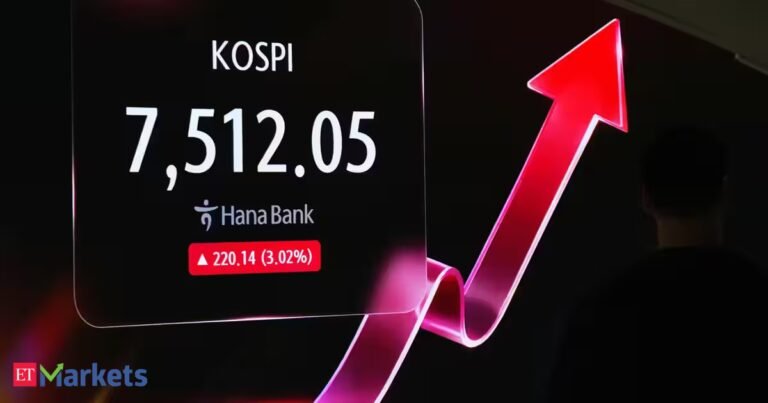
Indian equities lag South Korea, Japan and US markets: New study reveals why long-term investors should not worry
Indian equities have underperformed several global markets over the past year, but according to Abakkus Investment Managers, the weakness is largely driven by sentiment and valuation rather than the country’s economic fundamentals.
The Abakkus study says India’s long-term investment story continues to be supported by robust economic growth, healthy foreign exchange reserves, improving domestic demand and policy continuity.
Why have Indian equities lagged global peers?
One of the biggest reasons has been the global shift in investor money toward artificial intelligence (AI)-linked markets such as the US, Taiwan and South Korea.
As of 30 June, the Nifty 50 TRI delivered a negative 0.4% one-year return, compared with:
- South Korea’s Kospi: 103.2%
- Taiwan’s TAIEX: 83.2%
- Japan’s Nikkei: 56.7%
- US Nasdaq: 20.1%
However, the trend looked different over the past month. The Nifty 50 TRI gained 2.4%, while South Korea’s Kospi declined 22.2%.
What has kept Indian markets under pressure?
According to Abakkus Investment Managers, the key factors include:
- Global investors shifted capital towards AI, semiconductor and data centre-linked opportunities in the US, Taiwan and South Korea.
- India has limited exposure to semiconductor manufacturing and AI hardware.
- Concerns over AI-led disruption weighed on large Indian IT services companies.
- Foreign institutional investors (FIIs) reduced exposure due to global capital reallocation, geopolitical uncertainty, tariff concerns and rupee depreciation.
- Large-cap stocks witnessed valuation compression despite healthy underlying businesses.
- Geopolitical uncertainty, including US tariff policies, Middle East tensions and India-China relations, continued to shape global capital flows and investor sentiment.
Why is India’s market structure still positive?
India’s sector composition is more evenly distributed, reducing dependence on any single sector and supporting diversified market exposure.
In contrast, the MSCI Emerging Markets Index remains heavily tilted towards Information Technology.
Why does India’s long-term outlook remain strong?
Abakkus believes India’s structural growth drivers remain intact and could support markets over the medium to long term.
- India continues to benefit from strong domestic demand, favourable demographics, infrastructure creation and the formalisation of the economy.
- While AI-linked semiconductor and storage companies have driven exceptional business growth and stock market gains globally, India remains outside the core AI manufacturing ecosystem, leaving room to benefit as global capital rotates beyond these markets.
- FIIs that have recently booked profits in markets such as South Korea could consider India for fresh allocations over the next 6-12 months.
- Strong domestic inflows through mutual funds and SIPs have continued to support the mid-cap and small-cap segments, which have significantly outperformed despite weakness in large-cap stocks.
- Dollar outflows are moderating as dependence on imported energy is gradually reducing. Lower precious metal imports are easing a key source of dollar demand.
- RBI initiatives (FCNR) are supporting stronger foreign currency inflows and improving external liquidity.
- A stable or strengthening rupee could improve dollar-denominated returns for foreign investors and support renewed global interest in Indian markets.
Aman Chowhan, Head of Equities – Alternates, Abakkus Investment Managers Private Limited, said,
“The country’s underlying growth drivers, including demographics, consumption, formalisation and infrastructure creation, continue to strengthen. Periods of market underperformance often create the foundation for future opportunities.”