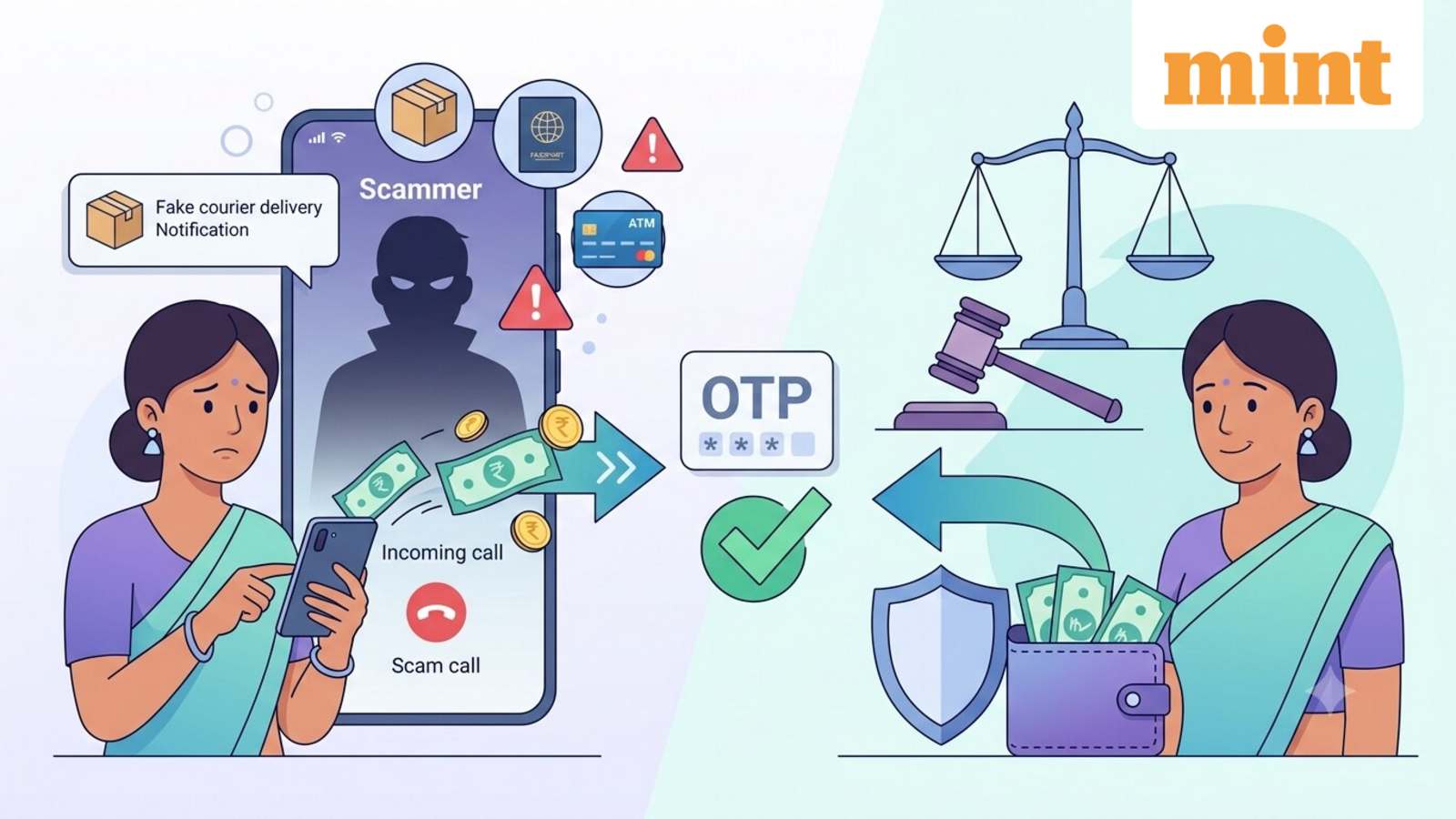
Can a bank be held liable if you voluntarily transfer money to a scammer? Here’s what Consumer Commission says
Most online scam victims believe that once they have voluntarily transferred money or completed an OTP authentication, they cannot get that money refunded by their bank.
However, a recent ruling by the Nagpur District Consumer Disputes Redressal Commission shows that banks may still be held accountable if they fail to detect or act on suspicious transactions.
In a case reported by The Economic Times, the commission directed ICICI Bank to refund over ₹5.18 lakh, along with interest and compensation, to a woman who lost nearly ₹6.93 lakh in a FedEx parcel scam.
Here’s what happened and why the bank was held liable despite the transfers being authorised by the customer.
What happened in the FedEx parcel scam?
According to The Economic Times, the incident took place on 8 January 2023, when the woman (currently living in Gurugram) received a call from someone claiming to be from FedEx customer service.
The caller alleged that an international parcel booked in her name contained two passports, five ATM cards, 300 grams of weed, and a laptop. When she denied sending any parcel, she was told that her identity had been misused and was threatened with police action.
Fearing legal consequences, she transferred around ₹95,000, ₹3.08 lakh, ₹1.9 lakh and ₹1 lakh in four transactions, amounting to nearly ₹6.93 lakh, to a scammer’s ICICI Bank account.
What did the woman do after realising the fraud?
After discovering she had been cheated, the woman immediately contacted ICICI Bank’s customer care and was advised to report the incident on the National Cyber Crime Portal. She also filed a police complaint in Gurugram.
Initially, the bank provided a temporary “shadow credit” on 9 January 2023. However, around two months later, it reversed the credit, stating that the transactions had been authorised through OTP authentication using her registered mobile number.
Then the woman approached the Banking Ombudsman, which directed ICICI Bank to credit about ₹1.75 lakh, roughly 25% of the disputed amount. Unsatisfied, she moved the consumer commission, arguing that the bank had failed to take preventive steps despite the RBI‘s customer protection framework.
What was ICICI Bank’s defence?
As reported by The Economic Times, ICICI Bank argued that the transfers were carried out strictly on the woman’s instructions and after OTP verification. It maintained that she voluntarily transferred the money to a stranger and that no negligence could be attributed to the bank.
The lender also said the woman misinterpreted the RBI Zero Liability Circular and is wrongly claiming compensation for a loss arising out of her own negligence.
Why did the consumer commission rule against the bank?
The commission examined findings recorded by the Banking Ombudsman and noted unusual activity in the beneficiary (scammer) account, which was also with ICICI Bank.
According to the order, the account belonged to a plastic products manufacturer with an annual income of ₹1 lakh to ₹5 lakh and a turnover of up to ₹40 lakh. Despite having virtually no transactions in December 2022, February 2023 and until 14 March 2023, the account saw credit and debit transactions worth about ₹2.84 crore during January 2023.
The commission observed that such inconsistent and unusually high-value transactions should have triggered closer monitoring by the bank.
It further noted that because both the victim’s account and the beneficiary account were with ICICI Bank, the transfers could reasonably have appeared genuine to the customer. The responsibility to monitor the beneficiary account, it said, rested squarely with the bank.
The commission held that the bank had committed “deficiency in service, negligence, and unfair trade practices” under the Consumer Protection Act, 2019.
What compensation did the woman receive?
The Banking Ombudsman had earlier directed ICICI Bank to credit ₹1.75 lakh to the woman’s account.
The Nagpur consumer commission has ordered the bank to refund the remaining ₹5,18,437 with 9% annual interest. It has also directed ICICI Bank to pay ₹25,000 as compensation for the physical and mental agony suffered by the woman and ₹10,000 towards litigation costs.
Mint has not been able to independently verify the authenticity of the report.
Disclaimer: This is only for informational and educational purposes. Please consult a qualified expert for the latest laws and regulations.