Austin sets revenue bond sale for convention center

City of Austin
Austin launches long-term financing for a convention center this week with a $663 million revenue bond sale as it joins other big Texas cities in the pursuit of bigger and better venues.
Processing Content
The deal, scheduled to price Tuesday, consists of $540.55 million of senior lien and $122.45 million of junior lien special tax revenue bonds backed with revenue from certain hotel occupancy taxes and incremental state tax revenue generated within a project finance zone the city established in 2024 around the convention center.
The city expects to issue an additional approximately $600 million of senior and junior lien bonds by June 2027 to complete financing for the $1.66 billion project, which will also relies on cash funding of about $410 million, according to the deal’s investor presentation.
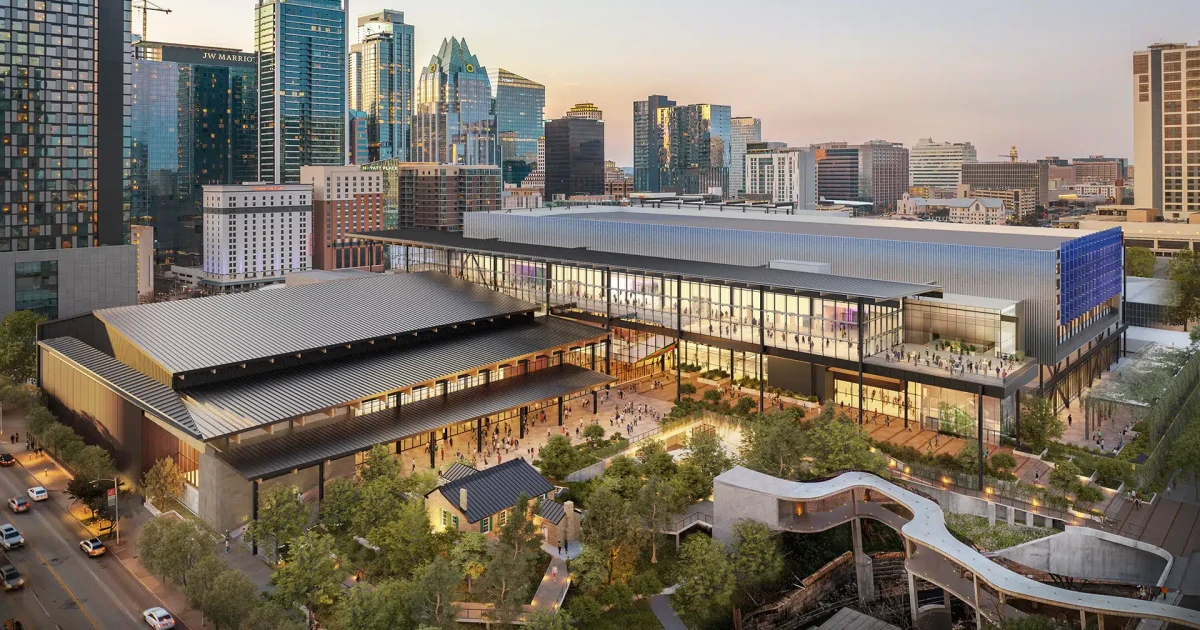
Bond proceeds will finance the replacement of Austin’s now-demolished convention center with a Net Zero Carbon certified facility expected to open in early 2029 that will have 70% more rentable space at about 620,000 square feet.
“The redevelopment and expansion of the Austin Convention Center will elevate the facility from the 61st largest to the 35th largest in the country,” a city spokesperson said in an emailed response to questions. “Austin will bring to market a state-of-the-art facility in a top 10 destination city for events. The new, expanded center will enable us to host larger events, accommodate multiple events simultaneously, and welcome groups that previously outgrew our space.”
Ahead of the deal, Austin issued $20.75 million of hotel occupancy tax revenue bonds to refund all outstanding subordinate lien bonds issued in 2012 and 2008 for the previous convention center.
The refunding allows the city “to better delineate” the pledge of HOT revenues to secure and repay the expansion bonds being issued, as well as to accelerate the payoff of prior venue bonds, “generating cashflow savings,” according to an October
The combined 6.5% pledged hotel tax revenue for the new bonds, which totaled $50.2 million in 2020, is projected to reach $101 million this year, according to the preliminary official statement. The compound annual growth rate for the pledged HOT revenue is 7.65% since 2015, the investor presentation said.
Revenue from state sales and hotel taxes, as well as from state sales and gross receipts taxes on mixed beverages, defined as alcohol and non-alcoholic drinks and ice sold to mix with alcohol, generated within a project financing zone above base year 2024’s collection of nearly $89.7 million are also pledged to pay off the bonds.
The senior bonds earned ratings of AA-minus from S&P Global Ratings and KBRA and Aa2 from Moody’s Ratings.
The junior lien bonds were rated Aa3 by Moody’s, A-plus by KBRA, and BBB-plus by S&P, which said the rating “is capped in the ‘BBB’ category due to our expectation of thin debt service coverage reflecting both the 1.05x (additional bonds test) and projected maximum annual debt service coverage of under 1.25x when considering total projected debt service for planned senior and junior lien bonds issued in 2026 and 2027.”
The investor presentation indicated the junior lien bonds could be insured.
Austin is in discussions with bond insurance companies, and continues to evaluate whether the use of bond insurance makes sense for this transaction, according to the city spokesperson.
KBRA said its senior and junior lien ratings “reflect the established collection history and growing trend of pledged hotel occupancy tax receipts as well as the exceptionally strong socioeconomic characteristics of the underlying Austin area economy.
“These strengths are balanced by the sensitivity of pledged receipts to the economic cycle and events that disrupt travel,” it added.
The ratings from all three agencies carry stable outlooks.
The project faced a potential delay last year from a petition drive by Austin United PAC that sought a ballot measure to stop the demolition and reconstruction of the convention center for seven years — or until the project was approved by voters — and prioritize city funding for local live music, arts, cultural, and outdoor tourism.
Petition backers turned to Texas courts after Austin City Clerk Erika Brady determined in November the drive fell 494 signatures short of a requirement for 20,000 valid signatures of registered voters.

Rich Saskal
An appeal of a district court’s refusal to compel Brady to reverse her decision has been filed in state appellate court after the Texas Supreme Court dismissed the backer’s
The organization and its attorney did not immediately respond to requests for comment.
The underlying Austin United PAC case and appeal does not call into question the city’s ability to issue the bonds and pledge revenue to secure the debt, according to the POS.
Meanwhile, Austin
BofA Securities leads the bond underwriting team consisting of co-managers Mesirow Financial, Hilltop Securities, and Loop Capital Markets. PFM Financial Advisors is the municipal advisor and Norton Rose Fulbright is bond counsel.
Austin’s deal comes as other big Texas cities are
Fort Worth completed the first expansion phase for its facility in December and plans to issue bonds for Phase 2. An expanded Henry B. Gonzalez Convention Center is part of