In 12 Words, JPMorgan CEO Jamie Dimon Just Issued a Stark Warning to Investors
It’s been a rocky few weeks for the stock market, as concerns surrounding AI spending have shaken investor confidence. The S&P 500 (^GSPC -1.52%) has dipped by 0.87% over the last month, as of this writing, while the tech-focused Nasdaq Composite (^IXIC -1.74%) is down by 1.43%.
In a recent interview on The Master Investor Podcast, JPMorgan Chase CEO Jamie Dimon discussed his take on everything from AI spending to geopolitical turmoil to interest rates. He also issued a warning for investors, and history has good and bad news about what may be coming next.

JPMorgan CEO Jamie Dimon. Image source: JPMorgan Chase & Co.
Investors may be underestimating risk
When discussing economic and geopolitical risks, Dimon noted that there are multiple threats facing the market — including wars in Ukraine and Iran, tensions between the U.S. and China, and mounting government deficits.
“I do think those risks are probably bigger than other people think,” he explained, adding that while he hopes these risks resolve, they “could cause a problem.”
For much of the last few years, markets have seemingly been forgiving of various risks and tensions throughout the world. The S&P 500 has climbed by more than 8% since the war in Iran began in late February, for example, and the index is up by 25% since early 2025, when President Donald Trump began announcing sweeping new tariffs.
But these gains may not last forever, and with renewed fears around AI beginning to spread, the market could have yet another hurdle to overcome.
Is it still safe to invest right now?
Despite some concerns, Dimon noted that he is optimistic about the future of AI technology. He emphasized, however, the importance of staying flexible.
The amount of money being spent [on AI] is huge. Will it, in total, pay off? Probably, just like the internet did. Will it pay off the way you expect on the timetable you expect? Definitely not.
He went on to remind investors that during the dot-com meltdown, some major companies went bankrupt while others went on to transform the tech landscape forever. In other words, investing during periods of volatility is not the real risk. The real risk is investing in the wrong companies.
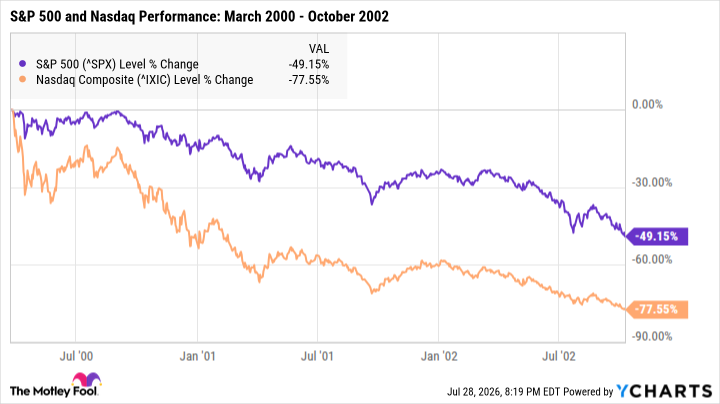
History backs this up, too. During the bear market following the dot-com bubble, for instance, Apple sank by nearly 80%, while Amazon lost nearly 95% of its value. Yet since January 2000, those stocks have earned staggering returns. While the dot-com bubble was brutal, that downturn ended up being a blip on the radar for many of the world’s most successful companies.
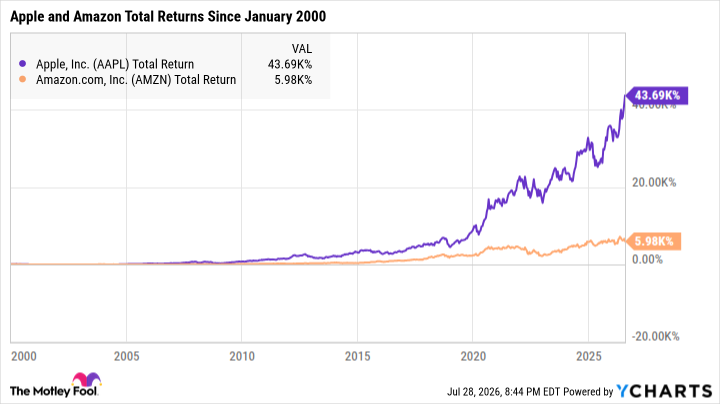
AAPL Total Return Level data by YCharts
If we are in an AI bubble that’s on the verge of popping, a similar scenario may play out. Some companies will likely crash and burn, and others will go on to experience extraordinary gains.
The difference between them will come down largely to fundamentals. Companies with solid foundations — like a sustainable business model and a healthy balance sheet — may tumble in the short term, but they’ll likely bounce back stronger than ever. Those fueled by hype, however, may struggle to recover at all.
The stocks you choose, then, will determine how your portfolio fares over the long haul.